The Craft of Reading
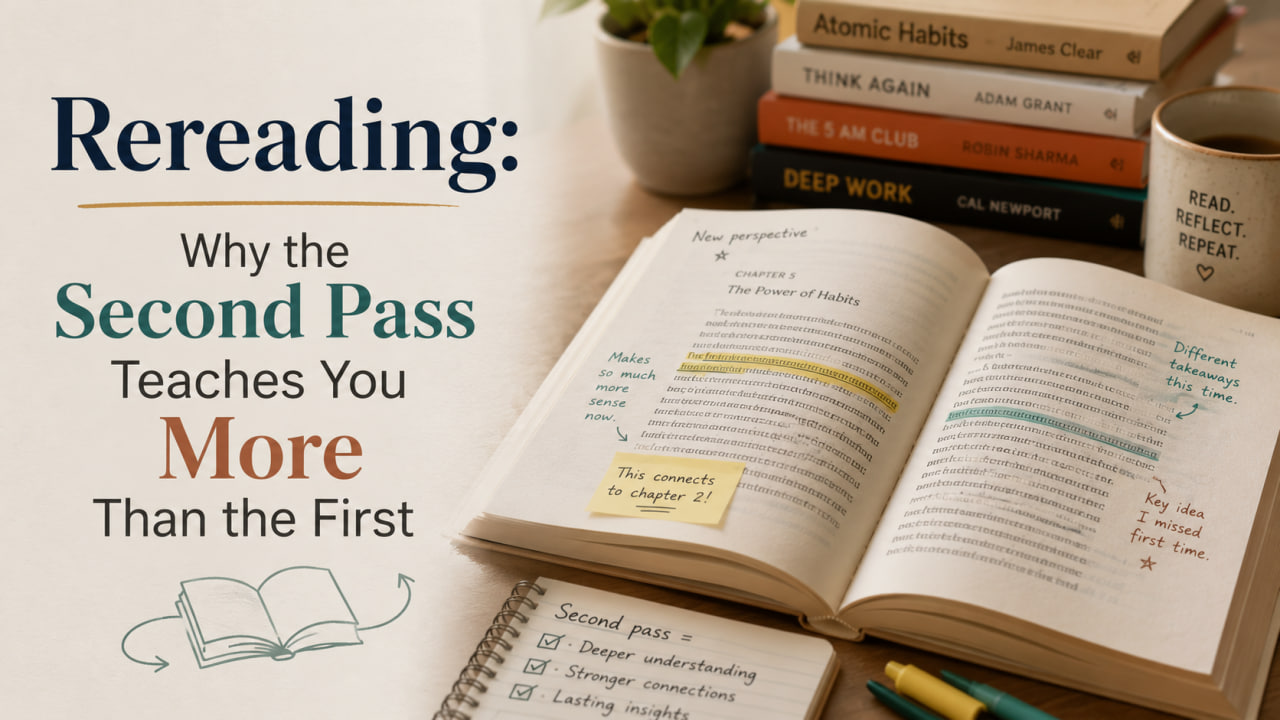
Why the Second Pass Teaches You More Than the First
There’s a quiet prejudice against rereading. With so many books in the world and so little time, returning to one you’ve already finished can feel like a waste — a failure of ambition, even, when the unread shelf stretches on forever. Why revisit a known quantity when the new and undiscovered beckons? It’s a reasonable-sounding objection, and it’s mostly wrong. The truth, which experienced readers tend to learn slowly and then never forget, is that you often understand a book only on the second reading, and sometimes only on the third. The first pass is frequently just preparation for the real one.
This isn’t sentimental nostalgia for old favorites, though that’s a real pleasure too. It’s a claim about how comprehension actually works. A complex book contains far more than any reader can absorb in a single pass, and the very act of finishing it changes the reader who would return to it. The second reading is a different event, performed by a different person on a now-familiar text. That combination is what makes it so unexpectedly rich.
The first reading is mostly about what happens
When you read something for the first time, an enormous amount of your attention is consumed by the simplest questions. What is going on? Who is this person? Where are we? What happens next? You’re assembling the basic architecture of the book in real time — tracking the plot, learning the characters, orienting yourself in the argument. This is necessary work, but it’s also expensive. The mental effort spent on figuring out the surface leaves little left over for everything beneath it.
In a novel, the pull of suspense compounds this. On a first read you’re often racing toward the resolution, hungry to know how it ends, and that hunger, while delightful, makes you a hurried reader. You skim the description to get to the dialogue, rush the quiet passages to reach the dramatic ones. You’re reading for the ending, and so you miss much of what the book is doing along the way. The same happens with a dense nonfiction argument: you’re working so hard to follow the thread that you can’t yet see the pattern of the whole.
The second reading is about how and why
Return to the same book knowing the story, and something remarkable happens: all the attention that was tied up in tracking the surface is suddenly freed. You already know what happens, so you stop racing toward it, and for the first time you can actually look at the book. You notice the craft — how a scene is built, how a sentence is shaped, how the author plants and pays off, how the structure holds together. The machinery that was invisible behind the suspense becomes visible, and often it’s more impressive than the story it was serving.
Knowing the ending also transforms the beginning. On a second reading of a good novel, early scenes that seemed innocent are now heavy with everything you know is coming. A casual line of dialogue turns out to have been a warning. A small detail you read past was quietly seeding the climax. The author was playing a long game you couldn’t see the first time because you didn’t yet know where it led. Foreshadowing only works as foreshadowing in retrospect; you have to know the future to recognize that the past was pointing at it. The second reading is when a well-made book reveals that almost nothing in it was accidental.
In nonfiction the gain is just as large. Freed from the labor of following the argument step by step, you can finally evaluate it — see where it’s strong and where it’s strained, how the pieces connect, what the author assumed without saying. You read the second time not as a student trying to keep up but as something closer to a peer, able to question and weigh rather than merely absorb. That shift, from following to judging, is most of what it means to truly understand a difficult book.
What the second reading reveals
◆ The craft — structure, pacing, and sentence-level work the suspense had hidden.
◆ The setup — early details that were quietly preparing the ending all along.
◆ The themes — the deeper concerns that only surface once the plot stops demanding your attention.
◆ The argument’s joints — where a nonfiction case is sound and where it merely sounds sound.
You are not the same reader twice
There’s a second, deeper reason rereading rewards you, and it has nothing to do with the book and everything to do with you. Between the first reading and the second, you change. You’ve lived more, learned more, suffered and enjoyed more, read other books that reshaped how you think. The book stayed the same on the page, but the mind meeting it is different — and a book is only ever half itself; the reader supplies the other half. Change the reader and you change the book.
This is why a novel read at twenty and reread at forty can seem like two entirely different books. At twenty you identified with the young protagonist and found the older characters tedious; at forty you find the protagonist callow and the older characters quietly heartbreaking. Nothing in the text moved. You did. A book about marriage, or grief, or ambition, or failure means something different once you’ve lived the thing it describes, and passages you skated over as a younger reader can stop you cold years later, because now you understand them from the inside. The book was waiting for you to catch up to it.
This is the real argument against the “too many books, no time to reread” objection. Rereading is not consuming the same content twice. It’s a genuinely new experience, because both the reading and the reader have changed. The great books are not exhausted by a single pass any more than a piece of music is exhausted by hearing it once. They’re designed, or have simply turned out, to reward return — to give you something different each time you come back, for as long as you keep changing.
What’s worth rereading — and what isn’t
Not every book rewards a second pass, and pretending otherwise would be dishonest. A great deal of reading is genuinely one-and-done: a thriller whose only engine is the question of what happens, a book of practical information you needed once, a piece of writing that gave you everything it had on the first read. There’s no shame in this and no need to reread it. The skill is in telling the difference — in recognizing which books have more to give.
The books most worth rereading tend to share a quality: there was more in them than you could take in at once. You finished with the nagging sense that you’d missed something, or that the book was larger than your grasp of it. You found yourself thinking about it afterward, turning it over. A passage struck you so hard you went back to it immediately. These are the signs of a book that has depth in reserve — one that was operating on more levels than your first reading could reach. Those are the ones to return to. The test is simple: if a book keeps living in your mind after you close it, it has more to say to you, and rereading is how you let it.
The childhood books we return to
There’s a special case of rereading that deserves its own mention: returning as an adult to a book you loved as a child. This is where the gap between the two readers is widest, and the rediscovery often most startling. A book that thrilled you at ten can reveal, at forty, a quiet sophistication you never suspected — jokes pitched over your young head, sorrow you couldn’t yet feel, a moral seriousness you mistook for mere adventure. The best children’s books were written by adults who understood both audiences at once, and the second audience is the one you’ve only now become.
Sometimes the rereading goes the other way, and that’s worth being honest about too. A book that enchanted you as a child can turn out, on adult return, to be thinner than you remembered — and the disappointment is real, though even it is instructive, because it measures how far you’ve travelled. But far more often the cherished book holds up and then some, opening a second door you couldn’t reach the first time. Either way, you learn something the first reading could never have told you: not just about the book, but about the distance between the reader you were and the one you’ve become. That measurement — taken against a fixed text — is one of the few honest ways we have of seeing how we’ve changed.
How to reread well
Rereading deliberately is different from rereading idly. If you’re returning to a book to understand it more deeply, slow down — you no longer need to rush toward the ending, so let yourself dwell. Read the passages you skimmed before. Pay attention to the craft now that the plot has released its grip. If you annotated the first time, your old marks become a fascinating record: you’ll often disagree with your younger self, or be moved by something you once ignored, and the contrast is its own kind of reading.
It also helps to leave time between readings. Reread a book the week after you finished it and you’ll mostly recall it; the surface is still too fresh to see past. Wait a year, or five, or twenty, and you return as a genuinely different reader to a book that has gone slightly strange and new in your memory. The gap is part of the method. The most rewarding rereadings are often of books you read long ago and half-forgot, met again across the distance of who you’ve since become.
There’s a practical objection worth answering here: how do you find time to reread when you barely keep up with new books? The honest answer is that you reread instead of reading something forgettable, not instead of reading something great. A great deal of what we read is mediocre and leaves nothing behind, and trading a few of those hours for a second pass through a book that genuinely shaped you is almost always the better deal. Rereading isn’t time taken away from your reading life; it’s time invested in the part of it that lasts.
A small, durable habit is to keep a short list of books worth returning to — the handful that felt larger than your grasp of them — and to actually circle back, rather than letting the endless pull of the new crowd them out forever. The unread shelf will always be infinite; you will never finish it, and chasing only novelty means you never go deep on anything. A reading life with some return built into it — some books you know intimately because you’ve met them more than once — is richer than one that only ever moves forward. Depth is a kind of reading that breadth alone can never provide.
Lingering questions
Isn’t rereading a waste when there’s so much I haven’t read?
Only if you think of reading as collecting titles. If the goal is understanding, a few books read deeply will teach you more than many read once and forgotten. Both breadth and depth have a place; a life with no rereading is missing one of them entirely.
How long should I wait before rereading something?
Long enough that you’ve changed and the book has faded a little in memory — often a year at minimum, and frequently far more rewarding after many years. The distance is what makes the return feel new.
How do I know a book is worth a second read?
If it kept living in your mind after you finished, if you sensed there was more in it than you caught, if a passage made you stop — those are the books with depth in reserve. Trust that lingering feeling; it’s usually right.
Many of the books most worth rereading are in the public domain and free to revisit through Project Gutenberg. For curated reading and reflection on literature, The Paris Review is a fine companion.