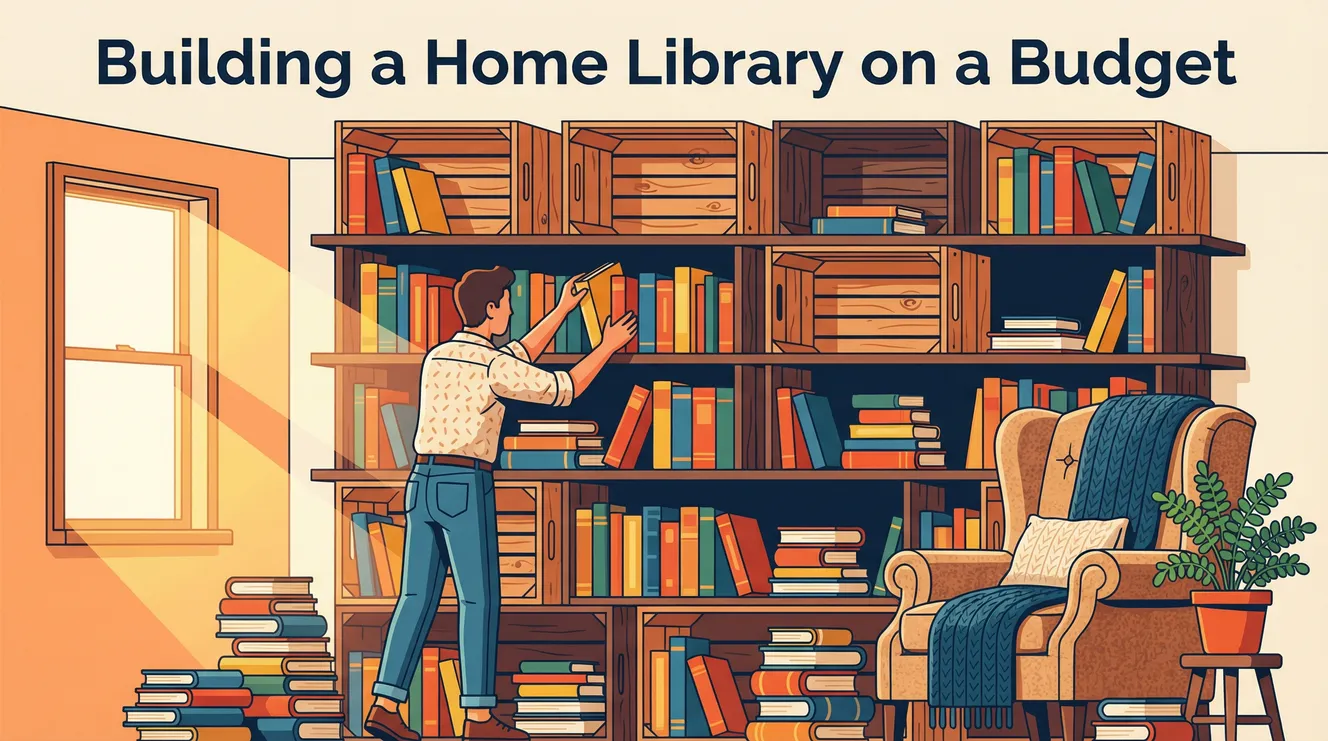
The average American household owns 114 books, yet only half of these are ever read. This statistic from a Pew Research study reveals a crucial truth: library value isn’t measured by volume but by intention. A curated collection of 30 books you actually read and love provides more intellectual nourishment than 300 pristine decorations. The secret to building a home library on a budget lies not in compromising quality, but in redefining how books enter your life.
Budget-conscious bibliophiles understand that books are one of the few consumer goods that depreciate rapidly but retain utility. A $30 hardcover becomes a $3 used book within two years, yet the words inside remain unchanged. This market inefficiency creates extraordinary opportunities for those willing to hunt. The $2,000 you might spend on a single shelving unit could instead acquire 600 carefully chosen volumes when redirected toward secondhand sources and DIY solutions.
◆
The Acquisition Arsenal: Seven Unconventional Book Sources
Traditional book-buying wisdom directs you to Barnes & Noble or Amazon, where new releases command premium prices. But the budget library builder operates in the shadows of the publishing economy, tapping into seven overlooked channels that turn one person’s clutter into your intellectual goldmine.
Library Discard Sales: The Professional’s Secret
Public libraries regularly cull their collections, removing 3-5% of inventory annually to make room for new titles. These “withdrawn” books aren’t damaged—they’re simply victims of limited shelf space. Most libraries host quarterly sales where hardcovers sell for $1-2 and paperbacks for $0.25-0.50. Arrive early on the first day for quality, but return on the last day for the true bargains: many libraries offer “fill a bag for $5” deals to clear remaining stock. The Friends of the Chelsea Library reports that dedicated shoppers acquire 40-60 books per sale using these strategies.
Buy Nothing Groups: The Gift Economy Advantage
Facebook’s Buy Nothing Project has created hyperlocal gift economies where members give away items they no longer need. Books flow freely in these groups, especially children’s books and popular fiction. Post a simple “ISO: books for my home library—any genre welcome” and watch your neighbors offer boxes of free reading material. Unlike thrift stores, there’s no cost, and the giver often delivers. This method also builds community: today’s book giver becomes tomorrow’s borrowing partner, creating an informal lending network that multiplies your collection’s effective size.
Estate Sales: The End-of-Life Liquidation Window
The final chapter of a book lover’s life often ends with their collection being sold for pennies on the dollar. Estate sales typically price books at $0.50-$2 each, with bulk discounts on the sale’s final day. The key is targeting sales in educated, affluent neighborhoods where collections include scholarly works and quality literature. Arrive mid-sale when prices drop but selection remains. Look for the “book room” first—many estate companies sequester collections in a single space. While others fight over furniture, you can acquire a lifetime’s curated library for less than the cost of a single new hardcover.
Little Free Libraries: The Hyper-Local Exchange
With over 150,000 registered boxes worldwide, Little Free Libraries operate on pure reciprocity. The strategy isn’t just taking—it’s strategic swapping. Deposit books you’ve finished (especially recent bestsellers) and withdraw classics or obscure finds. Rotate through multiple boxes in your area weekly; each neighborhood attracts different donors. The official map reveals clusters in high-literacy areas where turnover is rapid and quality is high. Some devotees report acquiring 15-20 quality books monthly through systematic Little Free Library circuits.
Online Used Marketplaces: The Algorithmic Hunt
ThriftBooks, Better World Books, and eBay’s “lot” listings (where sellers bundle 20-50 books as a single auction) offer bulk buying power. The real hack is setting up saved searches with email alerts: “philosophy lot,” “classic literature bundle,” “history books bulk.” When new listings appear, you can snag collections for $0.50-$1 per book. The key is patience—wait for auctions ending at odd hours when competition is low, and always sort by “ending soonest” to find underpriced listings that others haven’t discovered.
Academic Library Surplus: The Scholarly Liquidation
University libraries deaccession thousands of books annually, often selling them directly to the public through “Friends of the Library” sales. These events are goldmines for academic texts, literary criticism, and obscure scholarly works that cost $40-100 new but sell for $2-5 used. Contact your local university library to ask about sale schedules. Many institutions also list surplus books on specialized sites like Book Depository clearance sections or Ex Libris remainder sales.
The $500 Home Library Challenge
A Philadelphia teacher documented building a 200-book library for $487 using these strategies:
Library sales: 87 books at $1 each = $87
Buy Nothing Group: 45 books = $0
Estate sale (final day): 68 books at $0.50 each = $34
DIY shelving (poplar boards + brackets): = $366
Total: 200 books + custom shelving for under $500, assembled over 6 months.
◆
The Shelving Revolution: From $20 to $2,000
Commercial book shelving follows a predatory pricing model. A basic six-shelf unit from a furniture retailer costs $400-800, while custom built-ins can exceed $10,000. Yet the fundamental requirement is simple: horizontal surfaces that support weight. Everything else is aesthetic preference. Budget library builders exploit this simplicity through four escalating DIY approaches.
Cinder Block & Plank: The Basement Classic
Eight cinder blocks ($2 each) and four 10-foot 2×12 planks ($15 each) create a 12-foot wall of shelving for $76. Stack blocks at each end and at two intermediate points, lay planks across. Paint everything matte black for a unified look. This system supports hundreds of pounds and can be reconfigured endlessly. The raw industrial aesthetic works perfectly in modern lofts and can be softened with plants and art. One Reddit user documented building an entire wall of shelving for $23 using reclaimed lumber and scavenged blocks.
IKEA Hack: The Billy Bookcase Transformation
IKEA’s Billy bookcase ($50) is the Swiss Army knife of budget shelving. The hack is simple: buy multiple units, align them flush, and add crown molding ($30) across the top and baseboard ($20) along the bottom. Suddenly $300 worth of flat-pack furniture looks like built-ins costing $3,000. For added sophistication, remove the backing boards and paint the wall behind a contrasting color. Add decorative brackets ($5 each) between units to create the illusion of custom carpentry. This approach scales from a single unit to wall-spanning installations.
Pipe & Wood Industrial: The Maker’s Choice
Black iron plumbing pipe ($2-4 per foot) threaded into floor flanges creates vertical supports. Threaded pipe pieces act as shelf brackets. Stain 1×12 pine boards ($10 each) for shelves. A 6-foot wide, 7-foot tall unit costs $120-150 but looks like $800 industrial furniture. The system is modular—add shelves incrementally as your collection grows. The exposed hardware becomes a design feature, and the sturdy construction supports heavy academic texts without sagging.
The Floating Illusion: Minimalist Wall Mount
Heavy-duty floating shelf brackets ($15 per pair) support solid wood shelves without visible supports. This creates a clean, modern look perfect for small spaces. The trick is installing brackets directly into wall studs—they’re rated for 50+ pounds per bracket. Use reclaimed barn wood ($5-10 per board) for character, or sanded construction lumber stained dark for sophistication. Total cost for a 4-shelf installation: under $100.
◆
The Curation Strategy: Quality Over Quantity
A home library’s value isn’t measured by spine count but by how often you pull books from shelves. The budget builder’s secret is ruthless curation: every book must earn its space. This philosophy prevents the collection from becoming a book cemetery—titles you feel guilty about not reading but can’t bring yourself to discard.
Implement the “three-month rule”: if a book sits unread for 90 days, it leaves your library. Donate it back to the sources you use. This creates a dynamic collection that evolves with your interests rather than accumulating as a static monument to aspiration. The average American reads 12 books per year; at that rate, a 100-book library contains more than an 8-year supply. Curate accordingly.
The Reference Core: Books Worth Buying
Even the most frugal builder should purchase certain books new: frequently referenced dictionaries, style guides, and specialized reference works in your profession. These are tools, not entertainment, and their cost-per-use justifies investment. For everything else, used copies suffice. A 30-year-old edition of “Moby Dick” contains the same text as a 2024 printing.
The Display-Read Distinction
Separate books into two categories: display (beautiful but unread) and active (current reading, frequent reference). Display books can be decorative objects—leather-bound classics that elevate a room’s aesthetic while you read their paperback versions. Active books should be accessible, organized by category or current interest. This division prevents the anxiety of “unread library syndrome” while allowing you to appreciate books as objects.
The $100 Annual Book Budget Allocation
Library sales: $30 (target seasonal sales, prioritize bulk deals)
Thrift stores: $20 (monthly visits, focus on half-price days)
Online lots: $25 (eBay/ThriftBooks bulk purchases, 1-2x annually)
Estate sales: $15 (final day fill-a-bag deals)
Little Free Libraries: $10 (gas money for weekly circuits, occasional donations)
◆
The Reading Nook: Creating Space Without Square Footage
A home library doesn’t require a dedicated room. The most inviting reading spaces are carved from underused corners: the landings of staircases, alcoves under eaves, or the dead space behind a sofa. The sprawling home libraries featured in design magazines ignore the reality that most of us live in homes where every square foot serves multiple purposes.
The Closet Conversion
A standard 2-foot deep closet becomes a reading nook by removing the door, installing shelves along the back wall, and adding a cushion to the floor. The enclosed nature creates a sense of retreat. Total cost: $50 for shelves and cushions. This works especially well in children’s rooms, where the small scale feels magical rather than cramped.
The Staircase Landing
That awkward 5-foot square at the top of your stairs is dead space—too small for furniture, too large to ignore. Add a narrow bookcase ($30) and a floor cushion ($20). Suddenly you have a reading perch with natural light from stairwell windows. The elevation creates psychological separation from household activity below.
The Window Nook
Install a 12-inch deep shelf at windowsill height across a wide window. Add cushions and pillows. You now have a reading bench with built-in natural light. The shelf below can store books. Cost: $40 for shelf and cushion materials. This transforms a previously unused wall into functional space without sacrificing floor area.
◆
The Aesthetic Alchemy: Making Budget Look Intentional
The difference between a chaotic book collection and a curated library isn’t money—it’s consistency. Three design principles transform scavenged items into a cohesive room: color unity, repetition, and editing.
Paint Unifies Everything
A single gallon of paint ($30) applied to mismatched shelves, secondhand furniture, and even book spines (for the brave) creates visual cohesion. Choose deep, muted tones—forest green, charcoal, burnt sienna—that evoke traditional libraries. Paint the ceiling the same color as walls to erase boundaries and make the space feel larger. Paint all shelving the same finish, regardless of origin.
Repetition Creates Rhythm
Buy 10 identical baskets from a dollar store ($20) and use them to organize books by category. The repetition of forms creates visual calm. Use the same style of picture frame (thrifted and spray-painted uniformly) for art. Stack books horizontally at regular intervals between vertical rows to create pattern. These repeating elements make the collection feel designed, not accumulated.
Editing Is Free
The most expensive-looking libraries are often the most sparsely filled. Remove 30% of your books and store them in closets. Rotate the remaining 70% seasonally. This negative space allows each book to breathe and makes the collection feel intentional. Face some covers outward (especially art books) to break up spine monotony. The goal is creating visual rest, not maximalist density.
The $50 Library Makeover Checklist
Paint: One gallon of oops paint (custom color returned to store) = $10
Hardware: Spray paint all mismatched knobs/brackets matte black = $8
Lighting: String lights behind shelves for ambiance = $12
Organization: 10 identical baskets from dollar store = $10
Finishing touch: One vintage globe or map from thrift store = $10
Total transformation: $50 to make a chaotic collection look like a design feature.
Your Library Is a Journey, Not a Purchase
The home library you envision doesn’t require a windfall or a renovation show’s budget. It requires a shift from consumer to curator, from instant gratification to patient assembly. Each book you acquire through a library sale, each shelf you build from reclaimed wood, each corner you transform into a reading nook—these aren’t compromises. They’re the very acts that make the library yours.
The most beautiful libraries aren’t those with matching furniture and pristine spines. They’re the ones that tell a story: the estate sale find that introduced you to your favorite author, the DIY shelf that wobbles but holds your most-treasured references, the tiny closet nook where you read your child to sleep. These imperfections aren’t flaws to be eliminated—they’re the patina of a life lived with books.
Start tonight. List three books you want. Find one Little Free Library near you. Set a calendar alert for the next library sale. Your library doesn’t need to be perfect tomorrow. It just needs to begin.
Key Takeaways
A meaningful home library is built through strategic acquisition from library sales, estate liquidations, Buy Nothing groups, and online marketplaces—not from retail purchases.
DIY shelving solutions using cinder blocks, reclaimed wood, or IKEA hacks can create custom storage for 5-10% of commercial built-in costs.
Curation trumps accumulation; a dynamic collection of 30 actively read books provides more value than 300 static decorations.
Reading nooks can be carved from unused corners, closet conversions, or staircase landings without requiring dedicated rooms or major renovations.
Paint, repetition, and editing create visual cohesion that makes budget collections appear intentionally designed rather than randomly assembled.
“`