Writing Craft
The fear that planning will drain the life out of your story is real — but so is the blank-page drift that strands most unplanned drafts. There’s a middle way.
Ask a room of novelists how they plan their books and you’ll start a small war. On one side are the outliners — sometimes called plotters — who map the story in detail before drafting. On the other are the discovery writers, or pantsers, who start with a situation and find the story by writing it, often disdaining outlines as creativity-killing straitjackets. Both camps are passionate, both produce great books, and both are partly right and partly wrong. The interesting question isn’t which side to join. It’s how to get the structural benefits of planning without smothering the spark of discovery that makes writing feel alive.
Because that fear — that outlining will kill the surprise — is not irrational. Many writers have had the experience of planning a story so thoroughly that, by the time they sat down to write it, there was nothing left to discover, and the drafting became a joyless act of transcription. If the whole story is already known, where’s the pleasure, and where’s the life? But the opposite failure is just as real and far more common: the unplanned draft that wanders, stalls in the middle, and collapses under its own shapelessness around the eighty-thousand-word mark. The goal is to find the planning that prevents the second disaster without causing the first.
Why discovery writers fear the outline
The discovery writer’s objection deserves to be taken seriously, because it points at something true about how creativity works. For many writers, the best ideas — the unexpected turn, the line of dialogue that reveals a character, the connection they never saw coming — arrive only in the act of writing itself, not in the act of planning. The page is where they think. A rigid outline can foreclose those discoveries by deciding everything in advance, leaving no room for the story to surprise its own author. And a story that doesn’t surprise the writer rarely surprises the reader.
There’s also a motivational truth here. Some writers are driven to the desk precisely by the desire to find out what happens — the not-knowing is the fuel. Take that away with a complete outline and the engine stalls; the work feels finished before it’s begun. For these writers, an over-detailed plan doesn’t organize the work, it kills the reason to do it. Any approach to outlining has to respect this, which means the answer can’t simply be “plan harder.”
Why no outline strands so many drafts
But the pure discovery approach has a brutal failure rate that its romance tends to obscure. Vast numbers of unplanned novels die in the middle, where the initial momentum of the premise runs out and the writer, with no map, has no idea where to go. The draft becomes episodic and aimless, scenes happen without building toward anything, and the writer eventually loses faith and abandons it — often after months of work. The blank-page freedom that felt liberating at the start becomes a swamp with no path through it.
Structure exists because stories need it; a satisfying narrative has shape, rising tension, and a sense that events are building toward something. Some writers can generate that shape intuitively as they go, but most cannot, and discover too late that they’ve written a hundred pages going nowhere. Even committed discovery writers usually have some sense of destination — they know roughly where they’re headed, even if not how they’ll get there. The complete absence of a plan is far rarer, and far more dangerous, than the romance of pantsing suggests.
Levels of outlining — pick your altitude
Destination only. Know the ending and a few key turns; discover everything else.
Signposts. A handful of major beats — the inciting event, the midpoint, the climax — with open road between them.
Chapter sketch. A loose paragraph per chapter, holding the shape but not the details.
Full outline. Detailed scene-by-scene planning — powerful, but guard against draining the discovery.
Outline the skeleton, discover the flesh
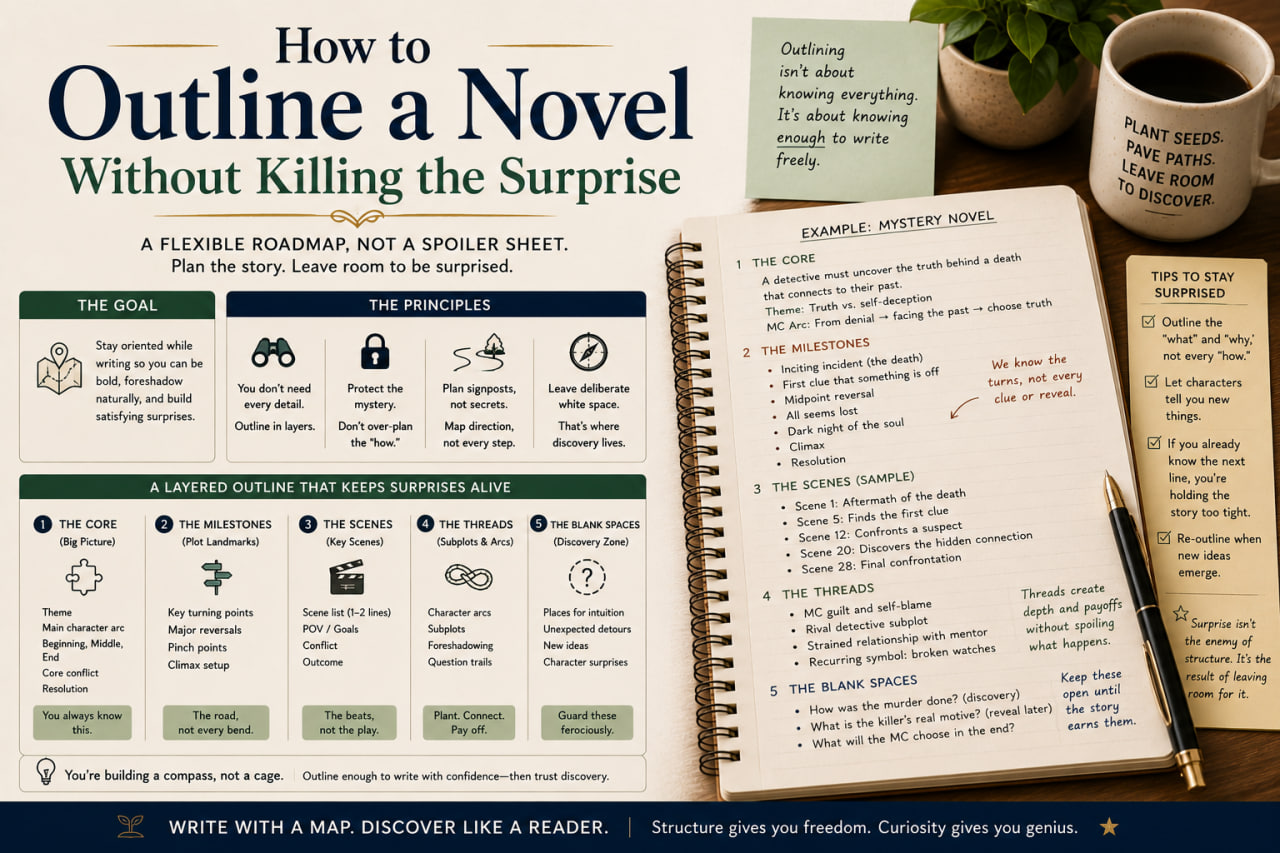
The most practical middle way is to outline the structure while leaving the texture to be discovered. Plan the load-bearing elements — roughly where the story turns, what the major crises are, how it ends — so the narrative has a spine and you always know where you’re headed. But leave the actual scenes, the dialogue, the specific events, and the moment-to-moment choices to be found in the drafting. You know the destination and the major waypoints; the road between them is open for discovery.
This gives you the best of both temperaments. The structural skeleton prevents the aimless drift that kills unplanned novels — you’re never lost, never staring at the page with no idea what the story needs. But because the scenes themselves aren’t pre-decided, the writing still surprises you; characters still say things you didn’t plan, connections still emerge, the story still breathes. You’re navigating toward known landmarks through unmapped territory, and that combination of direction and freedom is where a lot of the best writing happens. The outline tells you where; the drafting discovers how.
Leave deliberate gaps
A subtle but powerful technique is to build uncertainty into the outline on purpose. Rather than deciding every connection in advance, leave specific questions open — mark a place in the plan where you note “something forces the confrontation here, figure out what during the draft.” These deliberate gaps are gifts to your drafting self: problems to solve creatively in the moment, which is exactly where discovery writers thrive. The outline holds the shape and points to the gap, but doesn’t fill it, so the spark of finding the answer is preserved.
This reframes the outline from a set of answers into a set of well-chosen questions and constraints. You know a turning point must happen at roughly this spot, and you know what it must accomplish, but you don’t yet know exactly how — and that not-knowing keeps the work alive. A constraint with a gap in it is generative; it focuses the imagination instead of replacing it. The most useful outlines often look less like a list of events and more like a series of problems the draft is going to solve.
The outline is a hypothesis, not a contract
Whatever level of planning you choose, the most important mental shift is to treat the outline as provisional. An outline is your best current guess about the shape of the story, made before you know it well — and the act of writing always teaches you things the planning couldn’t. When the draft reveals that a planned scene is wrong, or that the story wants to go somewhere the outline didn’t anticipate, the outline is what should yield, not the living draft. Writers who feel imprisoned by their outlines are usually treating a guess as a vow.
Give yourself explicit permission to depart from the plan whenever the writing demands it, and to revise the outline as you learn. The plan that survives contact with the draft completely was probably too safe; the best stories almost always diverge from their initial maps as they discover what they really are. Hold the outline loosely. It exists to serve the story and to keep you from getting lost — not to dictate to a draft that has grown wiser than the plan that started it.
Or outline after you write
There’s a final option that dissolves the whole debate for committed discovery writers: outline backward. Write a messy exploratory first draft with little or no plan, treating it as a way of finding out what the story is. Then, before revising, reverse-outline what you’ve actually written — map the existing structure, see where it sags, where it repeats, where the shape is missing — and use that diagnosis to plan the rewrite. Here the discovery comes first and the structure comes after, which suits writers who simply cannot plan before they’ve explored.
This approach concedes that some writers genuinely need to discover the story by writing it, and meets them where they are: it doesn’t ask them to outline up front, only to impose structure once there’s a draft to structure. The cost is a messier, more wasteful first draft and more rewriting; the benefit is that the initial spark is never compromised by premature planning. Between full up-front outlining and pure pantsing, this is a real and underused third path. Find the spot on the spectrum that keeps you both unstuck and alive, and don’t let anyone tell you there’s only one right way to build a book.
How to find your own temperament
All of this raises a practical question: how do you discover where you actually fall on the spectrum, rather than where you imagine you should? The honest answer is that you find out by writing, not by deciding in advance. Many writers carry a self-image — “I’m a planner” or “I’m a pantser” — that turns out, on examination, to be borrowed from someone else’s process or from the writer they wish they were. The only reliable test is experiment: try a short project planned in detail, try another discovered freely, and pay close attention to which one you could actually finish and which one made the writing feel dead in your hands.
Watch for the specific signals. If detailed outlining leaves you with no desire to write the scenes you’ve planned, you lean toward discovery and should outline more lightly. If unplanned drafting consistently strands you in a directionless middle, you need more structure than your romantic self-image admits. Most writers land somewhere in between, and — importantly — the right spot can differ from book to book. A tightly plotted mystery may demand more planning than a character-driven literary novel from the very same author. Hold your method loosely, treat each project as its own case, and let results rather than identity decide. The writers who struggle longest are often those defending a label instead of noticing what actually gets words on the page. Your process is not your identity; it’s simply whatever reliably produces finished pages for you, on this particular book. Stay curious about it, and be willing to be wrong about yourself — the method that carried your last project may quietly fail your next one, and the writers who keep finishing are the ones who notice and adapt rather than insisting.
Common questions
I’m a discovery writer — do I really need any outline?
Probably at least a destination. Most abandoned novels die from having no sense of where they’re going. Even knowing only the ending and a couple of major turns dramatically lowers the odds of stalling in the middle, while leaving the scenes free to be discovered. Think of it as the difference between sailing toward a visible shore and drifting on an open sea — you can still wander, but you’ll never be truly lost.
How detailed should my outline be?
Only as detailed as you can stand without losing the urge to write. If planning a scene makes you no longer want to write it, you’ve gone too far for your temperament. Outline the structure to that personal limit and discover the rest.
What if my draft contradicts my outline?
Follow the draft. The outline was a guess made before you knew the story; the draft is the story teaching you what it actually wants. Revise the outline to match, and treat the divergence as progress, not error. The outlines worth keeping are the ones that change; an outline your draft never argues with was probably too cautious to be worth following in the first place.
Study how published novels are structured by reading widely — the classics at Project Gutenberg are free to analyze. For interviews in which novelists describe their own process, see The Paris Review. General educational guidance on fiction craft.