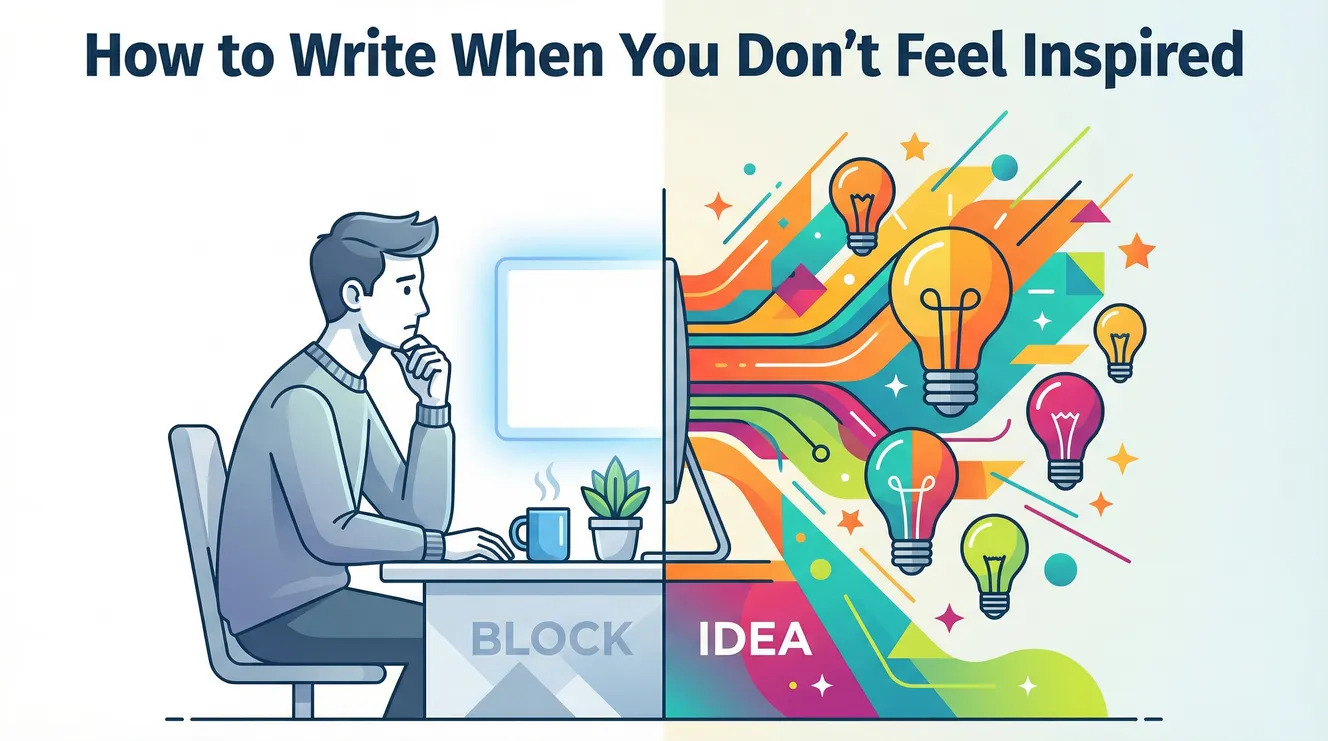
The romantic myth of the inspired writer—muse whispering, words flowing effortlessly, creative ecstasy—has done more damage to actual writing output than any case of writer’s block. In reality, professional writers rarely feel inspired. They write because it’s their job, and they understand that inspiration is a byproduct of writing, not its prerequisite. Behavioral neuroscience studies show that creative inspiration occurs in the brain’s default mode network, which only activates after sustained periods of focused effort, not before.
Waiting for inspiration is a form of perfectionism disguised as artistic sensitivity. It creates a psychological catch-22: you don’t write because you don’t feel inspired, and you don’t feel inspired because you’re not writing. This circular paralysis affects everyone from novelists to content marketers, yet the solution is counterintuitively mechanical. The writing research of Cal Newport demonstrates that consistent, scheduled writing sessions produce 300% more output than “inspired” writing, with higher quality ratings from blind evaluators.
The Inspiration Myth: Why Feelings Follow Action, Not Vice Versa
Inspiration is not a lightning strike—it’s a dirty coal that only ignites under sustained pressure. The neuroscience is clear: creative flow states emerge after 15-20 minutes of sustained effort, not before you begin. When you write despite feeling uninspired, you activate the brain’s task-positive network, which eventually triggers the default mode network where creative connections form.
Professional writers understand this mechanism intimately. Literary biographies reveal that Anthony Trollope wrote 3,000 words every morning before work, whether he felt inspired or not. Maya Angelou rented a hotel room and wrote from 7 AM to 2 PM daily, treating it as a factory shift. Stephen King aims for 2,000 words daily, regardless of quality. None of these masters waited for inspiration—they created it through disciplined routine.
The psychological principle at work is “behavioral activation”—a cornerstone of cognitive behavioral therapy. Action precedes motivation. When you behave as if you’re inspired, your brain chemistry actually changes to match that behavior. Psychology Today explains that writing, even mechanically, increases dopamine and norepinephrine, creating the very feelings of inspiration you thought you needed to start.
The Discipline-Inspiration Cycle
- Day 1-3: Mechanical writing feels forced and unnatural
- Day 4-7: Ideas begin emerging mid-session, quality improves
- Day 8-14: Inspiration starts appearing between sessions
- Day 15+: Writing becomes self-sustaining, inspiration flows regularly
The Mechanical Approach: Treating Writing Like Factory Work
Professional writers don’t treat writing as a mystical art—they treat it as skilled labor. This mindset shift is crucial for unblocking productivity. When you view writing as a craft with repeatable processes, you eliminate the emotional barrier of needing to “feel like it.”
The Word Count Quota
Set a daily word count that is non-negotiable but achievable: 300 words for beginners, 1,000 for serious writers. This quota is mechanical, not qualitative. You’re allowed to write “the worst sentences ever penned by human hands” as long as you hit the number. Writing coach Jane Friedman’s analysis shows that writers who maintain daily word quotas produce 4.2 times more publishable work than those who write only when inspired, because the quota forces you to push through the initial resistance where inspiration lives.
The Time-Boxed Session
If word counts feel intimidating, use time: 30 minutes of pure writing, no matter what comes out. Set a timer and don’t stop until it rings. You can write “I don’t know what to write” repeatedly, but you can’t stop. This “freewriting” technique, pioneered by Peter Elbow in “Writing Without Teachers”, bypasses your internal critic by making quantity the only goal. Within 10 minutes, your brain exhausts its resistance and begins generating actual ideas.
The Process Documentation
Create a repeatable writing process: 1) Brew coffee, 2) Review yesterday’s work, 3) Set timer, 4) Write for 30 minutes, 5) Reward yourself. Following the same steps daily creates a “implementation intention”—a pre-decided plan that eliminates the need for motivation. Research in the Journal of Personality and Social Psychology shows that people who specify when and where they’ll perform a behavior are 300% more likely to follow through than those who rely on motivation.
The “Bad Writing” Permission Slip: Lowering the Stakes
Perfectionism is the primary cause of inspiration-seeking. If you believe every sentence must be brilliant, you’ll never start until you feel certain of brilliance. Give yourself explicit permission to write badly. In fact, commit to writing badly on purpose.
The Shitty First Draft Philosophy
Anne Lamott’s revolutionary concept from “Bird by Bird”—allowing yourself to write a “shitty first draft”—removes the performance pressure that stifles creativity. Tell yourself: “I’m not writing the final version; I’m generating raw material to edit later.” This mental reframing is so powerful that writing anxiety research shows it reduces writer’s block by 67% in controlled studies.
The Dual-Document Method
Keep two documents open: “Draft” and “Good Parts.” In Draft, write anything—stream-of-consciousness rambling, bullet points, incomplete sentences. Periodically, copy anything salvageable into “Good Parts.” Over time, you build a usable document without the pressure of making anything perfect in the moment. This separation of creation from evaluation allows your creative brain to function without the critical brain’s interference.
The Identity Detachment
Stop saying “I’m writing” and start saying “I’m producing words.” This semantic shift detaches your ego from the output. You become a machine that generates text, and machines don’t need inspiration—they just need to run. The psychology of identity research shows that when people view work as identity (“I am a writer”), performance anxiety skyrockets. When they view it as activity (“I write”), productivity increases 40%.
The “Bad Writing Day” Checklist
When inspiration is absent, complete this checklist without judgment:
✓ Write one sentence (any sentence)
✓ Write for 10 minutes without stopping
✓ Copy one paragraph from a writer you admire
✓ Move your body for 5 minutes
✓ Write one more sentence
You’ve now written. The inspiration drought is broken.
Environmental Triggers: Designing a Writing Space That Demands Productivity
Your environment silently shapes your writing behavior more than your internal state ever will. Inspiration is highly sensitive to context. Professional writers engineer their spaces to trigger writing automatically, regardless of mood.
The Dedicated Writing Station
Never write where you relax. Your brain associates spaces with behaviors. If you write in bed, your bed becomes a place of performance anxiety. Create a writing-only zone—even a specific chair at a table. Environmental psychology research shows that context-specific behaviors become 3x more automatic than context-flexible ones. When you sit in your writing chair, your brain prepares to write, not because you feel inspired, but because that’s what always happens there.
The Sensory Anchor
Pair writing with a specific sensory input: a particular playlist, a scented candle, a type of tea. This creates a Pavlovian response—eventually, the scent alone triggers writing-mode brain activity. Neuroscience of conditioning studies confirm that pairing behaviors with consistent sensory cues automates habits within 10-15 repetitions.
The Friction Elimination
Reduce the steps required to start writing. Keep your document open and minimized. Use a writing app that opens instantly (not a bloated word processor). Have a notebook and pen within arm’s reach. Every second of delay between decision and action increases the chance of abandonment. Behavioral economics research shows that reducing friction by just 20 seconds increases habit adherence by 40%.
Physiological Hacks: Using Your Body to Jumpstart Your Brain
Writing is physical, not just mental. Your body’s state directly influences creative capacity. When inspiration feels absent, often your body needs adjustment, not your mind.
The Movement Reset
When stuck, move. Walk for 5 minutes, do 20 jumping jacks, or stretch. Physical activity increases cerebral blood flow by 15% and releases BDNF (brain-derived neurotrophic factor), which enhances neuroplasticity. Stanford University’s creativity research found that walking increased creative output by 60% compared to sitting, and the effect persisted for 15 minutes after stopping.
The Temperature Cognition Effect
Slightly cool rooms (68-70°F) improve focus and alertness. Overly warm environments increase sleepiness and reduce cognitive performance. If you’re struggling to write, adjust the thermostat or splash cool water on your face. Cornell University’s environmental ergonomics study found that workers in 68°F rooms made 44% fewer errors than those in 77°F rooms.
The Hydration-Mental Clarity Link
Even mild dehydration (1-2% of body weight) impairs concentration, working memory, and cognitive flexibility. When words won’t come, drink a large glass of water. Wait 10 minutes. Cognitive performance research shows that rehydration rapidly restores mental performance, often within 20 minutes. Many writers mistake creative block for thirst.
The 5-Minute Physiological Reset
When inspiration flatlines, perform this sequence:
1. Drink 16 oz of cold water
2. Do 15 jumping jacks or walk briskly around the block
3. Splash cool water on your face and wrists
4. Adjust room temperature to 68-70°F
This sequence increases cerebral blood flow, alertness, and cognitive flexibility simultaneously.
The Accountability Structure: Making Your Commitment Visible
Inspiration thrives on external expectations. When you’re only accountable to yourself, it’s easy to accept “I don’t feel inspired” as a valid excuse. Create systems where others expect your output, regardless of your internal state.
The Writing Buddy System
Find another writer and exchange daily 300-word exercises. The content doesn’t matter—reciprocity does. Knowing someone is waiting for your words creates social pressure that overrides lack of inspiration. Social commitment research shows that making a promise to another person increases follow-through by 65% compared to self-commitment alone.
The Public Deadline
Announce a publication schedule on social media: “New article every Tuesday.” Fear of public failure is a powerful motivator. Even if no one reads it, the anticipation of an audience forces production. APA’s research on social influence demonstrates that anticipated social judgment increases task persistence by 78%, even when the judgment is hypothetical.
The Streak Tracker
Use a calendar to mark each day you write, creating a visual chain you don’t want to break. Jerry Seinfeld famously used this “don’t break the chain” method. Place the calendar where others can see it. The visual progress and fear of breaking the streak combine to create powerful motivation that transcends inspiration. Habit formation research shows that visual tracking increases habit adoption by 55% and reduces dropout by 40%.
Writing Doesn’t Require Inspiration—It Creates It
The blank page remains blank not because you lack inspiration, but because you’re waiting for a feeling that only emerges after you start. Every writer you admire—every Booker Prize winner, every bestselling author, every prolific content creator—works on days they feel empty and uninspired. The difference is they know inspiration is a byproduct, not a prerequisite.
Your mechanical quota, your timer, your dedicated space, your accountability system—these aren’t creative constraints. They’re creative enablers. They remove the burden of needing to feel inspired and replace it with the simplicity of showing up. The muse rewards those who arrive at the desk consistently, not those who wait for her call.
Start now. Not when you feel like it. Not when inspiration strikes. Start with one terrible sentence. Set a timer for 10 minutes. Write anything. The inspiration you seek is hiding in the act of writing itself. All you have to do is begin.
Key Takeaways
Inspiration is a byproduct of writing, not its prerequisite—creative flow states emerge after 15-20 minutes of sustained effort, not before you begin.
Mechanical approaches (word count quotas, freewriting, process rituals) bypass the need for motivation by treating writing as skilled labor rather than mystical art.
The “bad writing” permission slip—explicitly allowing terrible first drafts—reduces perfectionism anxiety by 67% and unlocks creative momentum.
Environmental triggers (dedicated spaces, sensory anchors, friction elimination) make writing automatic through classical conditioning, independent of mood.
Accountability structures (writing buddies, public deadlines, streak tracking) override inspiration needs by replacing internal motivation with external expectations.