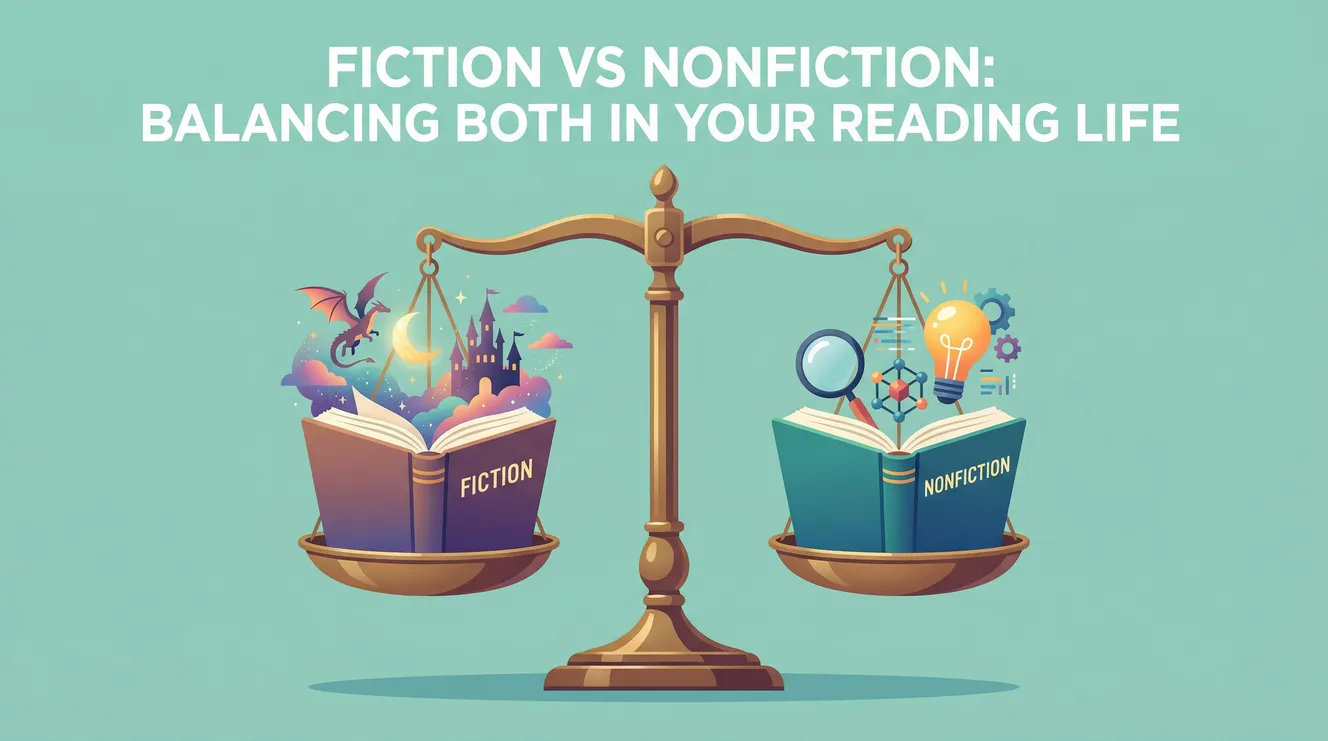
The fiction vs nonfiction debate often frames itself as a binary choice between entertainment and education, pleasure and profit. Yet neuroscience reveals this distinction is artificial. Stanford research on narrative comprehension shows that reading literary fiction activates the same brain regions responsible for understanding complex social dynamics—regions that remain dormant when reading expository text alone. Meanwhile, cognitive studies on nonfiction reading demonstrate that well-written factual prose can rewire neural pathways for critical thinking just as effectively as any novel.
The real question isn’t which to choose, but how to orchestrate both genres into a reading life that builds knowledge while nurturing empathy, that challenges intellect while feeding imagination. This synthesis creates something greater than the sum of its parts—a mental framework where facts inform feeling and stories illuminate truth. The balanced reader doesn’t just accumulate information; they develop wisdom.
The Neural Architecture: How Your Brain Builds Different Worlds
Fiction and nonfiction don’t just differ in content—they demand different cognitive operating systems. When you read nonfiction, your brain operates in acquisition mode. The prefrontal cortex catalogs facts, evaluates arguments, and cross-references new information with existing knowledge. This is deliberate, effortful processing that strengthens analytical pathways. You’re building a mental database, creating hooks to hang future learning on. The satisfaction comes from clarity, from complex ideas distilled into understandable frameworks.
Fiction triggers a parallel construction process. Instead of building a database, you’re building a simulation. The brain’s default mode network—active during daydreaming and self-reflection—lights up as you track characters’ inner lives. Mirror neurons fire as you experience fictional emotions, actually strengthening your capacity for real-world empathy. A 2013 Science study found that reading literary fiction temporarily improves theory of mind—the ability to understand others’ mental states—more than reading nonfiction or popular fiction does.
The Cognitive Trade-Off Table
Nonfiction Strengths: Fact retention, argument evaluation, pattern recognition across datasets, vocabulary expansion in specialized domains
Fiction Strengths: Emotional intelligence, moral reasoning, cultural perspective-taking, narrative memory encoding
Nonfiction Weaknesses: Limited emotional processing, potential for echo chambers (only reading what confirms beliefs), burnout from constant analysis
Fiction Weaknesses: Slower factual acquisition, potential for escapism that avoids real growth, difficulty applying insights to real problems
The key insight is that these processes aren’t exclusive—they’re synergistic. A reader who only processes facts builds a rigid mental architecture. One who only simulates fictional worlds constructs elaborate structures without foundations. The balanced reader alternates between laying concrete (nonfiction) and furnishing the rooms (fiction), creating a livable, expandable mental mansion.
The Comfort Zone Conspiracy: Why We Default to One Genre
Most readers secretly pledge allegiance to one genre. The “serious reader” accumulates political histories and science tomes, dismissing fiction as frivolous entertainment. The “book lover” devours novels but feels nonfiction is homework—necessary for students, not for pleasure. These preferences solidify into identity, creating a feedback loop where you read more of what you are, and become more of what you read.
This polarization often stems from early reading experiences. If your school assigned dry textbooks, you may associate nonfiction with boredom. If you were forced to analyze novels to death, fiction may feel like work. These formative experiences create genre PTSD that persists into adulthood. Education Week’s analysis of reading habits shows that adults who maintained pleasure reading through adolescence show less genre rigidity than those whose reading was primarily academic.
Professional identity also shapes preferences. Engineers and scientists often gravitate toward nonfiction that mirrors their analytical training, while artists and caregivers seek fiction that explores interior lives. This professional echo chamber makes sense—until it doesn’t. The engineer who never reads fiction misses out on the narrative thinking that solves human-centered design problems. The artist who avoids nonfiction lacks the factual grounding to make their work relevant to real-world issues.
The Synergy Spectrum: When Genres Cross-Pollinate
The magic of balance isn’t just in alternating genres—it’s in the synthesis. Reading about World War II history then diving into a novel set in that era creates a feedback loop where facts give fiction weight and fiction gives facts humanity. This cross-pollination transforms isolated knowledge into integrated understanding.
Consider the entrepreneur who reads Thinking, Fast and Slow (nonfiction) and The Circle by Dave Eggers (fiction). The psychology book explains cognitive biases; the novel dramatizes their consequences in a tech dystopia. Together, they create a mental model that’s both analytically sound and emotionally resonant. This is how wisdom forms—not through facts alone or stories alone, but through their marriage.
The Reading Pairing Strategy
Deep Dive Pairing: Read Dark Money by Jane Mayer (nonfiction) + The Motion of the Body Through Space by Lionel Shriver (fiction about political donations)
Skill Building Pairing: Read Atomic Habits (nonfiction) + The Power of Habit (narrative nonfiction that reads like story)
Historical Perspective Pairing: Read The Warmth of Other Suns (nonfiction) + The Underground Railroad by Colson Whitehead (historical fiction)
Ethical Exploration Pairing: Read Practical Ethics by Peter Singer (nonfiction philosophy) + Never Let Me Go by Kazuo Ishiguro (fiction about bioethics)
Career Enhancement Pairing: Read Deep Work (nonfiction) + Then We Came to the End by Joshua Ferris (workplace fiction)
This pairing approach, championed by Farnam Street’s learning frameworks, mirrors how the brain naturally encodes memory. We remember information better when it’s embedded in story, and we appreciate story more when we understand the factual context. The balanced reader doesn’t just read both genres—they engineer productive collisions between them.
The Balanced Reader Framework: A Practical Ratio System
Generic advice like “read more of both” fails because it ignores your starting point and life circumstances. A better approach is to calculate your current ratio, define your target, and implement transitional rules. This framework, adapted from behavioral economics, treats your reading diet like a portfolio to be rebalanced.
First, audit your last 20 books. Count fiction vs nonfiction. If you’re 90% fiction, aiming for 50/50 overnight is unrealistic and demotivating. Instead, target 70/30 for the next 10 books, then 60/40 for the following 10. This gradual shift prevents rebellion and allows you to discover nonfiction you genuinely enjoy rather than forcing yourself through “should” reads.
The Rule of Alternating Momentum
Never read two books of the same genre back-to-back if you’re trying to build balance. This simple rule prevents genre ruts. After finishing a dense nonfiction work on economics, follow it with a fast-paced thriller. After a emotionally draining novel, cleanse your palate with a pop science book. This alternation keeps your brain flexible and prevents burnout in either mode.
The Page-Count Parity Method
If you read 300 pages of fiction this week, balance it with 300 pages of nonfiction next week. This simple metric works better than book counting because it adjusts for length variation. A 500-page biography “counts” more than a 150-page novella. This method, popularized by Reddit’s 52 Book Challenge community, creates genuine equilibrium.
Phase-Based Balancing
Learning Phase (Career Launch): 70% Nonfiction (skill building, industry knowledge) / 30% Fiction (stress relief)
Stability Phase (Mid-Career): 50/50 Split (maintaining expertise + creative renewal)
Transition Phase (Career Change): 60% Nonfiction (new domain) / 40% Fiction (maintaining identity)
Legacy Phase (Late Career/Retirement): 40% Nonfiction (selective deep dives) / 60% Fiction (life reflection)
Crisis Phase (Burnout/Recovery): 80% Fiction (emotional restoration) / 20% Nonfiction (gentle inspiration)
Reader Stories: Real Balance Transformations
These composite profiles, drawn from Goodreads community surveys and reading group interviews, demonstrate how strategic genre balancing transformed reading lives.
The Tech Executive Who Rediscovered Humanity
Sarah, a 42-year-old CTO, read exclusively nonfiction—management books, AI research, biographies of founders. Her reading tracked her ambition. But after a decade, she felt emotionally flat, unable to connect with her team’s human struggles. On a therapist’s suggestion, she began adding one novel per month. Starting with contemporary literary fiction (Rachel Cusk, Sally Rooney), she found her ability to read emotional subtext in meetings improved dramatically. Fiction didn’t make her less analytical—it gave her analytical tools for the human elements she’d been ignoring. Her new ratio is 60/40 nonfiction to fiction, and she credits this balance for her company’s improved retention.
The Poet Who Learned to Build Things
Marcus, a 29-year-old poet and MFA graduate, considered nonfiction a betrayal of art. His reading was 95% poetry and experimental fiction. But mounting student debt and career instability forced a pragmatic shift. He began incorporating career-oriented nonfiction—books on freelance business, digital marketing, and personal finance. Instead of killing his creativity, this knowledge freed him. He learned to price his work, manage cash flow, and negotiate contracts. The security allowed riskier artistic choices. His poetry didn’t suffer; it gained depth from understanding economic realities. He now maintains a 70/30 fiction to nonfiction balance, protecting his creative core while building practical scaffolding.
The Retiree Who Found New Purpose
After retiring from teaching, Karen, 67, filled her time with cozy mysteries and romance novels—comfort reading after decades of academic labor. But she felt her mind softening, curiosity dulling. She began adding nonfiction incrementally: one book on neuroscience, a biography of a forgotten historical figure, a deep dive into climate science. The shift was uncomfortable initially—like starting exercise after years of inactivity. But the mental clarity returned. She now leads a book club that intentionally pairs fiction and nonfiction around themes, creating community while maintaining her own cognitive vitality. Her ratio is 50/50, and she says it’s the perfect balance for a life that’s both restful and engaged.
The Lifelong Balance: Adjusting Across Decades
Your optimal ratio isn’t static—it should evolve with your life phase, career demands, and cognitive needs. A rigid 50/50 split applied year after year misses the point of balance, which is responsiveness to context. The goal is dynamic equilibrium, not mechanical equality.
In your 20s, when building career capital, a 70/30 nonfiction tilt makes sense. You’re acquiring frameworks, skills, and domain knowledge. In your 30s, as leadership and relationships become more complex, shifting to 50/50 develops the empathy and perspective needed for influence. In your 40s and 50s, a 40/60 fiction-heavy phase allows reflection on life’s patterns and meaning-making. In retirement, a return to 50/50 keeps the mind active while honoring the wisdom accumulated.
Major life events should trigger ratio reviews. Grieving? Increase fiction for emotional processing. Starting a business? Boost nonfiction for practical skills. Becoming a parent? Balance both to model intellectual curiosity while gaining parenting knowledge. The balanced reader treats their reading life as a living system, not a fixed schedule.
Your Genre Identity Is Not Fixed
The fiction vs nonfiction divide is a false choice that limits your intellectual growth. You don’t have to pledge allegiance to one camp. The most effective readers are genre polyglots, fluent in both analytical and narrative modes, able to switch registers based on what the moment demands.
Start today by identifying your bias. Then commit to one book from the neglected genre. Don’t choose what you think you should read—choose what whispers to your curiosity. The poet might try a narrative science book. The executive might sample a short story collection. The retiree might explore a biography.
Balance isn’t achieved by perfect calculations. It’s built through small, consistent choices that honor both the engineer and the artist within you. Your reading life can be both a workshop and a sanctuary. The only wrong ratio is the one that makes you stop reading altogether.
Core Principles
Fiction and nonfiction activate complementary cognitive processes—analytical reasoning vs emotional simulation—creating synergy when balanced rather than conflict when separated.
Genre preferences often stem from early conditioning and professional identity, but these biases can be gently rewired through strategic cross-genre exploration.
The optimal reading ratio isn’t static; it should flex with life phases, career demands, and emotional needs, creating dynamic equilibrium rather than rigid equality.
Pairing fiction and nonfiction around topics creates synthesis where facts gain humanity and stories gain grounding, developing wisdom beyond mere knowledge or empathy.
Small, consistent genre alternation—never reading two same-category books consecutively—builds mental flexibility and prevents reading ruts more effectively than dramatic overhauls.
“`