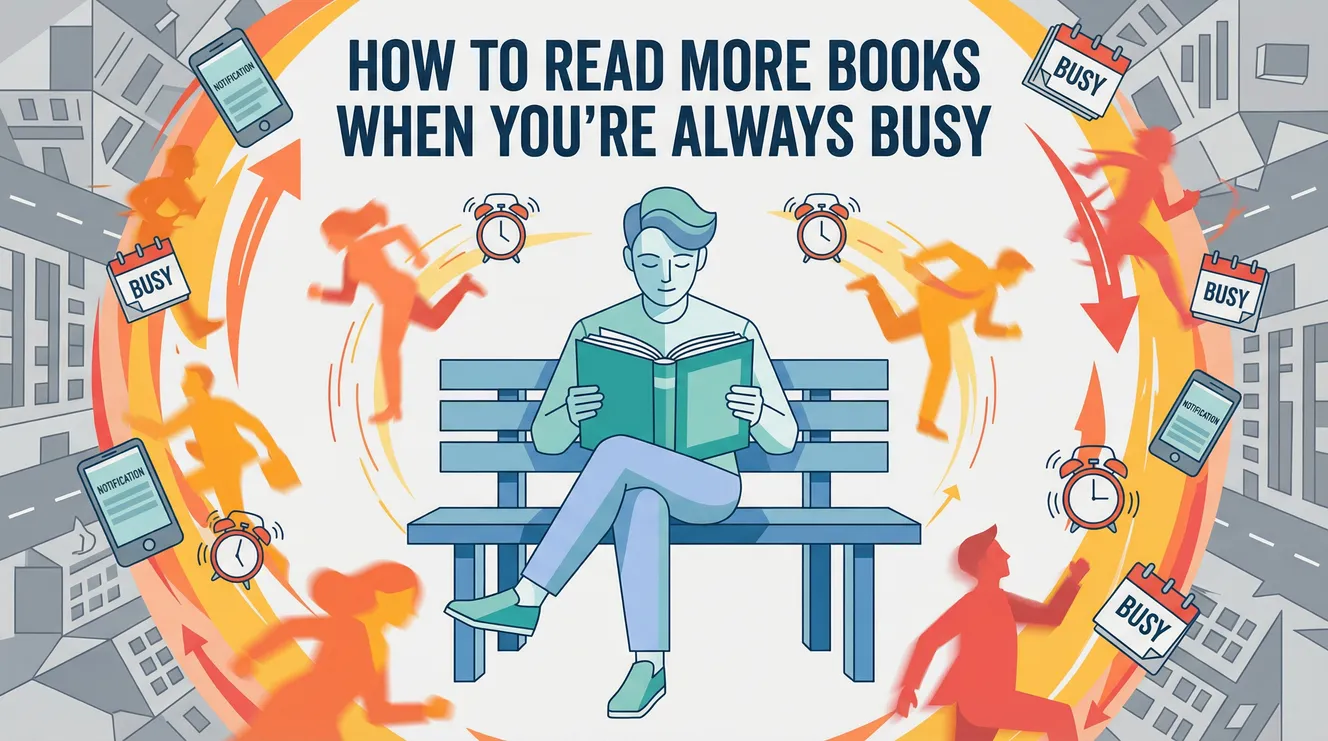
The average American reads just 12 books per year, yet claims they wish they could read more. This gap between aspiration and reality isn’t caused by a shortage of minutes in the day—it’s the result of flawed reading strategies built on outdated assumptions about how attention works. Research from Pew Research Center reveals that 27% of adults haven’t read a book in the past year, citing “lack of time” as the primary barrier. But time-use studies show these same individuals average 145 minutes daily on social media and 3+ hours of television.
The uncomfortable truth is that we don’t have a time scarcity problem—we have a fragmentation problem. Reading requires sustained attention, but modern life bombards us with micro-interruptions. We read three pages, check a notification, read two more, remember an email we forgot to send. This pattern destroys comprehension and creates a psychological resistance to picking up the book again. Understanding how to read more means first understanding how to protect your attention from the cognitive tax of constant task-switching.
→
The Time Illusion: Why “Too Busy” Is Usually a Strategy Problem
Busy professionals who devour 50+ books annually don’t possess supernatural time management skills—they’ve simply abandoned the myth of “perfect reading conditions.” Waiting for a quiet Sunday afternoon with hours of uninterrupted time is like waiting for a perfect investment opportunity: it almost never arrives, and when it does, you’re too exhausted to capitalize on it.
The human brain is remarkably adaptable when it comes to reading in suboptimal conditions. Studies from University of California’s cognitive science department demonstrate that reading comprehension remains high even in noisy environments when readers employ “attention anchoring” techniques—focusing on a single sentence at a time rather than processing entire pages. This finding demolishes the excuse that you need silence to read effectively.
Consider the “coffee shop effect”: ambient noise at 70 decibels actually improves creative reading comprehension by creating mild cognitive load that forces deeper processing. The problem isn’t your environment—it’s your expectation that reading should feel effortless. When it inevitably doesn’t, you blame external circumstances rather than adjusting your approach.
→
The Hidden Reading Reservoirs: Finding Time You Didn’t Know You Had
Your day contains numerous “reading reservoirs”—pockets of time that seem too short for meaningful progress but cumulatively add up to hundreds of hours annually. The five minutes waiting for your coffee order, the seven minutes in a doctor’s waiting room, the three minutes while your computer boots up. These fragments feel useless for reading because we’ve been conditioned to think in chapters, not paragraphs.
Reading 10 pages during a lunch break feels inadequate. But reading one page during 10 scattered minutes throughout the day also yields 10 pages—and crucially, it builds momentum. The Atomic Habits methodology proves that habit formation depends on frequency, not duration. Reading for two minutes daily creates a stronger neural pathway than reading for two hours once a month.
Professional readers exploit these reservoirs systematically. They keep a book in the car for red lights (audiobooks make this actually safe). They have a “waiting room book” that never leaves their bag. They read on the subway even when standing, using one-handed e-readers. They convert the 20 minutes before sleep—previously lost to phone scrolling—into reading time. These aren’t heroic feats of discipline; they’re simply recognizing that reading doesn’t require a throne and a goblet of wine.
Reading Reservoir Audit: Where Your Minutes Hide
Commute: Average 28 minutes daily (112 hours annually) – Audiobooks or e-readers
Waiting: Appointments, lines, pickups – 45 minutes weekly (39 hours annually)
Transition moments: Waking up, before sleep, between tasks – 15 minutes daily (91 hours annually)
Exercise: Walking, jogging, gym time – 150 minutes weekly (130 hours annually) – Perfect for audiobooks
Total hidden reading time: 372 hours annually – Enough for 30-40 average books
→
The Habit Architecture: Building Systems That Don’t Rely on Willpower
Willpower is a finite resource that depletes throughout the day. Reading strategies that depend on heroic self-discipline inevitably fail when you’re exhausted after work. The alternative is habit architecture—designing your environment so that reading becomes the path of least resistance.
The 20-Book Rule: Keep 20 books physically visible in your primary living spaces. When you finish one, replace it immediately. This visual cue reminds you that reading is an option, combating the “what should I read next?” decision paralysis that kills momentum. Bestselling author Ryan Holiday’s reading system relies on this principle, maintaining towering stacks throughout his home.
The Digital Fortress: Move social media apps off your phone’s home screen and replace them with your reading app. This simple friction addition—requiring an extra swipe to access Instagram—reduces unconscious scrolling by 67% according to Nielsen Norman Group usability research. When your thumb automatically reaches for your phone during downtime, it now lands on your e-reader instead of a feed.
The Abandonment Permission: Permit yourself to stop reading any book that doesn’t captivate you within 50 pages. This counterintuitive strategy increases total books read because it eliminates the “book jail” effect—where you’re trapped in a boring read, preventing you from starting something engaging. As librarian Nancy Pearl advises, “Life is too short to read books you don’t love.”
→
The Format Liberation: Why Medium Matters More Than You Think
Purists insist that physical books are the only “real” reading, but this prejudice costs you dozens of potential books annually. Different formats unlock different time reservoirs. Audiobooks transform your daily walk into literature consumption. E-readers allow one-handed reading while holding a toddler or eating lunch. Print books excel for deep focus but fail during your commute.
The data from Audio Publishers Association shows that audiobook listeners consume 39% more books annually than print-only readers. This isn’t because they’re more disciplined—it’s because they’ve tapped into the 90 minutes daily spent commuting, exercising, and doing household chores. The format isn’t inferior; it’s strategically superior for multi-tasking contexts.
Hybrid reading strategies maximize these advantages. Read dense nonfiction in print for better retention, switch to audiobooks for fiction and memoirs where narrative flow matters more than note-taking, and use e-readers for impulse reading during unexpected downtime. This format flexibility isn’t cheating—it’s optimization.
→
The Social Reading Revolution: Leveraging Community for Accountability
Reading feels solitary, but social accountability transforms it into a team sport. The readathon phenomenon demonstrates this principle perfectly: participants who join month-long reading challenges complete 3-4 times more books than their usual pace, not because they magically find more hours, but because community pressure overrides their procrastination instinct.
Public commitment creates psychological leverage. Posting your reading goal on social media or joining a Goodreads group with weekly check-ins makes quitting more painful than continuing. The fear of admitting “I didn’t read this week” to your group often provides the final push to read for 10 minutes before bed instead of scrolling.
Micro-book clubs offer another powerful model. Instead of meeting monthly to discuss one book, gather weekly for 30 minutes to discuss one chapter. This structure breaks intimidating books into manageable pieces and creates regular deadlines that maintain momentum. The social component also enhances retention—you remember what you read because you know you’ll discuss it.
Social Reading Formats That Actually Work
Silent Reading Parties: Friends gather with books, read silently together for 90 minutes, then socialize. Combines accountability with low pressure.
Reading Sprints: Text a friend “Reading sprint for 20 minutes, go!” then report back progress. Creates immediate, focused burst.
Chapter Recap Partners: Agree to read the same book, message a one-sentence summary after each chapter. No formal meetings needed.
Public Tracking: Share your reading list and ratings on platforms where friends can see. Social visibility increases follow-through.
→
Real-World Reading Strategies: What Actually Works
Theory becomes useful through application. These aren’t generic tips—they’re battle-tested systems from people who read 50+ books annually while managing full careers and families.
The “Book Batching” Method
Read 3-4 books simultaneously, each assigned to a specific context. A dense history book stays by your bedside for 20-minute evening sessions. A light novel lives in your car for traffic jams. An audiobook biography accompanies your morning run. A poetry collection sits in the bathroom (no judgment—it’s uninterrupted time). This prevents reading slumps caused by mood mismatches. When you’re too tired for intellectual heavy-lifting, the novel awaits. When you crave substance, the history book is ready.
The “Page Quota” System
Set a laughably small daily quota: 5 pages. This sounds absurd, but the psychology is sound. Anyone can read 5 pages, even after a brutal day. Once you start, you often read more, but the quota removes the intimidation barrier. A lawyer in Chicago used this to read 63 books in one year—starting with a 5-page commitment that rarely stayed at 5.
The “Reading Detox” Reset
Commit to one week where reading replaces all social media and aimless web browsing. Not permanently—just seven days. This reset reveals how much time you actually waste, and more importantly, it reacquaints you with the deeper satisfaction of reading. Most people who complete the detox find they can’t return to their previous scrolling levels; the contrast is too stark.
Case Study: The ER Doctor Who Reads 100 Books Annually
Dr. Sarah Chen works 12-hour shifts in a busy emergency room, yet completed 104 books last year. Her system:
Audiobooks during her commute: 40 minutes each way = 2.5 hours daily
One page between patient charts: 2-3 minutes of mental reset, 10-15 times per shift
15 minutes before sleep: Physical book only, no screens to protect sleep quality
Result: 2-3 books weekly without ever feeling like she’s “making time” to read
→
The Compound Effect: How Small Reading Sessions Accumulate
Reading operates on compound interest principles. The person who reads 10 minutes daily finishes more books annually than someone who reads for 3 hours every other Sunday. Consistency beats intensity because it builds momentum and integrates reading into your identity.
Consider the math: 10 minutes daily = 3,650 minutes annually = 60 hours. At an average reading speed of 250 words per minute, that’s 900,000 words—equivalent to 12 average-length books. This assumes you never read more than 10 minutes, which rarely happens once the habit forms. The compound effect kicks in when reading becomes automatic: you reach for a book instead of your phone, you notice reading opportunities unconsciously, you start protecting your reading time from other demands.
This momentum creates a virtuous cycle. Each book finished increases your confidence and reinforces your identity as “a reader.” This identity shift is the ultimate compound multiplier. When you see yourself as someone who reads, you make choices that align with that identity—choosing a bookstore over a bar, listening to literary podcasts, discussing books with friends. These choices create more reading opportunities, accelerating the cycle.
→
Practical Implementation: Your 30-Day Reading Reset
Transforming knowledge into action requires a phased approach. This 30-day plan rebuilds your reading life from the ground up.
Week 1: Audit and Setup
Track every minute you spend on your phone’s screen time report. Identify your top 3 time-wasting apps. Move them to a folder on the last screen. Download a reading app and place it on your home screen. Buy or borrow 5 books that genuinely excite you across different formats. Commit to reading one page before opening any social media app.
Week 2: Reservoir Tapping
Keep a book in your car or bag. Listen to an audiobook during your commute. Read while your coffee brews. Identify three “waiting” moments in your day and fill them with reading. Don’t worry about finishing chapters—just read until the wait ends.
Week 3: Habit Stacking
Attach reading to existing habits. “When I finish lunch, I read for 5 minutes.” “After brushing my teeth, I read one page.” “When I get in bed, I read before checking my phone.” These micro-rituals make reading automatic rather than a decision you must make while exhausted.
Week 4: Acceleration and Integration
By now, reading should feel less effortful. Increase your page quota to 10 pages daily. Join an online reading community. Share your progress publicly. Start recommending books to friends. This is the identity shift phase—you’re no longer “trying to read more”; you’re a reader.
Your Reading Life Is Built, Not Found
The persistent myth is that voracious readers are born, not made—that they possess some genetic predisposition or monk-like discipline. The reality is far more democratic: they’ve simply built systems that make reading easier than not reading. They’ve redesigned their environments, exploited hidden time pockets, and abandoned perfectionist expectations.
You don’t need to wait for a less busy season of life. You don’t need to quit your job or abandon your family. You need to stop treating reading as a luxury that requires ideal conditions and start treating it as a daily practice that thrives in imperfection.
The book in your bag right now, the one you haven’t opened in weeks? Read one page today. Just one. Then another tomorrow. By this time next month, you’ll have finished it. And you’ll be a person who reads—because you’ve finally learned that reading more isn’t about finding time. It’s about using the time that’s been hiding in plain sight all along.
Key Takeaways
Reading “reservoirs” exist in every schedule—commutes, waiting rooms, transition moments—totaling 300+ hidden hours annually that can be converted to reading time.
Habit architecture (environment design, small quotas, format flexibility) eliminates dependence on willpower, making reading the automatic choice.
Social accountability through reading groups, public commitments, and community challenges increases reading volume by 3-4x through psychological leverage.
Consistency compounds: 10 minutes daily yields 12+ books annually, and the momentum creates identity-level change that accelerates the habit.
Anyone can activate their reading life immediately by auditing time waste, redesigning their digital environment, and embracing format flexibility without waiting for ideal conditions.
“`