The publishing industry’s obsession with word count isn’t arbitrary—it’s a complex calculation of market economics, reader psychology, and production logistics. As literary agent Jessica explained during a recent Manuscript Academy panel, she recently fell in love with a commercial fantasy novel clocking in at over 150,000 words, devouring it in 36 hours. Yet despite its compelling nature, the word count itself presented a significant hurdle for a debut author. This paradox reveals the tension between quality and marketability that defines modern publishing.
Production costs provide the harsh mathematics behind these guidelines. Since 2020, paper prices have increased substantially, making longer books exponentially more expensive to print, ship, and store. For debut authors without proven sales records, publishers view excessive word count as amplified risk. A 150,000-word literary fiction debut faces nearly insurmountable market resistance, regardless of brilliance. The industry craves quantitative “objective” data, and word count provides an easy filter in a flooded market where agents receive thousands of submissions monthly.
◆
The Age Category Matrix: From Board Books to Adult
Reader age dictates attention span and comprehension level, creating rigid word count boundaries that evolve with developmental stages. Understanding these categories is fundamental before even considering genre-specific ranges.
Picture Books: The Economy of Storytelling
Picture books operate in a remarkably tight space: 250-750 words for most titles, with board books ranging from 25-200 words. As literary agent Noelle clarified, many writers are surprised by how minimal these counts truly are. The constraint isn’t punitive—it’s developmental. Young children process language slowly, and illustrations carry half the narrative load. Always include precise word count in queries and specify narrow age ranges (“ages 3-5” not “ages 1-6”). This precision signals professionalism to agents and editors who know that a 200-word difference can separate a bedtime story from a preschool teaching tool.
Middle Grade: The Sweet Spot for Young Readers
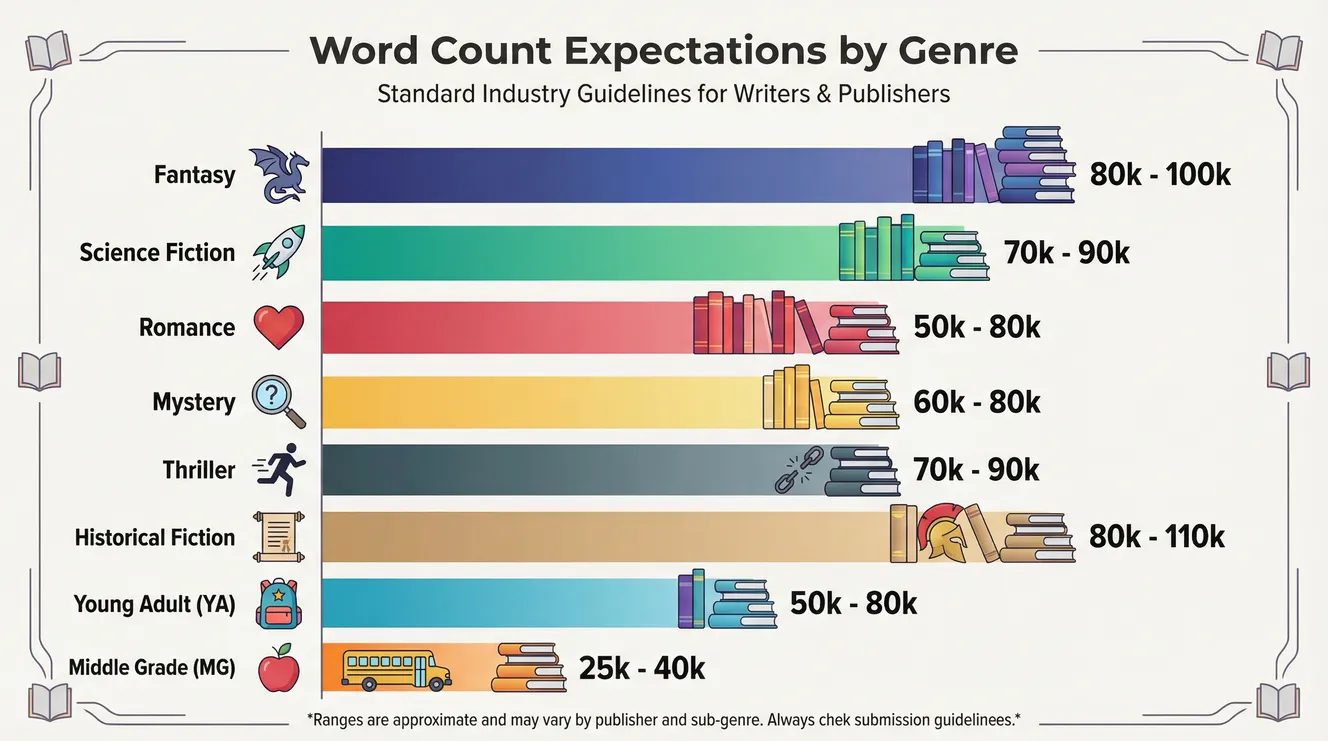
Middle grade fiction targets 40,000-60,000 words, with contemporary stories at the lower end (40-50K) and fantasy/adventure allowed to stretch to 60K. During a recent query review, Noelle praised a 48,000-word middle grade contemporary manuscript as “perfect” for the genre. Exceeding 65,000 words raises red flags about whether the book is actually young adult in disguise. However, speculative genres receive more leeway across all age categories because worldbuilding demands additional space. The key is ensuring every word earns its place in a developing reader’s limited attention span.
Young Adult: The Expanded Canvas
Young adult novels typically range from 60,000-90,000 words, with contemporary YA at 60-75K and fantasy permitted up to 90K. Crucially, always specify your protagonist’s age in queries—14-year-old protagonists suggest different content than 18-year-olds, affecting how agents interpret romance and relationships. Red flags appear around 90,000 words unless justified by complex worldbuilding or dual timelines. The YA market is particularly sensitive to pacing; excessive length can signal a story that hasn’t been disciplined enough for its target audience.
◆
Adult Fiction: Genre-Specific Boundaries and Flexibility
Adult fiction offers more breathing room but maintains clear expectations by genre. Debut authors face stricter scrutiny than established writers with proven sales records. Understanding these nuances can mean the difference between a request for pages and a form rejection.
Literary Fiction: The Lean Machine
Literary fiction debuts must aim for 80,000-95,000 words. When Noelle reviewed a literary fiction query at 110,000 words, she noted that for a debut, she’d prefer it closer to the 80-95K range. Established authors enjoy more leeway, but debuts are hard enough to sell without creating objective hurdles. Literary fiction over 100,000 words faces significant market resistance, as the genre prizes concision and elegant prose over expansive plotting. Every extra word in literary fiction must justify its existence through stylistic necessity rather than narrative sprawl.
Mystery & Thriller: Pacing Over Page Count
Mystery and thriller novels target 80,000-90,000 words, with pacing as the critical factor. Longer manuscripts can feel slowed down; shorter ones might lack expected complexity. During a recent event, a mystery query at 89,000 words was praised as “performing exactly as it should” for the genre. These genres demand relentless forward momentum, and excessive length often signals a plot that hasn’t been tightened sufficiently. Bestselling mystery author Agatha Christie routinely wrote between 40,000-60,000 words, proving that concision can be powerful when every scene serves the puzzle.
Romance: The Tightest Word Count Window
Romance maintains some of the strictest expectations: 70,000-90,000 words for contemporary, stretching to 80,000-100,000 for historical romance where period detail requires more space. The genre’s tight conventions mean readers expect specific beats at specific points; deviating too far disrupts the contract between writer and reader. Harlequin’s imprint guidelines provide explicit targets for each subgenre, recognizing that romance readers want their emotional payoff efficiently delivered. Too short feels underdeveloped; too long can drag the courtship past readers’ patience.
Science Fiction & Fantasy: The Worldbuilding Premium
Science fiction enjoys 90,000-110,000 words, while fantasy ranges from 90,000-120,000 words, with epic fantasy reaching up to 200,000 words. These genres earn their length through worldbuilding demands. As Noelle explained, she doesn’t mind reviewing works over 100K in sci-fi, fantasy, or historical fiction because these categories naturally run longer. However, even here there are limits—fantasy over 130,000 words needs to be extraordinary to overcome production cost concerns. Notable exceptions exist: Kindlepreneur’s research shows that while the average fantasy novel is 109,000 words, debuts are strongly encouraged to stay below 140,000 words.
The Debut Author Dilemma: Why First-Timers Face Stricter Limits
Established authors with proven sales can exceed guidelines significantly. Brandon Sanderson, George R.R. Martin, and J.K. Rowling publish books well above typical word counts because their audiences are guaranteed. For debuts, word count is one of the few objective metrics agents and publishers can use to reduce risk. A 150,000-word debut fantasy isn’t just a creative choice—it’s a production gamble. The advice is clear: earn your audience with a standard-length book, then give them longer works once they’re invested.
◆
Memoir and Nonfiction: The Platform Premium
Memoir and narrative nonfiction target 70,000-90,000 words, with traditional memoir facing stricter limits than experimental forms. As Noelle noted, “Memoir is sort of perennially difficult,” making adherence to word count even more critical. Platform has become increasingly important in the post-Eat, Pray, Love era. Traditional memoir without an extraordinary hook or massive platform struggles regardless of length.
Self-help and prescriptive nonfiction operate differently: 40,000-70,000 words is ideal because readers seeking practical guidance want solutions quickly, not epic narratives. For example, Find Your Thing by Lisa Zelenak succeeds at 30,000 words because its audience values concise, actionable advice over exhaustive exploration.
◆
The Reader Psychology: Why Expectations Feel Invisible Until Broken
Genre readers develop unconscious length expectations through repeated exposure. A romance reader who devours 75,000-word novels will feel a 120,000-word romance dragging, even if they can’t articulate why. The pacing feels wrong—not because the story is slow, but because their internal clock expects resolution at a different point. Conversely, fantasy readers anticipate 100,000+ word epics; a 60,000-word fantasy might feel underdeveloped, lacking the immersive depth the genre promises.
This psychological contract is why debut authors must be especially careful. You haven’t trained your audience to trust your pacing yet. Exceeding genre word counts without delivering extraordinary value breaks a implicit promise. Established authors can stretch boundaries because readers know they’ll be rewarded. Debut authors are asking readers to take a risk; respecting word count expectations is one way to reduce that perceived risk.
◆
Strategies for Hitting Your Target: When to Cut and When to Keep
If your manuscript exceeds genre norms, you face a choice: trim or justify. Trimming is usually the wiser path. Most overwritten manuscripts suffer from redundant scenes, excessive description, and subplot sprawl. The Self Publishing School guide emphasizes that for every genre, first-time writers should research industry standards and choose the appropriate range. Your first book is not the place to “break rules”—it’s where you prove you understand them.
The 10% Rule: Safe Expansion Zone
Sticking within 10% of the target word count is generally safe. An 85,000-word YA novel might pass; a 105,000-word YA novel faces immediate rejection. If you must exceed, ensure every subplot ties directly to the main narrative, every description serves double duty (characterization and atmosphere), and every scene ends as soon as possible. Ruthlessly eliminate throat-clearing and backstory dumps.
The Novella Alternative: When Shorter Is Smarter
If your story consistently falls short of novel ranges, consider the novella format (17,500-40,000 words). Many authors force expansion, creating bloated novels from tight novellas. Digital publishing has revived novella markets, especially in romance and SFF. A tight, compelling 30,000-word novella sells better than a padded, anemic 60,000-word novel. The key is honest assessment of your story’s true scope.
The Word Count Diagnostic: Is Your Manuscript Overweight?
Multiple POV syndrome: Each viewpoint adds 20-30K words. Does every POV serve the core story?
Worldbuilding bloat: Every new location needs description. Can you combine settings?
Subplot sprawl: Does each subplot resolve by the midpoint? Late subplots feel tacked-on.
Over-researched details: Historical authenticity is admirable; showing off research is not.
Dialogue redundancy: Characters repeating information readers already know slows pace.
◆
Final Word: The Exception That Proves the Rule
Every rule has exceptions, but exceptions aren’t strategies. J.K. Rowling’s later Harry Potter novels exceeded 200,000 words because she had already captured a global audience. George R.R. Martin publishes 150,000-word tomes because his track record guarantees sales that offset production costs. These outliers prove that word count standards apply most stringently to debuts—the very writers seeking to break in.
Your manuscript’s length should be a deliberate choice, not an accident. If your YA fantasy is 120,000 words, you need to know exactly why every word is essential. If your literary debut is 110,000 words, you must justify the length through extraordinary prose and structure. Word count expectations aren’t arbitrary gates—they’re reader promises. Break them intentionally or respect them strategically, but never ignore them blindly.
The First Impression Hidden in Your Word Count
Word count is the first thing an agent sees after your query letter’s opening line. Before they read your stunning prose or compelling premise, they see a number that either fits their mental template or triggers a micro-rejection. It’s not fair, but it’s reality.
The good news: word count is completely within your control. You can’t change market trends overnight, but you can cut 15,000 words through revision. You can’t make agents love your 180,000-word epic, but you can recognize it belongs to the small press world, not the Big Five.
Know your genre’s expectations. Know your target publishers’ preferences. Then write the best book that fits those parameters. The story that matters will survive the cutting. The fluff that pads won’t. And the manuscript that respects its genre’s word count contract will find its way to readers who expect exactly what you’re delivering.
Key Takeaways
Word count functions as a market signal, production cost calculator, and reader expectation contract that agents use to filter submissions efficiently.
Age categories (picture books, MG, YA) have stricter boundaries than adult genres, with developmental psychology and attention span dictating limits.
Debut authors face significantly stricter word count scrutiny than established writers, who can exceed guidelines based on proven sales records.
Genre-specific ranges reflect reader psychology and pacing conventions; romance expects 70-90K while epic fantasy can justify 120-200K.
Manuscripts exceeding genre norms by more than 10% require ruthless revision or honest reassessment of whether the story’s scope matches market realities.
“`