The Business of Publishing
The gap between a book’s cover price and what the author keeps surprises almost everyone. Here’s the chain of hands the money passes through — and why.
Almost every new author is startled, sometimes shocked, by how little of a book’s price ends up in their pocket. You see a novel priced at, say, the cost of a couple of coffees, and you naturally imagine the author earning a healthy chunk of that with each sale. The reality is far more modest: the author’s share of a traditionally published book is a small slice of the cover price, and the journey from a reader’s payment to the writer’s bank account passes through several sets of hands, each taking a cut for the work they do. Understanding this chain — what a royalty actually is and where the rest of the money goes — is essential for setting realistic expectations and making sound decisions about your career.
None of this is necessarily a scandal, though some of it is genuinely debatable; mostly it reflects that turning a manuscript into a book people can buy involves real costs and real labor performed by people who expect to be paid. But the system is opaque to outsiders, and that opacity breeds both naive optimism and cynical conspiracy theories, neither of which serves a working writer. What follows is a plain, honest map of where the money goes, with the important caveat that specific numbers vary enormously by format, publisher, contract, and country, and they shift over time — so treat any percentage here as an illustration of how the structure works, not a fixed rule to bank on.
What a royalty actually is
A royalty is the author’s share of the money from each copy sold, paid by the publisher under the terms of the publishing contract. Crucially, it’s a percentage, not a flat fee, so the author earns a defined slice of each sale rather than a fixed sum per book or a one-time payment. This is the basic mechanism of traditional publishing income: you license your book to a publisher, they sell copies, and they pay you an agreed percentage of the proceeds from those sales, typically accounting and paying out on a periodic schedule. The size of that percentage, and crucially what it’s a percentage of, is where the real complexity — and the real money — lives.
The single most important thing to understand about that percentage is that it is, by design, a minority share. The author’s royalty is a fraction of the book’s price, not the bulk of it, because the rest of the money has to cover everything else involved in producing and selling the book: the publisher’s costs and profit, the retailer’s substantial cut, production, distribution, and more. The writer created the actual content, which can make the small share feel unjust, but the structure reflects how many other parties are required to turn that content into a physical or digital product on sale around the world. Whether that division is fair is a worthwhile debate; that it exists is simply the reality every author works within.
List versus net: the distinction that changes everything
Here is the detail that trips up the most authors and matters more than the headline percentage: a royalty can be calculated on the book’s list price (its cover price) or on the publisher’s net receipts (what the publisher actually receives after the retailer takes its cut). These produce very different amounts of money from the same nominal percentage, because the publisher’s net is substantially lower than the list price once the retailer’s large discount is removed. A given percentage of net is worth considerably less to the author than the same percentage of list, and the difference is not small.
This means you cannot evaluate a royalty rate without knowing its basis. A higher percentage of net can easily be worth less than a lower percentage of list, and a contract that quotes an impressive-sounding rate on net may pay less than a humbler-sounding rate on list. Authors and their agents pay close attention to this distinction precisely because it so directly affects earnings, and a writer who only looks at the headline number can badly misjudge a deal. Whenever you see a royalty figure, the essential follow-up question is always: a percentage of what? Until you know the basis, the number tells you almost nothing.
The hands a book’s price passes through
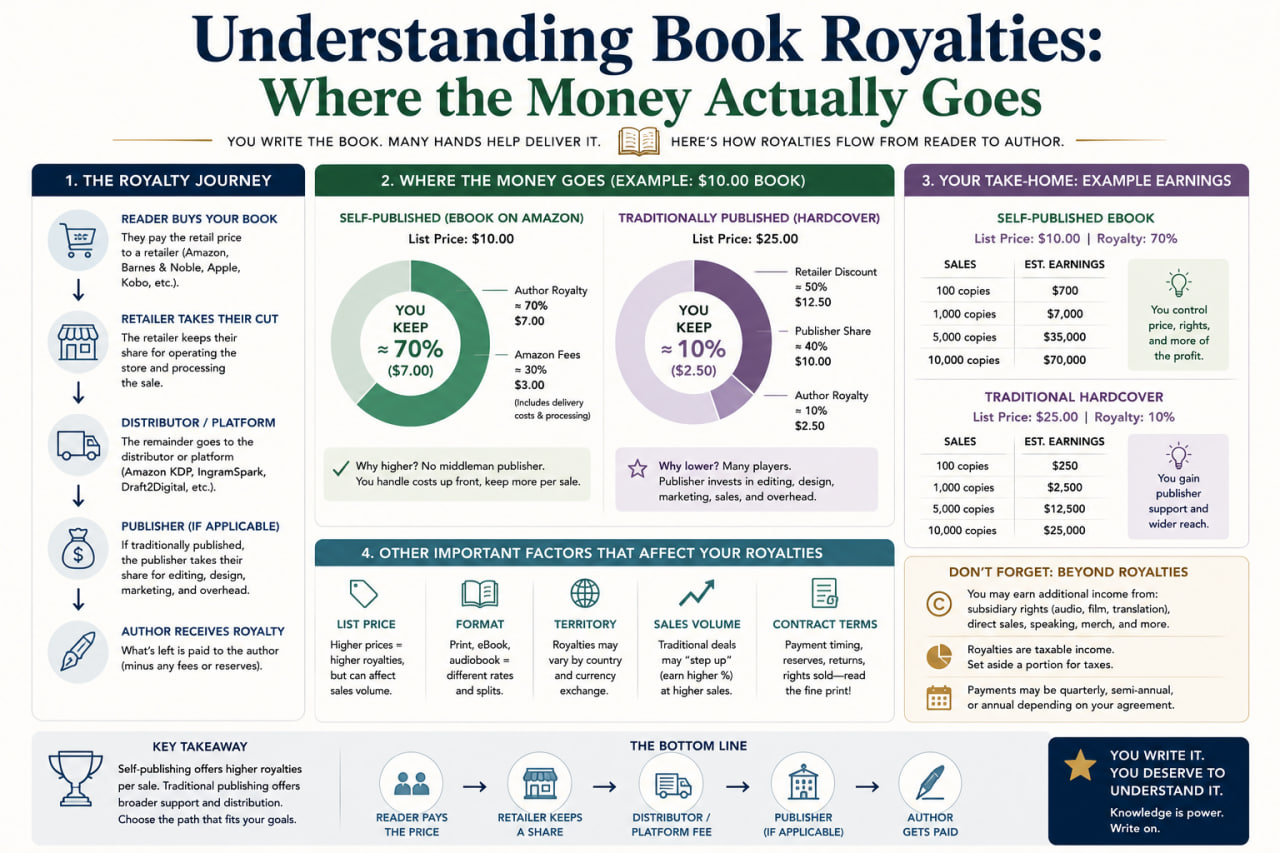
The retailer takes a large share — selling the book is its own substantial business.
The publisher covers editing, design, printing, distribution, overhead, and profit from its portion.
The agent takes a percentage of the author’s earnings for representing and selling the work.
The author receives the royalty — a defined slice of what remains.
The advance, and “earning out”
Many traditional deals include an advance — money paid to the author up front, before any copies sell. The vital thing to understand is that an advance is not a bonus on top of royalties; it’s an advance against them, a prepayment of money the author is expected to earn from future sales. The author doesn’t receive any further royalty payments until the book has sold enough copies for the accumulated royalties to equal the advance already paid — the point known as “earning out.” Only after a book earns out does the author start receiving additional royalty checks beyond the advance.
This has consequences that surprise new authors. A book can be a perfectly respectable success and still never earn out, meaning the author’s total income from it is simply the advance and nothing more — which, depending on the advance’s size, may be modest or substantial. Importantly, the author generally doesn’t have to repay an advance if the book underperforms; the publisher absorbs that risk, which is one real value of the advance. There’s also a wrinkle called a reserve against returns: because unsold books can be returned by retailers, publishers may hold back part of the royalties owed for a time as a hedge, further delaying when money reaches the author. The upshot is that the timing and certainty of author income are far messier than the simple idea of “a percentage per book” suggests.
Self-publishing royalties: higher share, your costs
Self-publishing inverts the royalty picture in the way you’d expect from cutting out the publisher and agent: the author keeps a much larger percentage of each sale. Without a publisher taking the lion’s share, a self-published author’s cut of a given sale can be dramatically higher than a traditional royalty — which is the central financial argument for going it alone. On the surface, keeping the great majority of each sale rather than a small fraction looks like an obvious win, and for books that sell well it genuinely can be.
But the higher percentage is not free money, and the comparison is more even-handed than it first appears. The self-published author bears all the costs the publisher would otherwise have covered — editing, cover design, formatting, and marketing come out of the author’s own pocket up front. The retail platform still takes its cut, and for print books, printing costs are deducted from each sale, sometimes substantially. Platforms also frequently pay different, lower rates outside certain price ranges or conditions, so the headline “keep most of it” figure applies only within specific limits. The larger share is real, but so are the costs and deductions it has to cover, and a clear-eyed author weighs the whole picture rather than the percentage alone.
Subsidiary rights: where real money can hide
Beyond the royalties on the main edition lies a category that can matter more than the book itself: subsidiary rights. These are the rights to exploit the work in other formats and markets — translation and foreign editions, audiobook rights, film and television adaptation, and more. For some books, the income from these secondary rights dwarfs what the original edition earns, and a single foreign-language deal, audio license, or screen option can outweigh years of royalties on the home-market print edition. This is part of why the handling of subsidiary rights is one of the most consequential and negotiated elements of any publishing contract.
Who controls and profits from these rights — whether they’re licensed to the publisher or retained by the author, and how the proceeds are split — varies by deal and can significantly shape an author’s total earnings. It’s an area where the structure of a contract, often invisible to outsiders focused on the headline royalty rate, quietly determines where substantial money flows. Authors and agents negotiate these terms carefully for good reason, and a writer evaluating a deal should understand that the royalty on copies sold is only one part of the financial picture — sometimes a smaller part than the rights to everything the book might become.
Why most books earn little — and what to do with that
Set against all this, an uncomfortable truth deserves stating plainly: most books, traditionally and self-published alike, earn their authors fairly little. The combination of a small per-copy share, modest sales for the typical title, the costs and cuts taken along the way, and the sheer volume of books competing for attention means that writing is, for the overwhelming majority, not a path to significant income. This isn’t cynicism; it’s the realistic base rate, and knowing it protects you from the disappointment and bad decisions that unrealistic expectations produce. The authors who earn substantial money exist, but they are a small minority, and treating their outcomes as the expected case leads writers astray. The visible success stories are visible precisely because they are exceptional; the far larger number of capable books earning quiet, modest sums simply never make headlines, which quietly distorts everyone’s sense of the real odds.
None of which means the money doesn’t matter or that you shouldn’t try to earn well — you should understand royalty structures, negotiate carefully, weigh your publishing path with the finances in view, and treat your work as worth being paid for. But it does mean going in with clear eyes: understand exactly how you’ll be paid and how little the typical book returns, so your choices rest on reality rather than on the fantasy of easy riches that lures so many writers into bad deals and bitter surprises. Know where the money actually goes, expect modest returns, be delighted if you beat them, and make your decisions — about advances, rights, and which path to take — as the informed professional that understanding this chain allows you to be.
Common questions
Why is the author’s share of the cover price so small?
Because many parties are required to turn a manuscript into a book on sale worldwide — the retailer takes a large cut, the publisher covers production and overhead, the agent takes a percentage. The author created the content, but a lot of paid labor sits between that content and a purchasable product.
What does it mean for a book to “earn out”?
An advance is a prepayment against future royalties. A book earns out once its accumulated royalties equal the advance already paid; only then does the author receive further royalty payments. A solid book can sell well and still never earn out, leaving the advance as the total income.
Does self-publishing really pay more per book?
Per copy, usually yes — you keep a far larger share. But you also pay for editing, cover, and marketing yourself, the platform takes a cut, and print costs are deducted. The higher percentage is real, but it has to cover costs a publisher would otherwise absorb, so weigh the whole picture.
This is general educational information, not financial or legal advice. Royalty rates, advances, and contract terms vary widely by format, publisher, country, and deal, and change over time — review any contract closely and consider professional advice. For author resources, see the Authors Guild and Poets & Writers.