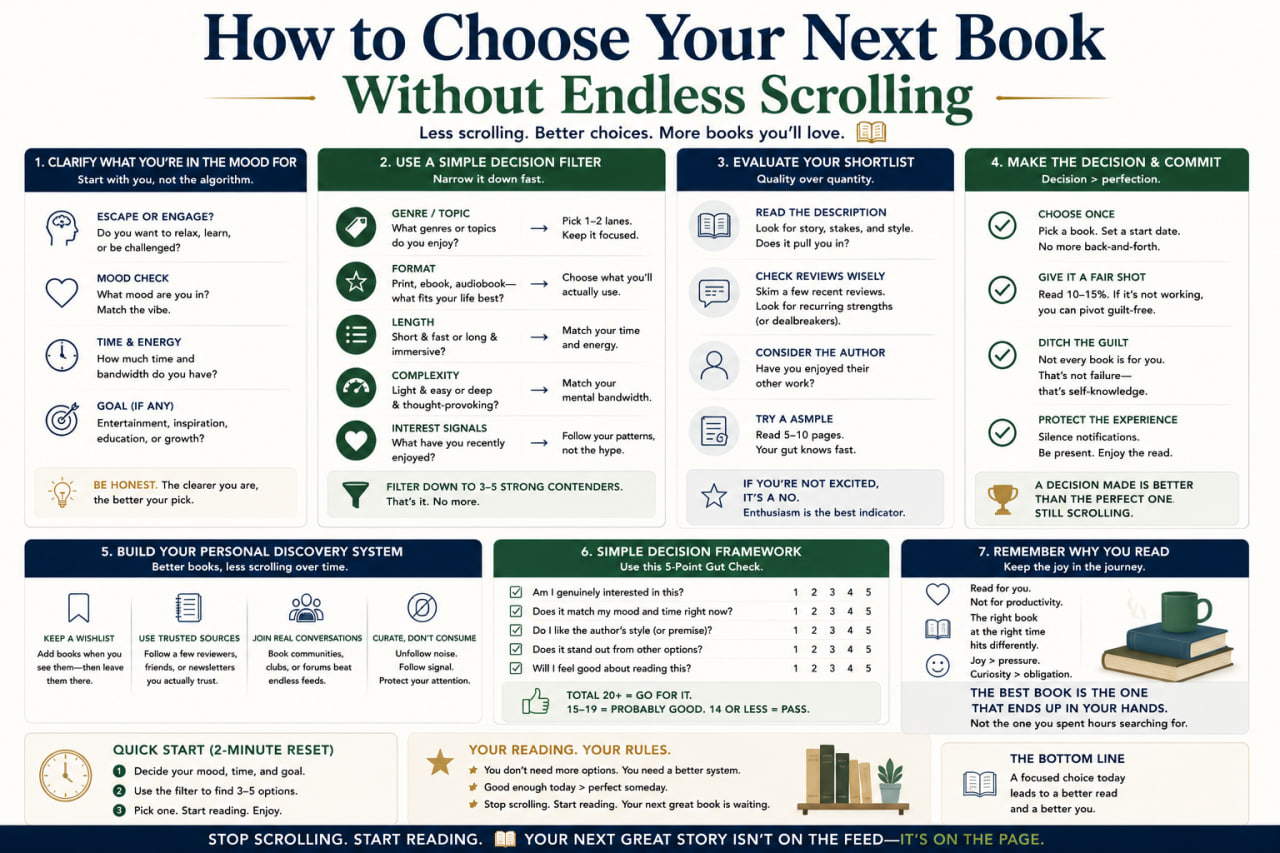
The Reading Life
With millions of books a tap away, the hardest part of reading is often just deciding what to read — and the deciding can quietly eat the reading.
Here is a small, modern absurdity that many readers know well. You finish a book, feel that pleasant sense of accomplishment, and go to pick your next one — and then you don’t read at all, because you spend the evening scrolling through lists, reviews, and recommendations, unable to choose. The very abundance that should be a reader’s paradise — millions of books instantly available, endless reviews, infinite suggestions — becomes a paralysis. The time you meant to spend reading gets spent shopping for something to read, and the gap between finishing one book and starting the next stretches into days, then weeks, and a reading habit quietly stalls not from lack of books but from too many.
This is a genuine problem with a genuine cause, and it’s worth taking seriously rather than dismissing as indecision. The modern reader faces a choice environment specifically engineered to keep them browsing — endless options, social proof, algorithmic suggestions, the constant implication that the perfect book is just a few more taps away. Choosing well in that environment is a skill, and like most skills it comes down to a few principles: building systems that make the choice easy, knowing when good enough beats perfect, and recognizing that the search itself has a cost. Master those, and the gap between books closes — which, for a reading habit, matters enormously.
Why choosing got so hard
For most of history, choosing a book was constrained in helpful ways: you read what was on your shelf, what the local library or bookshop carried, what a friend pressed into your hands. The options were limited, and limited options are easy to choose among. Today the constraint is gone entirely — virtually every book ever written is available within minutes, which sounds wonderful and partly is, but removes the natural boundaries that used to make the decision simple. When everything is possible, nothing is obviously next, and the mind, faced with unlimited choice, tends to freeze rather than feel free.
Layered on top of infinite supply is infinite information about each option: reviews, ratings, recommendations, hot takes, and algorithmic suggestions, all promising to help you choose and mostly making it harder. Every book now comes with a chorus of opinions that can talk you out of anything and into endless comparison. And the platforms have every incentive to keep you browsing rather than reading, because browsing is engagement. The result is a perfect storm of choice overload, and recognizing it as a structural problem — not a personal failing — is the first step to escaping it. You’re not bad at choosing; you’re choosing in an environment built to prevent it.
The hidden cost of the search
The most important thing to understand is that searching for the perfect next book is not free — it has real costs that the search disguises as diligence. The most obvious is time: hours spent browsing are hours not spent reading, and for many people the search consumes more time than a chapter would have. But the subtler cost is to the reading habit itself. The gap between finishing one book and starting the next is exactly where reading habits go to die; momentum fades, the daily reading slot gets filled with something else, and a week of not reading becomes the new normal. A long, indecisive search doesn’t just waste an evening — it can quietly end a streak.
There’s also decision fatigue: the more options you weigh and the longer you deliberate, the more drained and dissatisfied you become, until choosing anything feels exhausting and even your eventual pick is shadowed by the sense that something better was out there. The cruel irony is that all this effort rarely produces a better choice; studies of decision-making consistently find that more deliberation among abundant options leads to more regret, not more satisfaction. The search promises a better book and delivers a worse reading life. Internalizing that the search is costly — and that a quick “good enough” choice usually serves you better than an exhaustive hunt — reframes the whole problem.
Keep a living to-read list
The most effective single fix is to separate the moment of discovering books from the moment of choosing one to read, by maintaining a running list of books you want to read. Recommendations arrive constantly — a friend mentions a title, a writer you admire names an influence, an article praises a book, you stumble on something intriguing. The mistake is to let these float past and then, in the moment of needing a book, start the search from scratch. Instead, capture every appealing book the instant you encounter it, into one list you trust, so that the discovery happens continuously and effortlessly in the background.
Then, when you finish a book and need the next, you don’t search at all — you go to your list and pick from a curated set of books you already wanted to read, chosen by you in unpressured moments rather than scrabbled for under the pressure of an empty slot. This collapses the agonizing open-ended search into a quick choice among a handful of pre-vetted options, which is a fundamentally easier and faster decision. A simple notes app, a list in a tool like Goodreads, or a notebook all work; what matters is that it’s one reliable place you actually feed and consult. A well-stocked to-read list is the difference between “what on earth should I read?” and “which of these three that I already want shall it be?”
Where good recommendations come from
People whose taste you know — friends and readers whose past picks you’ve loved.
Authors you admire — the books and writers they cite as influences.
Booksellers and librarians — humans who read widely and ask what you like.
Curated sources — trusted critics and outlets, not algorithmic feeds.
The book in your hand — what an author you just enjoyed wrote next, or what’s shelved beside them.
Choose for your mood, not for “best”
A major source of choice paralysis is the hunt for the objectively best book — the most acclaimed, the most important, the one you most “should” read. But there is no single best next book; there’s only the best book for you, right now, in your current mood and circumstances, and that’s a far easier and more useful question to answer. The most garlanded literary novel is the wrong choice for a week when you’re exhausted and need something that pulls you along; a fun, fast read is exactly right then, and choosing it isn’t lowering your standards, it’s matching the book to the moment. Reading is not a duty to consume the canon in order of prestige.
So when choosing, ask what you’re in the mood for rather than what’s best in the abstract: something light or demanding, familiar or challenging, fast or slow, escapist or substantial. Matching the book to your actual appetite makes the choice quick and makes the reading more likely to happen and to be enjoyed — which is what keeps the habit alive. The “best” book read grudgingly does less for you than a “good enough” book read with pleasure. Trust your own appetite over the prestige rankings, and both the choosing and the reading get easier.
Trust curators over algorithms
Where recommendations are concerned, a human curator whose taste you understand beats an algorithm almost every time. Algorithms optimize for engagement and popularity, nudging you toward whatever is broadly trending and keeping you scrolling, while a friend, a bookseller, or a critic whose sensibility you’ve come to know can point you to the specific book that suits you. The richest source of all is people whose past recommendations you’ve loved — their next suggestion carries real signal, because their taste has already proven compatible with yours. Cultivate a few such people and lean on them; one trusted human recommendation is worth a hundred algorithmic ones.
Librarians and independent booksellers are an underused treasure here, professionals who read widely and will happily steer you toward something good if you tell them what you’ve enjoyed — a far better and faster experience than drowning in online lists. Trusted critics and curated outlets like Poets & Writers or The Paris Review serve the same function at a distance, filtering the overwhelming flood down to things worth your attention. The common thread is human judgment you can trust, which cuts through the noise that pure abundance creates. The goal isn’t to consult more sources; it’s to consult a few good ones and ignore the rest, because more inputs mean more paralysis, not better choices.
One source is so close at hand that readers routinely overlook it: the books they already own and haven’t read. Most committed readers have a small backlog of unread books they were once excited enough to acquire — and that shelf is a curated to-read list assembled by the person who knows your taste best, namely you, at moments when you genuinely wanted each book. Before scrolling anywhere, look at what’s already in your house or on your e-reader. The next great read is very often a book you bought months ago and forgot about, requiring no search, no shipping, and no decision beyond reaching for it. Shopping for new books while a pile of unread ones you chose yourself sits waiting is a peculiarly modern way to avoid reading.
Limit the inputs and just pick
Ultimately, beating the endless scroll comes down to deliberately limiting your inputs and accepting good enough. Set boundaries on the search: give yourself a few minutes to choose, not an open-ended evening; consult one or two trusted sources, not every list online; and when you’ve found a book that appeals, commit to it rather than continuing to look for something marginally better. The perfect-book search has no natural endpoint, so you have to impose one. A decisive “this one looks good, I’ll read it” serves your reading life far better than another hour of comparison.
And remember that no choice is final or high-stakes, which should drain the anxiety out of it entirely. If you start a book and it isn’t working, you can simply stop and pick another — you haven’t committed to anything irreversible, so the cost of a “wrong” choice is trivial. This is liberating: you don’t need to choose perfectly, because you can correct cheaply. So lower the stakes, trust your list and your gut, give the decision a couple of minutes, and pick. The reader who chooses quickly and starts reading is always better off than the one still searching for the flawless next book — because the first one is reading, and the second one isn’t. The whole point was the reading, not the choosing; don’t let the smaller activity devour the larger one.
Common questions
How do I stop spending so long choosing a book?
Build a running to-read list and pick from it instead of searching from scratch. Limit yourself to a few minutes and one or two trusted sources, and commit once something appeals. The open-ended search has no endpoint unless you impose one.
Should I trust algorithm recommendations or people?
People, mostly — especially those whose past picks you’ve loved. Algorithms optimize for engagement and popularity; a friend, bookseller, or trusted critic can match a book to your specific taste. One good human recommendation beats a hundred algorithmic ones.
What if I pick a book and don’t like it?
Then stop and pick another — the cost is trivial. No choice is final, which is exactly why you don’t need to choose perfectly. Knowing you can correct cheaply should take all the pressure off the decision and let you just start reading.
Build your to-read list and find curated recommendations through Goodreads, Open Library, and trusted outlets like Poets & Writers. Free public-domain titles to start immediately are at Project Gutenberg. General guidance on the reading life.