The Reading Life
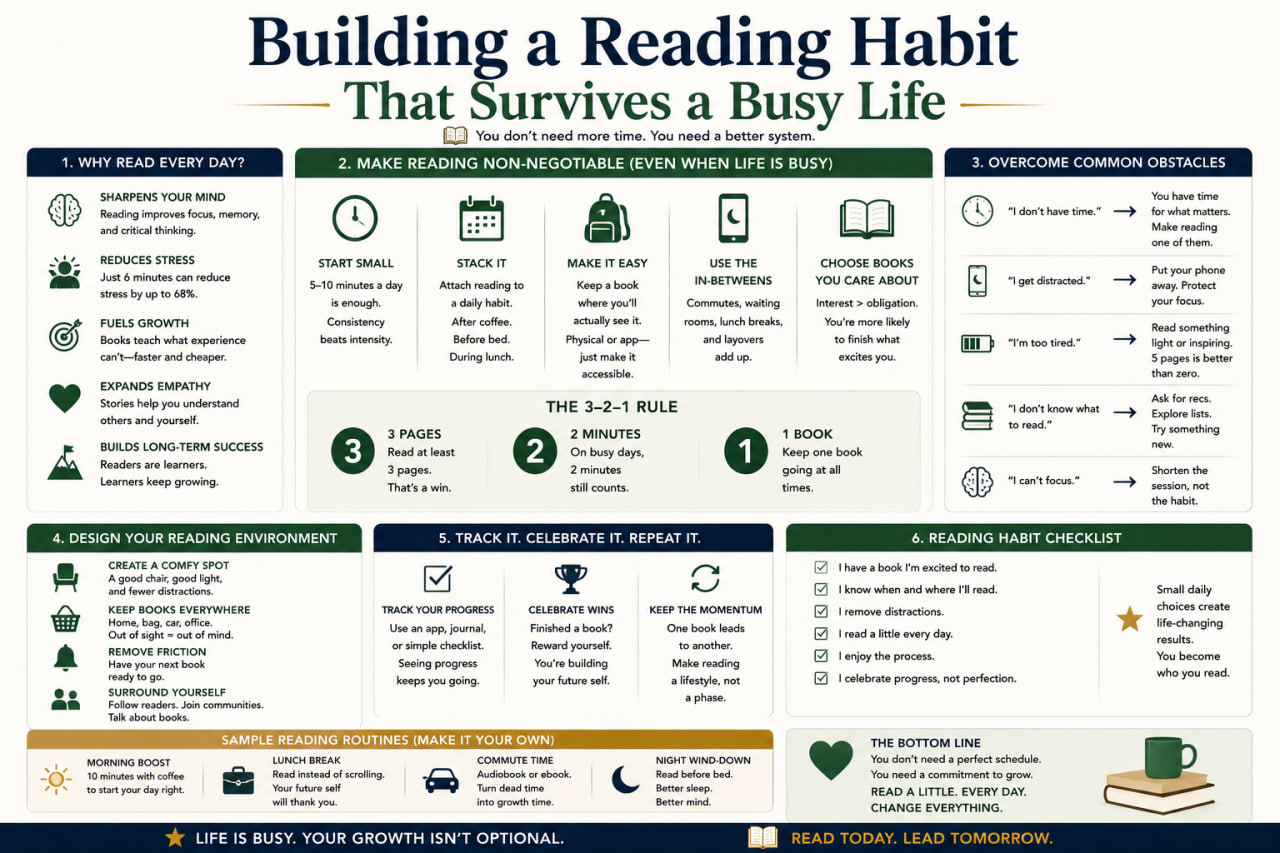
The reading habits that last aren’t built on willpower or free time. They’re built on triggers, tiny minimums, and a plan for the days everything falls apart.
Nearly everyone who wishes they read more has, at some point, resolved to do it — declared a goal, maybe joined a challenge, read enthusiastically for a week or two, and then watched the habit quietly evaporate the first time life got busy. The resolution wasn’t the problem; resolutions are easy. The problem is that most attempts to read more rely on the two least reliable resources a busy person has: willpower and free time. Both are in short supply exactly when life is demanding, which is precisely when the fragile new habit collapses. Building a reading habit that survives a busy life means building it on something sturdier than good intentions.
The encouraging truth is that durable habits are built on understood mechanics, not on character. The people who read consistently through hectic, overcommitted lives are rarely more disciplined than everyone else; they’ve simply arranged things so that reading happens almost automatically, requiring little decision or willpower, and so that it can absorb the inevitable disruptions without breaking. Those arrangements are entirely learnable. This isn’t about finding more time or summoning more grit — it’s about designing a habit that runs on triggers and systems robust enough to survive the weeks when grit and time both run out.
Why reading habits collapse
Reading habits fail in a few predictable ways, and naming them points straight to the fixes. The most common failure is having no trigger: “read more” is a vague wish floating free of any specific moment, so nothing actually prompts you to do it, and on a busy day it simply never crosses your mind. A second failure is depending on willpower — trying to force reading through effort, which works while motivation is high and fails the moment it dips, as it always eventually does. A habit that requires you to want it every day is a habit that will lapse the first day you don’t.
Then there’s the all-or-nothing trap: setting an ambitious target like an hour a day or a book a week, hitting it briefly, then missing it under pressure and concluding you’ve failed, which leads to abandoning the whole effort rather than scaling it down. And finally there’s disruption — the trip, the deadline, the crisis that breaks your routine — after which the habit, having no resilience built in, simply doesn’t resume. Each of these is fixable, and the fixes compound: a habit with a clear trigger, a tiny minimum, and a disruption plan can weather almost anything a busy life throws at it.
Anchor reading to something you already do
The single most powerful technique for a durable habit is to attach the new behavior to an existing one — to stack reading onto a routine that already happens automatically, so the old habit becomes the trigger for the new. You already make coffee every morning; read while it brews and while you drink it. You already commute, eat lunch, get into bed; each is an existing anchor you can hang reading onto. Instead of hoping you’ll remember to read at some unspecified point, you tie it to a specific, reliable cue that fires every day without you having to decide.
This works because it removes the hardest part of any habit: remembering and deciding to do it. When reading is anchored to your morning coffee, the coffee does the remembering; you don’t rely on motivation or a mental note, you rely on a routine that already runs on autopilot. Choose an anchor that’s stable in your life and that pairs naturally with reading — a quiet moment, a transition, a wait — and let it carry the habit. It’s worth being a little choosy here, because not every anchor is equal: pick a moment that’s genuinely reliable and not already crowded with other demands, or the new habit will lose the slot to whatever else competes for it. A frazzled, multitasking moment makes a poor anchor; a calm, predictable one makes an excellent home. And resist trying to anchor reading to several moments at once at the start — one solid anchor that fires every day beats three aspirational ones that each fire sometimes. A reading habit with a solid daily anchor is dramatically more durable than one floating free, because it’s no longer competing for a slot in a busy day; it’s riding on a slot that’s already guaranteed.
What a habit that survives looks like
A trigger, not a wish — reading anchored to something you already do daily.
A tiny minimum, small enough that no day is too busy for it.
An environment that makes the book easier to reach than the phone.
An identity — you read because you’re a reader, not because a goal demands it.
A disruption plan — a missed day is normal; the rule is simply never miss twice.
Make the minimum absurdly small
The most counterintuitive key to a busy-life reading habit is to set the daily minimum far lower than feels worthwhile — ten minutes, five, even a single page. The instinct is to aim high, but a small minimum is what makes a habit survive the hard days, and surviving the hard days is the whole game. On a calm day you’ll easily exceed the minimum; the minimum isn’t there for calm days. It’s there for the brutal ones, when a tiny, almost-effortless target is something you can still hit, keeping the chain unbroken when an ambitious target would have snapped it.
This matters because consistency, not volume, is what builds a lasting habit. A reader who manages five minutes every single day, including the worst ones, has a far sturdier habit than one who reads an hour on good days and nothing for the weeks in between. The unbroken chain has its own momentum and its own identity-reinforcing power, while the broken one keeps having to be restarted from scratch. And there’s a bonus: once you’ve started your tiny session, you almost always read longer, because starting was the hard part. The small minimum isn’t really a five-minute habit; it’s a doorway you walk through daily that usually opens onto much more.
Make it who you are, not what you do
There’s a subtle but powerful shift that makes habits stick: moving from doing reading as a task to being a reader as an identity. When reading is a task on a list, it competes with every other demand and loses on busy days. When being a reader is part of how you see yourself, reading becomes something you do naturally, the way you naturally do the other things your self-image entails — not because a goal requires it, but because it’s simply what you do. Identity-based habits are far more resilient than task-based ones, because they’re not negotiable in the same way; skipping them feels like acting out of character rather than merely falling behind.
You build this identity the way you build any: through small, repeated actions that accumulate into self-evidence. Every time you read, even briefly, you cast a vote for being a reader, and enough votes change how you see yourself. This is part of why the tiny daily minimum matters beyond its page count — each small session reinforces the identity, and the identity then sustains the sessions, in a self-feeding loop. Start calling yourself a reader and acting like one in small ways, and the habit stops feeling like something you have to maintain and starts feeling like an expression of who you already are. That’s the most durable foundation a habit can have.
Plan for the days it all falls apart
Every habit eventually meets a disruption — a trip, a deadline, an illness, a family crisis — and whether the habit survives depends almost entirely on whether you planned for this. Most people treat a missed day as a failure that proves they “can’t stick to it,” spiral into guilt, and abandon the whole effort. The durable approach is the opposite: accept in advance that days will be missed, treat a single miss as completely normal and not a failure at all, and follow one simple rule — never miss twice in a row. One missed day is life; two in a row is the beginning of a lapse, and getting back on the very next day is what keeps a stumble from becoming a collapse.
This single rule — never miss twice — gives a habit the resilience to survive almost anything, because it removes the catastrophic thinking that turns one bad day into a abandoned month. You don’t need a perfect streak; you need a habit that bends without breaking. It also helps to have a fallback minimum for chaotic days: when even ten minutes of reading feels impossible, a few minutes of an audiobook while doing something else keeps the chain alive. The goal during disruption isn’t to read well; it’s simply to not stop entirely, so that when life calms down the habit is still there, dented but intact, ready to resume rather than needing to be rebuilt from nothing.
Match the book and the format to your life
A busy-life reading habit lasts longer when you stop fighting your own circumstances and start working with them. Match the book to your available energy: keep something light and propulsive for tired evenings and fragmented attention, and save the demanding, slow books for the rare stretches when you’re fresh. Forcing a difficult literary novel through an exhausted, distracted week is a reliable way to stall out and conclude you have no time to read, when really you just brought the wrong book to the wrong moment. Having more than one book going — matched to different energy levels — keeps you reading something rather than nothing.
Audiobooks deserve special mention for busy lives, because they reach time that print never can. You can’t read a paperback while commuting, exercising, cooking, or cleaning, but you can listen to a book through all of them, turning dead time into reading time without adding a single minute to an overloaded schedule. For many busy people, audiobooks don’t replace print reading — they add an entire second stream of books layered onto activities that were already happening. Libraries lend them free through apps like Libby, so cost is no barrier. Used this way, the busy life that seemed to have no room for reading turns out to have been full of hidden room all along; you just needed a format that could fit into it.
Common questions
How small should my daily reading minimum be?
Smaller than feels worthwhile — ten minutes, five, even a page. The minimum exists for your hardest days, not your easiest. A tiny target you hit every day, including the brutal ones, builds a far sturdier habit than an ambitious one you abandon under pressure.
What do I do when life gets too busy to read?
Shrink, don’t stop. Drop to your tiny minimum or a few minutes of audiobook during another activity, and follow the rule: never miss twice in a row. The aim during a busy stretch is just to keep the chain alive so the habit is still there when things calm down.
Why do my reading habits always fizzle out?
Usually because they rely on willpower and free time, lack a daily trigger, set targets too high, and have no plan for disruption. Anchor reading to an existing routine, make the minimum tiny, and treat missed days as normal — and the habit gains the resilience it was missing.
Free books and library audiobooks make a daily habit cheap to sustain — browse Open Library and Project Gutenberg, and check your local library. General guidance on building lasting habits.