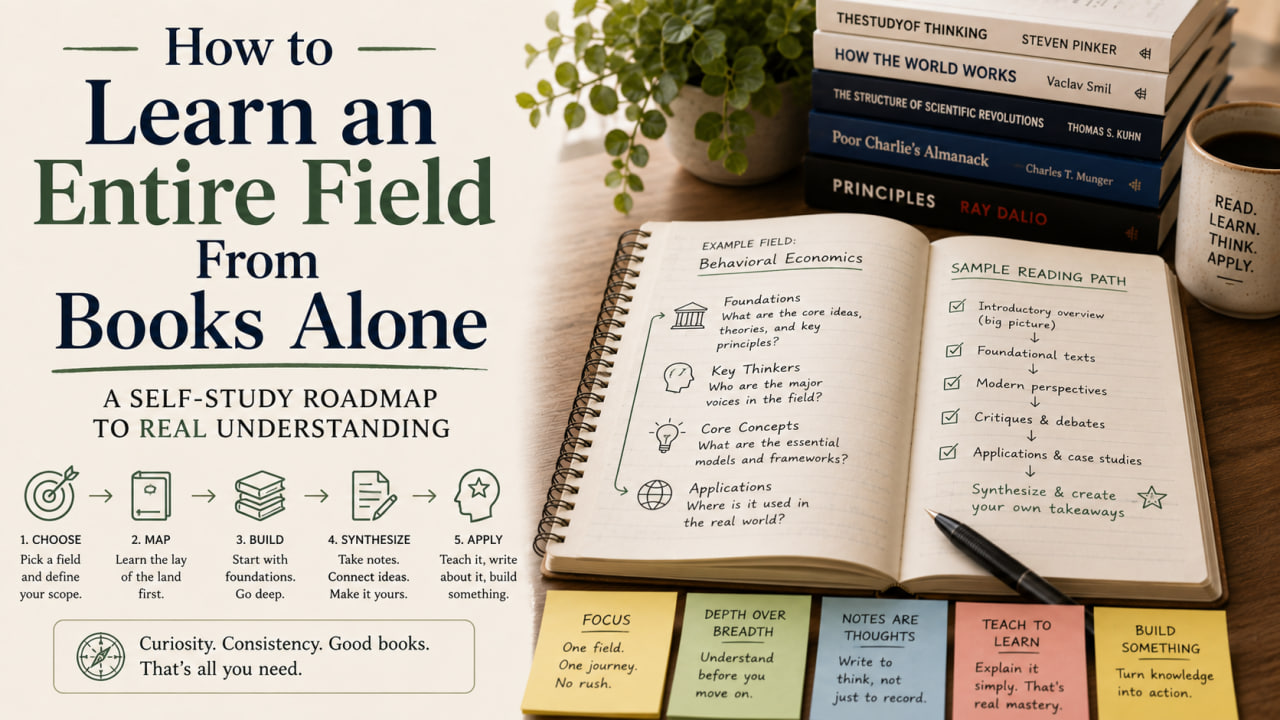
Self-Education Through Books
You can get remarkably far on self-study — if you read like a student instead of a fan, and know exactly what books can’t give you.
It is one of the quiet privileges of literacy that almost any field of human knowledge is, in principle, available to anyone willing to read. The accumulated understanding of economics, biology, history, philosophy, or computer science sits waiting in books, and a determined autodidact can absorb an astonishing amount of it without ever enrolling in anything. People have taught themselves entire disciplines this way and gone on to do serious work in them. But there’s a wide gap between what’s possible and what most self-learners actually achieve, and the gap is rarely about intelligence or even effort. It’s about method.
Most people who set out to learn a field from books read like enthusiasts rather than students. They pick up whatever looks interesting, read passively, follow no sequence, test themselves on nothing, and end up with a scattered collection of facts and a comfortable but fragile sense of knowing the subject. Learning a field properly from books is entirely achievable, but it demands a different and more disciplined approach — one that mimics, as closely as a solitary reader can, what a good formal education actually does.
What books can and can’t teach
Start with an honest accounting of the medium’s limits, because pretending books can do everything sets you up to fail. Books are superb at conveying the conceptual content of a field — the theories, the facts, the arguments, the history, the ways of thinking. For anything that lives primarily in ideas and understanding, books are not just adequate but often the best teacher available, more thorough and patient than any lecture. A great deal of most fields is exactly this kind of conceptual knowledge, and it’s fully learnable from the page.
What books struggle to teach is skill that lives in practice and feedback: the things you can only learn by doing them and being corrected. You cannot learn to perform surgery, play an instrument well, conduct laboratory work, or speak a language fluently from reading alone, because those require physical practice and, crucially, someone or something telling you when you’re doing it wrong. Be clear-eyed about which parts of your chosen field are conceptual and which are practical. The conceptual parts, books will carry you through. The practical parts will need doing, and no amount of reading substitutes for it — a limit worth knowing before you start, not after.
Map the field before you read into it
The single most common self-study mistake is diving into specific, advanced, or merely interesting-looking books before understanding the shape of the field as a whole. This produces knowledge with no skeleton — isolated facts and ideas that never connect because there’s no framework to connect them. Before reading deeply, spend time getting the lay of the land: the major subfields, the central questions, the key thinkers and schools, the basic vocabulary. A good broad overview read first makes everything afterward click into place.
This is also where you can borrow the structure of formal education without paying for it. Universities have already worked out, through long experience, what order to teach a field in and which texts to use. Published course materials — including open resources like MIT OpenCourseWare and structured lessons at Khan Academy — lay out these sequences openly. Finding the curriculum a real program uses, and following its reading order, hands you a field’s structure for free. You don’t have to design the map from scratch when experts have already drawn it.
Read in three tiers
A reliable approach is to read a field in tiers of increasing rigor, never skipping straight to the hard stuff. The first tier is popular and introductory works — accessible books written to convey a field’s ideas to a general audience. These give you the big picture, the motivation, and the vocabulary painlessly, and they’re the right place to start even for a subject you intend to learn deeply. They lower the barrier to everything that follows.
The second tier is the serious foundational texts — the textbooks and major works that practitioners themselves learn from. This is where real understanding is built, and it’s slower, harder reading that rewards the groundwork the first tier laid. The third tier, reached only when the second is solid, is primary and specialized material: the original sources, the technical papers, the advanced works at the field’s frontier. Climbing these tiers in order means each book is readable when you reach it, instead of crushing you before you’re ready. Most self-learners fail by attempting tier three with tier one preparation, then concluding they’re not smart enough. They simply skipped the staircase.
The three-tier ladder
Tier one — orientation. Accessible popular introductions for the big picture and vocabulary.
Tier two — foundation. The textbooks and major works practitioners actually learn from.
Tier three — frontier. Primary sources and specialized texts, attempted only once tier two is solid.
Test yourself, or fool yourself
Here is the discipline that separates real self-education from the comfortable illusion of it. Reading produces a powerful feeling of understanding that is frequently false — the words made sense as you read them, so you assume you’ve learned them. The only way to know is to test yourself, and self-learners who skip this step are nearly always overestimating what they actually know. Close the book and try to explain what you just read, in your own words, without looking. Where you can’t, you didn’t learn it; you only recognized it.
This technique — trying to recall and reconstruct material from memory rather than rereading it — is one of the most robust findings in the study of learning, and it works precisely because it’s uncomfortable. The struggle to retrieve something is what cements it. So build retrieval into your reading: after a chapter, summarize it from memory; periodically, try to lay out a whole topic on a blank page; explain concepts aloud as if teaching them. In quantitative fields, the equivalent is doing problems without the solution in view. The discomfort of being tested is the sensation of actually learning, as opposed to the pleasant numbness of passive reading that teaches almost nothing.
One more habit separates efficient self-learners from the rest: they don’t read every book cover to cover, and they don’t feel guilty about it. A textbook is a reference structured for thoroughness, not a novel meant to be read straight through, and treating it like one is a recipe for burning out in chapter three. Skilled readers of a field skim to find what matters, read closely where the difficulty or importance warrants it, and skip what they already know or don’t yet need. They use the index and table of contents as tools for hunting specific understanding rather than as a checklist to complete. This selective approach feels like cheating to the dutiful beginner, but it’s how practitioners actually use the literature of their field — as a resource to be mined for what they need, not a monument to be conquered page by page. Learning to read strategically, rather than completely, is itself one of the skills that self-education quietly teaches.
Read more than one book on the same thing
Beginners read one book on a topic and consider it learned. People who genuinely master a field by reading do something different: they read several books on the same subject, and the overlap is where deep understanding forms. No single author has the whole truth or the best explanation of everything. One book’s murky chapter is another’s clearest; one author’s blind spot is another’s specialty; where two sources agree you can trust the material, and where they disagree you’ve found exactly the contested questions worth understanding.
Reading multiple treatments of the same core material also frees you from absorbing one author’s biases as if they were the field itself. Every book has a perspective, and reading only one means adopting that perspective wholesale, often without realizing it. Triangulating across several gives you the field as it really is — contested, multi-voiced, and far more interesting than any single account. This is, in fact, roughly what graduate education does: it makes you read many sources on the same questions until you can hold the whole conversation in your head. You can do the same alone.
The autodidact’s blind spots
There is one disadvantage of learning alone that’s worth confronting directly, because the people most likely to teach themselves a field are also the least likely to notice it. A good teacher does something a book cannot: they see your misunderstandings from the outside and correct them. The solitary reader has no such mirror. You can absorb a subtle error early and build everything on top of it, never knowing, because nothing ever pushes back. You can also develop gaps you’re entirely unaware of — whole important areas you skipped without realizing they existed, because no syllabus forced you through them. What you don’t know, you by definition don’t know to look for.
This doesn’t doom self-study, but it does mean you have to manufacture, deliberately, the corrective feedback a teacher would otherwise supply. Several substitutes work well. Problem sets with worked solutions tell you immediately whether you actually understood. Practice exams written for the field measure you against an external standard rather than your own optimistic self-assessment. Reading the critics and the counterarguments — not just the books you agree with — surfaces errors a one-sided reading would hide. And engaging with others who know the field, whether in person or in serious online communities, exposes you to the questions and corrections you’d never generate alone. The autodidact who builds these checks in approaches the rigor of a formal education. The one who reads in a sealed room, never tested and never challenged, risks ending up confidently wrong in ways they’ll never discover.
Know when to stop reading
Finally, recognize that at some point more reading stops being the answer. For the conceptual core of a field, books can carry you a very long way — further than most people imagine. But every field eventually asks you to do something with the knowledge: to apply it, to make things, to engage with practitioners, to be tested against reality rather than against your own sense of how well you understood a chapter. The reading is preparation; at some stage the preparation has to meet the world.
This is not a failure of self-study but its natural completion. If your goal is understanding for its own sake, deep reading may be the whole of it, and that’s a worthy end. If your goal is to use the field — to work in it, build with it, or be credentialed in it — then reading is the foundation on which doing is built, not a substitute for it. The autodidact’s real skill is knowing which phase they’re in: still mapping and absorbing, or ready to close the book and put what they’ve learned to the test. Learn the field from books as far as books can take you — which is remarkably far — and then go find out, in practice, what you actually know.
Common questions
Can I really learn a field as well as a degree teaches it?
For the conceptual content, often yes — sometimes better, since you can go at your own pace and read more widely. What a degree adds is structure, feedback, credentials, and the practical components books can’t deliver. How much that gap matters depends entirely on your goal.
How do I know which books are the right ones?
Borrow from the experts: published university syllabi and open resources like MIT OpenCourseWare name the standard texts. Beyond those, read the books that serious works in the field repeatedly cite — the field tells you its own foundations through its references.
Isn’t reading several books on one topic redundant?
It feels redundant and isn’t. The overlap reinforces the core, the gaps fill each other in, and the disagreements reveal the real open questions. Single-source learning quietly inherits one author’s blind spots; multi-source learning is how mastery is actually built.
Free books for self-study are available at Project Gutenberg and Open Library; structured open courses and lessons can be found at MIT OpenCourseWare and Khan Academy. This article offers general educational guidance.