Self-Education Through Books
Before search engines and note apps, thinkers kept everything worth remembering in one book. The method still works — arguably better than what replaced it.
Here is a problem every reader knows intimately. You read something genuinely striking — a sentence that reframes how you see things, a fact you want to remember, an argument you’ll surely want to use — and you think, I’ll never forget that. A month later it’s gone, leaving only the faint, frustrating sense that you once knew something good. The reading happened, the insight registered, and then it quietly evaporated, as nearly everything we read does. For centuries, educated people had a deliberate cure for this, and it has almost nothing to do with memory and everything to do with a notebook.
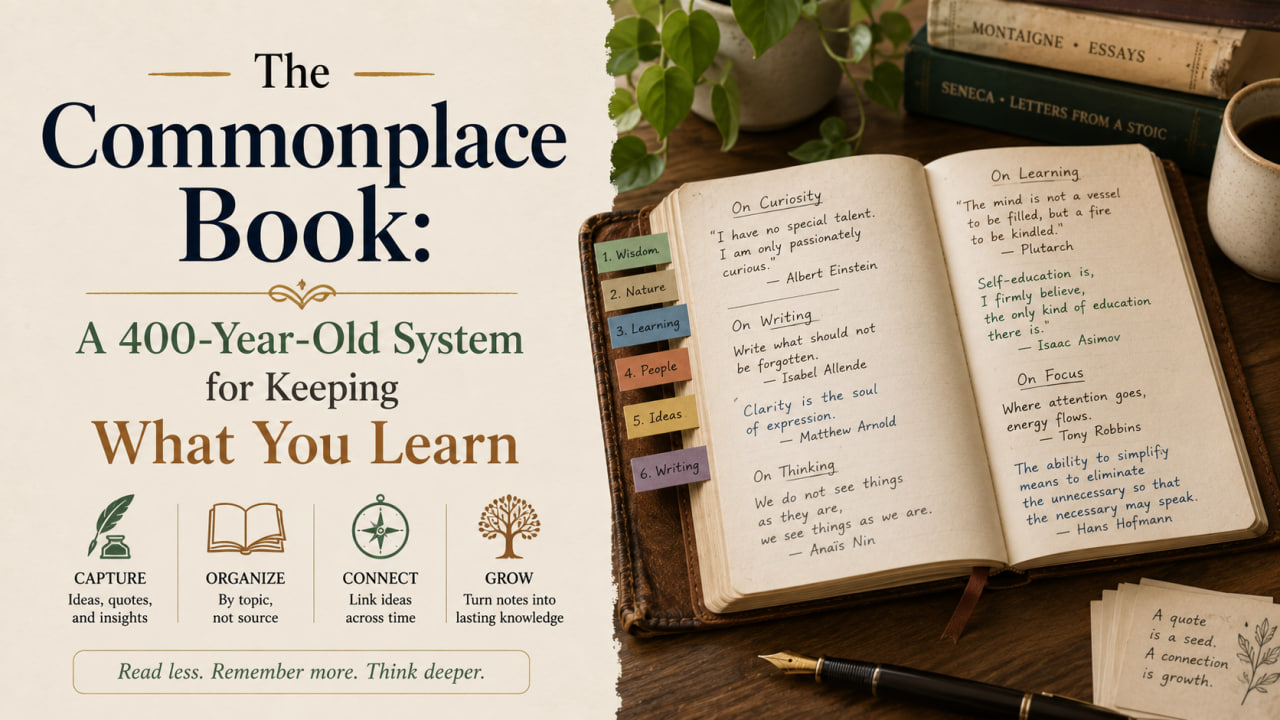
The cure was the commonplace book, and from the Renaissance through the nineteenth century it was a standard tool of anyone serious about learning. Writers, scientists, statesmen, and students kept one: a single book into which they copied the passages, ideas, quotations, and observations they wanted to keep, gathered from everything they read and thought. It was a personal anthology of the best of what passed through one’s mind — and in an age of infinite information and shrinking memory, the practice may be more useful now than it has ever been.
What a commonplace book actually is
Strip away the antique name and the idea is simple. A commonplace book is a place where you collect, in your own hand, the things worth keeping from what you read and think. Not a diary — it’s not about your day — and not a reading log that merely lists titles. It’s a curated store of content: the actual passage that struck you, copied out; the fact you want to retain; the line of reasoning you found persuasive; your own reflection sparked by something you read. Over time it becomes a distillation of your intellectual life, the signal extracted from years of reading’s noise.
The word itself comes from the idea of gathering ideas under common headings or “places” — topics under which related material accumulates. But you needn’t be rigid about that. At its core the practice is just this: when you encounter something you want to keep, you don’t trust your memory to hold it. You write it down, in one consistent place, in a form you can return to. That single discipline, maintained over years, compounds into something remarkably valuable.
Why copying by hand beats highlighting
The obvious objection is that we already have better tools — highlight on an e-reader, screenshot a passage, save a link. But these capture without engaging, and that’s precisely their weakness. A highlight takes a fraction of a second and leaves almost no trace in your mind; most people’s highlights are never looked at again, a graveyard of good intentions. The commonplace book demands something the highlight doesn’t: that you slow down and write the passage out yourself.
That friction is the whole point. The act of copying a passage by hand forces you to attend to every word, to process its meaning, to live with it for the half-minute it takes to transcribe — and that attention is what lodges it in memory far more firmly than any highlight could. You’re not just storing the idea externally; you’re working it into your own mind in the process of storing it. The labor that makes the method feel inefficient is exactly what makes it effective. Slow is the feature, not the bug.
There’s a second, less obvious payoff that anyone who writes will recognize quickly. A well-kept commonplace book is not only a store of memory; it’s raw material. When you sit down to write an essay, a talk, an argument, or even a thoughtful message, the book becomes a reservoir you can draw on — the apt quotation you remember encountering, the statistic you filed away, the half-formed idea you jotted that now fits perfectly. Ideas that were scattered across years of reading are suddenly gathered in one place, ready to be combined in ways their original authors never intended. This is how many writers and thinkers have actually used the practice: not as a passive archive but as a generative one, a private workshop where the best of what they’ve read collides and recombines into something new. The book gives back far more than you put in, precisely because the act of keeping it has already half-digested everything inside.
What goes in a commonplace book
Passages and quotations that struck you, copied with their source.
Facts and figures you want to retain.
Arguments or ideas you found persuasive, in your own words.
Your own reflections, sparked by what you read.
Definitions, vocabulary, and turns of phrase worth keeping.
Connections you notice between different books or ideas.
Keeping one on paper
The traditional commonplace book is a physical notebook, and many people who try both still prefer paper for exactly the reasons above: the slowness, the focus, the absence of distraction. A blank or lined notebook is all you need. As you read, keep it nearby; when something is worth keeping, copy it in, noting the source and page so you can find it again. Date your entries. Leave a little room to add a thought of your own beside the passage, because your reaction is often the most valuable part.
Don’t fuss over neatness or system at the start — the fatal mistake is making the practice so elaborate that you abandon it. A messy, consistently kept commonplace book is infinitely more useful than an immaculate one you gave up on. Begin by simply copying what strikes you, in order, and let any organization emerge later. The habit is the hard part; the tidiness can wait, and frankly never matters as much as you fear.
Keeping one digitally
If your reading is mostly on screens, a digital commonplace book is entirely legitimate and has real advantages, chiefly that it’s searchable. A simple document, a notes app, or dedicated software can all serve. The crucial thing is to preserve the active element: don’t just paste and clip. Type the passage out yourself, or at minimum add your own summary and reaction, so that the engagement that makes the method work isn’t lost to the convenience of copy-paste. A digital commonplace book full of unread clippings is just a highlight graveyard with extra steps.
The genuine payoff of the digital version arrives later, when you can instantly search years of accumulated thinking for a half-remembered passage or every note you ever made on a theme. That retrieval power is something paper can’t match, and for some people it more than compensates for the loss of the page. Whichever you choose, consistency in one place matters far more than the medium. Scattered notes across ten apps are not a commonplace book; they’re the chaos it was meant to solve.
Indexing: the part everyone skips
A commonplace book grows more valuable as it grows larger — but only if you can find things in it. A thick notebook of brilliant passages you can’t navigate is a frustration, not a resource, and this is where most attempts quietly fail. The philosopher John Locke was so troubled by this that he devised a famous indexing method for commonplace books, and while you needn’t adopt his exact scheme, the principle is essential: build some way to retrieve what you’ve stored.
On paper, the simplest approach is to reserve the first few pages for an index, listing themes or topics with the page numbers where they appear, updated as you go. Digitally, tags or a searchable structure do the same work with far less effort. Without retrieval, a commonplace book is a write-only memory — satisfying to fill, useless to consult. With it, the book becomes something you actively use: a personal reference of everything you’ve ever found worth keeping, organized by the only mind that matters here, which is yours.
What it does over years
The deepest value of a commonplace book reveals itself only with time. Keep one for a year and it’s a useful store of notes. Keep one for a decade and it becomes something else entirely — a record of your own intellectual development, a map of how your thinking changed, a distilled anthology of everything that ever moved or persuaded you. Reading back through old entries, you meet your former self and measure the distance travelled. You rediscover ideas you’d forgotten you ever had, and find connections between things read years apart.
It also changes how you read in the present. Once you keep a commonplace book, you read with a pen in your mind, alert for what’s worth keeping, engaged rather than passive. The practice quietly makes you a more active and attentive reader, because you’re always lightly evaluating: is this worth writing down? That single question, asked continuously, transforms reading from something that washes over you into something you genuinely retain. In an age that floods us with more to read than any generation in history and leaves us remembering less of it, that may be the most valuable habit a reader can keep.
How to start this week
The practice sounds venerable and demanding, but starting one is genuinely a five-minute decision, and the people who keep commonplace books for decades almost all began with something humble. Pick your medium — a cheap notebook or a single document, it truly doesn’t matter which — and set the bar deliberately low: one entry per reading session, even just one. A single copied passage with its source is a complete, successful day of commonplacing. The aim at the start is not to capture everything worth capturing; it’s to build the reflex of reaching for the book when something strikes you, and that reflex forms through repetition, not ambition.
Resist, above all, the urge to over-engineer it before you’ve begun. The internet is full of elaborate systems — color codes, tagging schemes, cross-referencing rituals — and they are the single most common reason people quit, because the system becomes a chore that crowds out the simple act of keeping. Begin with nothing but a running record of what you want to keep, in order, with sources. Add an index once the book is thick enough to need one; add structure only when the lack of it actually bites. The commonplace book is one of those rare tools where the crudest version, faithfully kept, vastly outperforms the most sophisticated version, abandoned. Start crude, start now, and let the method grow into whatever your own use reveals it should be. The version you keep for a month will look nothing like the one you keep for a decade, and that’s exactly as it should be — the system earns its complexity by being used, not by being designed. What matters on day one is simply that the notebook exists and that you’ve put one thing worth keeping inside it. Everything else is downstream of that first entry.
Common questions
How is this different from just taking notes?
Ordinary notes are usually tied to one book or one purpose and then forgotten. A commonplace book is a single, ongoing collection of everything worth keeping across all your reading and thinking, maintained over years and built to be revisited.
Paper or digital?
Paper maximizes the focus and retention that make the method work; digital maximizes searchability. Both are valid — choose by which you’ll actually keep up, and preserve the active step of writing in your own words either way.
Won’t copying passages take too long?
That slowness is the mechanism, not the obstacle. The minute spent transcribing a passage is what fixes it in memory. If speed is the goal, you’ll get a fast, forgettable highlight; the commonplace book trades speed for retention on purpose. If you want a fast, forgettable record, almost any tool will do; the whole reason to keep this one is that the slowness is doing the work.
Many classic works discussing reading and learning are free to read at Project Gutenberg. For more on the history of the practice, the collections of the Library of Congress are a rich starting point.