Writing Craft
Beginnings are exciting and endings write themselves. The middle is where novels go to die — and where most of them are abandoned.
There’s a reason so many half-finished novels live in drawers and hard drives, stalled at roughly the same place: the middle. Beginnings are easy and thrilling to write — the premise is fresh, the characters are new, the possibilities feel infinite. Endings, once you reach them, have their own momentum, pulling everything toward resolution. But the vast stretch in between, where the story has to actually develop and sustain itself, is where energy drains away, direction blurs, and writers lose faith. The “saggy middle” is the single most common reason manuscripts are abandoned, and learning to diagnose and fix it is one of the most practical skills a novelist can have.
The good news is that a saggy middle is a recognizable, well-understood problem with a known set of cures. It isn’t a sign that your story is broken or that you lack talent; it’s a structural issue that afflicts nearly everyone and responds to specific techniques. Understanding why middles sag is the first step, because each cause points to its own fix, and once you can name what’s actually going wrong, the repair is usually within reach.
Why middles sag
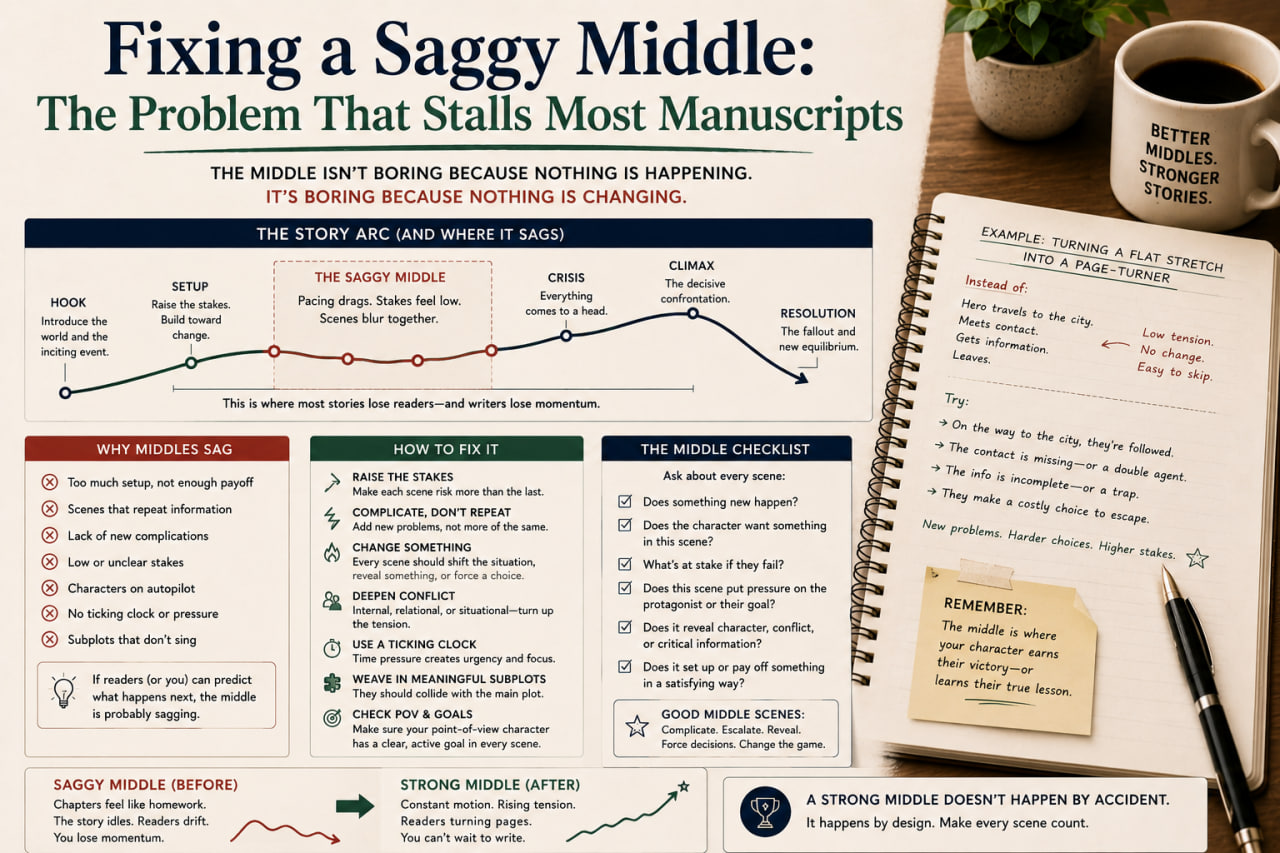
The fundamental problem is that the energy of the beginning naturally dissipates. The opening runs on novelty and the momentum of the inciting event — the thing that kicked the story into motion. But that initial push only carries so far, and somewhere past the first act it runs out. Meanwhile the climax, the next great source of momentum, is still distant. The middle is the long valley between two peaks, and without deliberate effort it flattens into a plain where nothing seems to be building toward anything.
Saggy middles also tend to go episodic. Without the strong forward pull of clear escalation, scenes start happening one after another without building on each other — this happens, then this, then this — a sequence of events rather than a rising structure. The reader (and the writer) loses the sense of mounting stakes and inevitable collision. A second, related cause is that the central tension goes slack: the conflict that drove the opening gets temporarily resolved or set aside, and nothing equally pressing replaces it, so the story coasts. Whatever the specific cause, the symptom is the same — a loss of momentum and direction right where the book most needs to be tightening its grip.
Symptoms of a saggy middle
You dread writing it, or readers report drifting there.
Scenes feel episodic — “and then, and then” — rather than building.
The central tension has gone slack with nothing urgent replacing it.
You’re adding scenes to fill space rather than because they’re needed.
The stakes feel the same as fifty pages ago — nothing has escalated.
Fix one: escalate the stakes
The most reliable cure is escalation. A middle sags when nothing is intensifying, so the fix is to make sure things get progressively worse, harder, or more dangerous as the story proceeds. Whatever the protagonist faces should grow more difficult; whatever they stand to lose should grow larger; the pressure should mount rather than plateau. If the stakes at the midpoint feel the same as the stakes at the end of the first act, that’s the sag, named — and raising them is the cure. The middle should be a tightening screw, not a level road.
Crucially, escalation isn’t just about external danger getting bigger; it’s about the pressure becoming more personal and more inescapable. The threat should close in, the protagonist’s options should narrow, the cost of failure should become more intimate. A story sags when the character could plausibly walk away; it grips when walking away becomes impossible. Ask of your middle: is it harder for my protagonist now than it was a hundred pages ago, and harder still than it’ll be a hundred pages from now? If not, you’ve found exactly what to fix.
Fix two: turn the screws with reversals
Steady escalation can still feel monotonous if it’s just a straight line of things-getting-worse. The antidote is reversal — the unexpected turn that upends the situation and forces the story in a new direction. Just when the protagonist seems to be gaining ground, something goes wrong; just when a problem seems solved, it creates a worse one; an ally betrays them, a plan backfires, a secret surfaces. These turns keep the middle unpredictable and prevent the reader from settling into the comfortable boredom of knowing roughly what’s coming.
Good reversals do more than surprise — they complicate. Each one should genuinely change the protagonist’s situation and raise new questions, not just delay the inevitable with empty shocks. The difference between a gripping middle and a saggy one is often simply that the gripping one keeps turning: the ground keeps shifting under the characters, so neither they nor the reader can relax. If your middle is a smooth descent, break it with reversals that make the reader gasp and reassess. A story that keeps surprising itself can’t sag.
Fix three: build to a strong midpoint
One of the most powerful structural tools is the midpoint turn — a major event planted at roughly the center of the story that changes everything and gives the middle its own peak. Many strong novels have a significant reversal, revelation, or shift right at the midpoint: the protagonist learns something that recasts the whole situation, a victory turns out to be a trap, the goal itself changes. This midpoint event splits the long middle into two halves, each with its own momentum, and prevents the entire stretch from being one undifferentiated slog.
If your middle sags, the question to ask is whether anything significant happens at its center. Often the answer is no — the writer cruised from the first-act break toward the climax with nothing major in between — and installing a strong midpoint turn fixes the structure at a stroke. It gives the first half of the middle something to build toward and the second half a new direction to run in. Think of the midpoint as a second engine bolted into the center of the book, firing exactly where the original momentum was about to die.
Fix four: make subplots feed the main story
Subplots can either rescue a middle or worsen its sag, depending on how they’re handled. Done badly, they’re filler — unrelated business the writer adds to pad the wordcount, which only dilutes the momentum further. Done well, they’re a powerful tool: secondary storylines that develop in the middle, intersect with the main plot, and add complication, texture, and pressure exactly where the central line might otherwise flag. The key is that a subplot must connect to and feed the main story, not run parallel to it untouched.
The best subplots raise the stakes of the central conflict or force the protagonist to make harder choices — a relationship that complicates the mission, a secondary threat that collides with the main one, a moral dilemma that mirrors and deepens the book’s central question. When subplots weave into the spine of the story this way, they enrich the middle instead of distracting from it. When they’re just side errands, cut them. The test is always the same: does this thread make the main story more pressured, or merely longer?
Fix five: maybe it’s just too long
Sometimes the middle doesn’t sag because something is missing — it sags because there’s simply too much of it. Writers, anxious about length or in love with their own scenes, pad the center with material that doesn’t earn its place, and the cure isn’t to add escalation but to cut ruthlessly. A tight, fast middle of necessary scenes beats a bloated one stuffed with filler, however well-written the filler is. Be honest about which scenes are actually doing structural work and which are just there because you wrote them.
Finally, remember that a saggy middle is often a symptom of slack character pressure, not just slack plot. If the protagonist isn’t being forced to change, decide, and reveal who they are under mounting strain, no amount of plot mechanics will fully fix the drag. The most gripping middles work because the external escalation forces internal transformation — the rising stakes press on the character until they have to become someone different to survive them. Tighten the plot, yes, but also ask what the middle is doing to your protagonist. A middle that changes the character can never truly sag, because the most compelling thing in any story is a person under pressure, becoming.
Preventing the sag before it starts
Repairing a saggy middle in revision is entirely doable, but it’s easier still to design against the sag before you write it — and the single most useful preventive tool is the try-fail cycle. Strong middles tend to be built from a sequence in which the protagonist attempts to solve their problem, fails or partly succeeds in a way that makes things worse, regroups, and tries again against steeper odds. Each cycle escalates: the attempts grow more desperate, the failures more costly, the stakes higher. Structured this way, a middle can’t go slack, because every unit is actively raising the pressure and pushing toward the climax rather than marking time.
It also helps, before drafting the middle, to know two things: what the protagonist wants badly enough to keep pursuing, and what stands implacably in the way. A clear, urgent goal meeting a genuine, escalating obstacle generates forward motion almost automatically, because every scene can ask whether this attempt brings the character closer or knocks them back. Middles sag most often when the writer themselves has lost sight of what the protagonist is driving at, so the scenes lose their sense of pursuit. Anchor the middle to a want and a wall, run it through escalating try-fail cycles, and you’ve built in the momentum that the sag is merely the absence of. Prevention, here, is mostly a matter of never letting the story forget what it’s chasing. Keep the protagonist’s goal visible to yourself on every page of the middle, and you’ll rarely write the kind of drifting, optional scene that sags. And if you ever sit down to a middle scene and can’t say what the character is trying to get or what’s stopping them, treat that blankness as the warning it is, and answer those two questions before you write another line.
Common questions
Should I fix the middle while drafting or wait for revision?
Usually keep drafting to the end first — a finished bad draft is fixable, an abandoned one isn’t. Note where it sags and address it in revision, when you can see the whole shape and know what the middle actually needs to support. Trying to perfect the middle mid-draft is one of the most common ways writers stall out entirely and never reach the end at all.
How do I know if my middle is too long or too empty?
Read it asking whether each scene escalates something or turns the situation. If scenes are present but nothing intensifies, it’s too empty — add escalation and reversals. If strong scenes are buried among filler, it’s too long — cut.
What’s the single most effective fix?
For most stalled middles, installing a strong midpoint turn — a major reversal or revelation at the center — does the most structural good, because it gives the whole stretch two engines instead of none. Pair it with steadily rising stakes and a protagonist who is being forced to change, and even a long middle will keep its grip from the first-act break clear through to the climax.
Study how published novels sustain their middles by reading widely; the classics at Project Gutenberg are free to analyze. For craft resources and community, see Poets & Writers. This article offers general educational guidance on fiction craft.