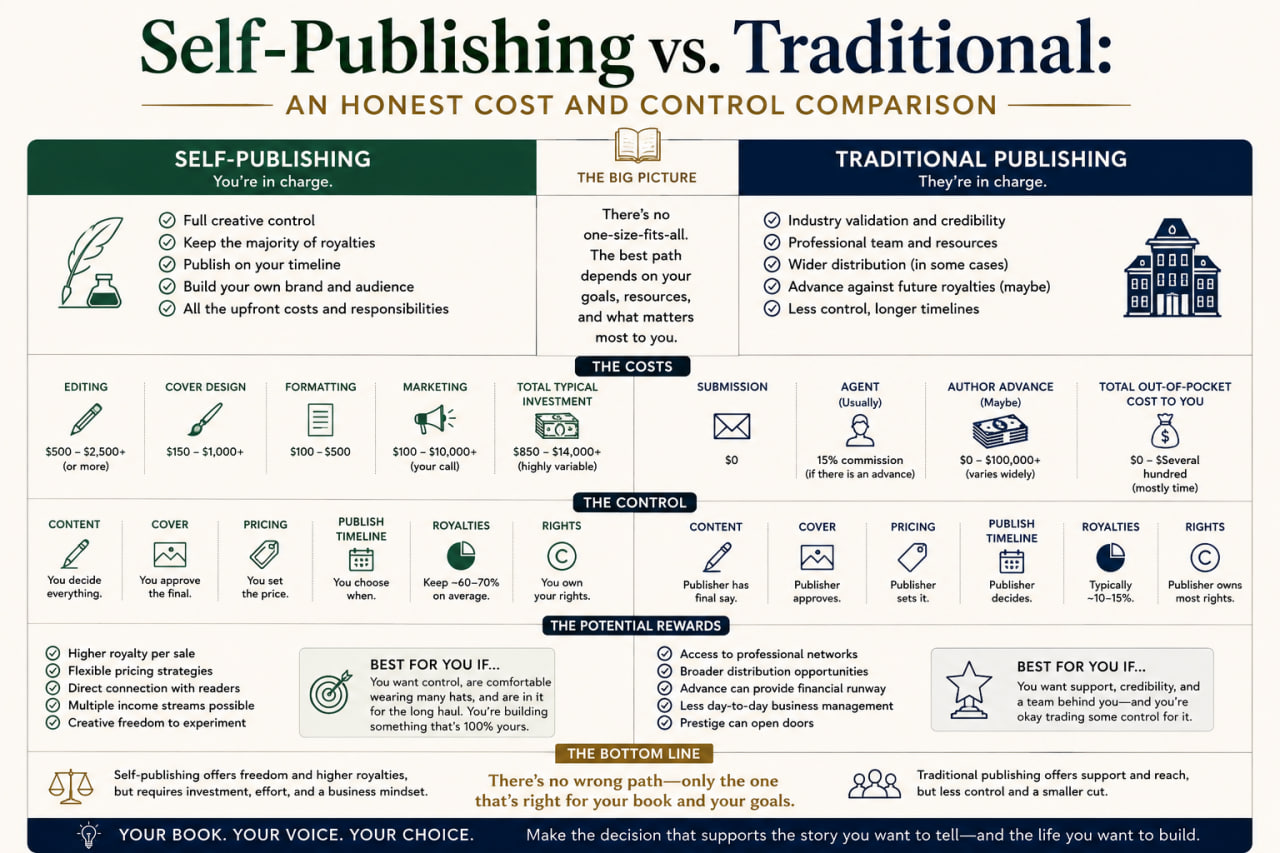
The Business of Publishing
Neither path is “better.” They’re two different businesses with different trade-offs — and the right one depends on what you actually want.
The question “should I self-publish or go traditional?” gets asked as if there were a single correct answer waiting to be discovered, and most of the advice you’ll find argues passionately for one side as though the other were obviously foolish. That framing is the first thing to discard. Self-publishing and traditional publishing are not a better option and a worse option; they are two fundamentally different ways of bringing a book into the world, each with real advantages and real costs, and the honest comparison is less about which is superior than about which set of trade-offs fits your particular book, your goals, and your temperament. Plenty of writers have thrived on each path, and plenty have been miserable on each.
To choose well, you have to understand what each path actually is beneath the marketing and the war stories. Traditional publishing means a publisher licenses the right to publish your book, takes on the financial risk and the production work, and pays you a share of the proceeds. Self-publishing means you become the publisher — you bear the costs, make every decision, keep a far larger share of each sale, and shoulder all the risk and labor yourself. Almost every difference between the two flows from that single structural fact, and once you see it clearly, the trade-offs stop being mysterious and start being a straightforward question of what you’re willing to give and what you need to get.
Two genuinely different businesses
In traditional publishing, you are essentially an author who licenses work to a company that does the publishing. A literary agent typically represents you, sells your manuscript to a publisher, and takes a percentage of what you earn. The publisher then handles editing, design, printing, distribution, and at least some marketing, investing their own money in your book in the expectation of profit. You give up control and a large share of the revenue in exchange for not having to fund or manage any of that machinery yourself, plus the credibility and reach the publisher brings. You are, in effect, a contractor whose product the company takes to market.
In self-publishing, you are the company. You hire (and pay) the editor, commission the cover, format the book, choose the retailers and platforms, set the price, and run the marketing — or you do these things yourself. You keep most of the money from each sale because there’s no publisher taking a cut, but you also absorb every cost and every task, and there is no one validating, funding, or pushing the book but you. This is genuinely running a small publishing business, with everything that implies about responsibility, learning curve, and effort. The freedom is total, and so is the burden.
The money works in opposite directions
The financial structures are nearly mirror images, and understanding this is the heart of the comparison. Traditional publishing usually offers an advance — money paid up front against future earnings — and then a relatively small royalty per copy sold, because the publisher’s costs and the agent’s cut come out of the revenue first. You get paid something before the book sells a single copy, but your share of each sale is modest. Self-publishing reverses this: there is no advance and no one pays you anything to start, but your share of each sale is far larger because you’ve cut out the middlemen who would otherwise take most of it.
This means the better financial deal depends entirely on how the book sells and what you value. A book that sells modestly might earn more, in total, self-published, because the much higher per-copy share outweighs the lack of an advance. A book that needs a publisher’s reach and investment to sell at all might earn nothing self-published and meaningfully through a traditional deal. And the advance has real value beyond its size: it’s money in hand regardless of sales, and it represents the publisher betting their own capital on your book. Neither structure is simply more lucrative; they pay out differently, under different conditions, and the specific numbers vary enormously from deal to deal and book to book.
What you trade, in short
Traditional: give up control and most per-copy revenue; gain an advance, professional production, distribution, and credibility.
Self: give up the advance, the gatekeeper’s validation, and wide bookstore reach; gain total control, speed, and a far larger share of each sale.
Both: require real marketing effort from the author — this is not a difference, despite the myths.
Control: shared versus total
For many writers the deciding factor isn’t money but control, and here the paths diverge sharply. Traditional publishing means giving up a great deal of it. The publisher may change your title, override your cover preferences, edit in directions you dislike, set the price, decide the release timing, and let the book go out of print when it suits them. You have input, sometimes significant input, but you are not the final decision-maker on your own book, and writers who care intensely about every aspect of how their work appears can find this genuinely painful. You’re collaborating with a company that has its own priorities, and those won’t always align with yours.
Self-publishing hands you complete control over everything — cover, title, content, price, timing, the lot — which is liberating if you have strong vision and a frustration if you’d rather not make a thousand decisions, many of them outside your expertise. Total control also means total responsibility: there’s no experienced editor to catch the structural flaw you can’t see, no seasoned designer to save you from a cover that quietly broadcasts “amateur,” no one to tell you the book isn’t ready. The freedom is real, but it comes attached to the burden of being the last line of quality control on your own work, which is a notoriously hard thing to be.
Speed, gatekeeping, and rejection
The two paths run on completely different clocks. Traditional publishing is slow — often very slow. Finding an agent can take months or years of querying and rejection; selling to a publisher takes more; and once sold, a book commonly takes a year or two to actually appear, ground through the deliberate machinery of a large organization. You must also pass through gatekeepers who reject the overwhelming majority of what they see, which means rejection is the default experience and acceptance is rare, regardless of a manuscript’s quality. This gatekeeping filters out a lot of weak work, but it also filters out plenty of good work that simply didn’t find the right champion at the right moment.
Self-publishing eliminates the gatekeepers entirely. No one can stop you from publishing, and you can go from finished manuscript to a book for sale in weeks rather than years. For writers tired of rejection, or working in a niche the big publishers ignore, or simply impatient, this openness is the whole appeal. But the absence of a gatekeeper cuts both ways: nothing prevents an unready book from reaching readers, the market is flooded with competition because the barrier to entry is so low, and the validation that comes from a publisher choosing your book — which some writers crave and some readers still look for — is unavailable by definition. Open doors let everyone in, including the work that wasn’t ready.
The costs nobody mentions
A persistent myth is that traditional publishing is free for the author while self-publishing is expensive. The truth is messier. Doing self-publishing properly does cost money — a good editor, a professional cover, and formatting are real expenses, and skimping on them is the surest way to produce a book that fails. But traditional publishing isn’t “free” either; you simply pay in revenue share rather than up front, handing the publisher a large cut of every sale for the life of the book. Over a long-selling title, that cumulative share can vastly exceed what professional production would have cost out of pocket.
The most important shared cost, though, is one writers consistently underestimate on both paths: marketing and the author’s own effort to find readers. The fantasy that a traditional publisher will handle all promotion is, for most authors, exactly that — a fantasy. Beyond their biggest titles, publishers expect authors to do substantial marketing themselves, and a midlist book given little promotional support can sink quietly. Self-published authors, of course, must do all of it. So while the paths differ in much, they converge here: in either case, the author who does no marketing should expect few readers. This is the reality that surprises the most people, and ignoring it dooms books on both sides of the divide.
Beware the expensive middle
Between the two legitimate paths lurks a zone you should approach with real caution: companies that charge writers large sums to publish their books while dressing themselves up as something more prestigious than self-publishing. Vanity presses and predatory “hybrid” operators take an author’s money up front, promise editing, marketing, and distribution, and frequently deliver little of value while keeping rights and revenue. The simplest protective rule in publishing is the old one: with rare and clearly-disclosed exceptions, money should flow toward the author, not away. A legitimate publisher pays you; it does not charge you thousands to be published.
This doesn’t mean every paid service is a scam — hiring your own freelance editor or cover designer for self-publishing is completely normal and legitimate, because you’re buying a specific service at a fair price and keeping all your rights. The danger is the company that blurs the line, charging publisher-sized fees while offering self-publishing-grade results and claiming the credibility of a traditional house. Before signing anything that asks for your money, research the company thoroughly and consult watchdog resources like SFWA’s Writer Beware, which exists specifically to warn writers about publishing scams. The excitement of seeing your book in print makes writers vulnerable, and that vulnerability is exactly what predatory operators rely on.
So which path fits you?
Strip away the partisanship and the choice comes down to honest self-knowledge. Lean traditional if you want the validation, distribution, and credibility a publisher provides, you’d rather not run a business or fund production yourself, you write in a category that still sells strongly through bookstores, and you have the patience to endure a slow process and heavy rejection for the chance at a publisher’s backing. Lean self-publishing if you value control and speed, you’re willing to invest in or do the production work, you want a larger share of each sale, and you’re prepared to act as the publisher — marketing included — rather than waiting for permission.
It’s also worth remembering that the choice isn’t permanent or exclusive. Many writers do both, choosing the path that suits each particular project, and the experience of one informs the other. The worst outcome is choosing based on a fantasy — picking traditional because you imagine a publisher will do all the work and make you famous, or picking self-publishing because you imagine effortless riches without the gatekeepers. Both fantasies lead to disappointment. Choose based on the real trade-offs, with clear eyes about the work and the odds on either side, and you’ll be far happier with whichever path you walk. There is no right answer in the abstract — only the right answer for you, this book, and what you actually want from publishing it.
Common questions
Is self-publishing seen as less legitimate?
The stigma has faded substantially, and many successful, respected books are self-published. That said, some readers, reviewers, and institutions still treat a traditional imprint as a mark of vetting. How much that matters depends entirely on your audience and goals.
Will a traditional publisher market my book for me?
For most titles, only partly. Big promotional pushes go to a publisher’s lead books; midlist authors are typically expected to do significant marketing themselves. Assume you’ll be doing real promotional work on either path, and you won’t be blindsided.
How do I avoid getting scammed?
Follow the money: legitimate publishers pay you, they don’t charge you to publish. Be wary of any company asking for large up-front fees while claiming publisher prestige, and check watchdog resources like SFWA’s Writer Beware before signing anything.
This is general educational information, not financial or legal advice; specific costs, royalty rates, and contract terms vary widely and change over time — review any contract carefully and consider professional advice. For author resources, see the Authors Guild and Poets & Writers; for scam warnings, SFWA’s Writer Beware.