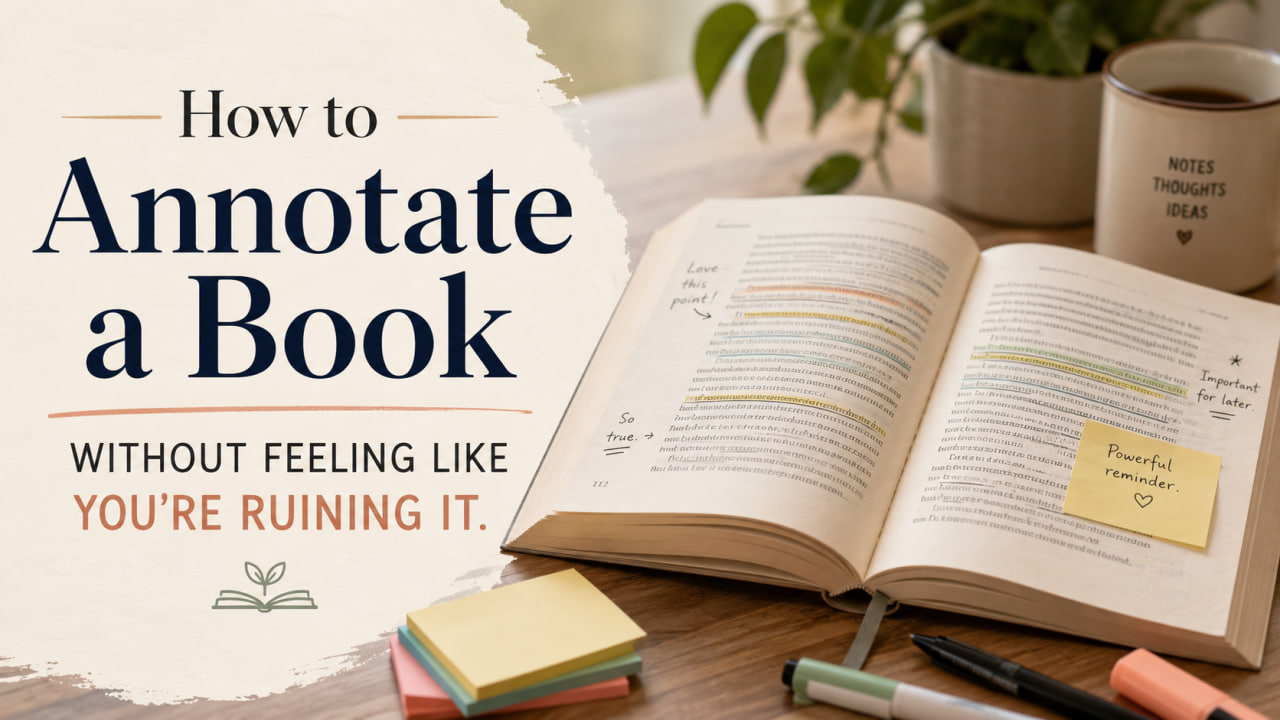
The Craft of Reading
Writing in your books isn’t vandalism. It’s a conversation — and it makes you a sharper reader.
A lot of people would no sooner write in a book than scratch their initials into a painting. The book arrives clean and unmarked, and there’s a quiet instinct to keep it that way — pristine pages, an unbroken spine, no evidence that a human ever touched it. The first pencil mark feels like a small violation. If that’s you, this is partly an attempt to talk you out of it, because the unmarked book is often a barely-read one, and a well-annotated book is one that’s been genuinely thought through.
There’s a long and respectable tradition behind this. Some of history’s most famous readers left their books crowded with notes, arguments, objections, and exclamations. The margins were where reading became thinking — where a reader stopped passively receiving the text and started talking back to it. Annotation isn’t damage; it’s participation. The question is only how to do it in a way that helps you rather than clutters the page, and how to get over the feeling that you’re spoiling something.
Why mark up a book at all?
The deepest reason is that annotation changes how you read. When you read knowing you’ll mark the important passages, react to the surprising ones, and note where you disagree, you read more alertly. You’re no longer letting the words slide past; you’re constantly asking what matters, what’s strange, what you think about it. That active stance is the difference between reading a book and merely passing your eyes over it, and the marks are both the cause and the record of it.
Annotation also dramatically improves what you keep. We forget most of what we read, and quickly. A book you finished a year ago can feel almost entirely gone — a vague impression and a few stray images. But an annotated book can be reopened and re-grasped in minutes: your underlines lead you straight to what struck you, your margin notes remind you what you thought, and the whole experience comes flooding back. Your annotations turn a finished book from a closed door into a resource you can return to for the rest of your life. That alone is worth a few pencil marks.
The reframe that helps most: you’re not defacing the book. You’re recording your half of a conversation with it — one your future self will be grateful to overhear.
Start with the gentlest possible methods
If the idea of permanent marks gives you anxiety, begin with annotation that leaves no scars. A pencil is the obvious first step: light underlines and small marginal ticks that can be erased if you ever truly want them gone. Most people who start in pencil discover within a few books that they never actually erase anything, and the fear quietly dissolves. The pencil was just training wheels for the permission to mark at all.
For the genuinely commitment-averse, there are non-destructive alternatives that still capture your engagement. Sticky tabs flag important pages without touching the text. Small sticky notes hold a thought in the margin and peel away cleanly. A separate notebook — more on that shortly — lets you annotate heavily while keeping the book itself untouched. None of these is as fast or as integrated as writing directly on the page, but any of them is far better than reading passively and marking nothing. Start wherever your hesitation allows, and let the habit deepen as your fear fades.
A simple system that doesn’t turn into a mess
The most common annotation failure isn’t marking too little — it’s marking too much. The enthusiastic beginner underlines half of every page, and within a chapter the underlining means nothing, because if everything is emphasized then nothing is. The whole value of a mark is that it stands out from the unmarked text around it. A page that’s mostly underlined is just a page, harder to read than the original.
The cure is a light hand and a small, consistent vocabulary of marks. You don’t need an elaborate color-coded scheme; you need a handful of symbols you’ll actually remember and use. The point is to make your future self’s job easy: to be able to flip through and instantly see what you thought was important, what you questioned, and what you want to come back to.
A starter marking vocabulary
Underline — sparingly, only the lines that genuinely matter or that you might want to find again.
A line in the margin — for a whole passage worth flagging, faster and cleaner than underlining every word.
A star or exclamation — for the truly important or surprising.
A question mark — where you don’t follow, disagree, or want to think more.
A short margin note — a few words capturing your reaction, an objection, or a link to something else.
The endpapers — the blank pages at front and back, perfect for a running personal index of page numbers and themes.
That last one is the secret weapon. As you read, jot the page number and a couple of words on the front or back blank pages whenever you hit something you’ll want to find again. By the end you’ve built a custom index to the parts of the book that mattered to you — not the publisher’s index of topics, but a map of your own reading. Reopen the book a year later and that homemade index takes you straight back to everything worth remembering. It’s the single highest-return habit in the whole craft.
Margin notes: the real work
Underlining is useful, but it’s still passive — it only marks what the author said. The margin note is where you say something back, and that’s where annotation earns its keep as a thinking tool. A margin note can be almost anything: a reaction (“yes, exactly”), an objection (“but what about…”), a connection to another book or idea, a question you’ll chase later, a translation of a dense sentence into your own plainer words. Each note forces you to do something with the text rather than merely absorb it.
The note that translates a hard passage into your own words is especially powerful, because you cannot paraphrase what you don’t understand. The moment you try to write “in other words, he’s saying X” in the margin, you discover whether you actually grasped it. Often you’ll find you didn’t, which is the whole point — the failed paraphrase sends you back to read the passage properly. Annotation, done this way, is a constant, low-grade comprehension check that you run on yourself without even noticing.
When not to write in the book
There are real exceptions, and honesty requires naming them. A library book is not yours to mark — use sticky notes, tabs, or a separate notebook. A borrowed book deserves the same restraint unless the owner says otherwise. A genuinely valuable edition — a first edition, a signed copy, an antiquarian volume — should be left alone for reasons of preservation and value, and read in a cheaper copy if you want to annotate. And a book you intend to give as a gift should obviously stay clean.
But notice what’s not on that list: ordinary books you bought to read. A paperback you paid for is a tool, not an artifact. Its purpose is to be read and understood, and writing in it serves that purpose. The mass-market copy of a novel or a nonfiction book you own has no preservation value worth protecting against your own engagement. The instinct to keep it pristine is treating a working tool like a museum piece, and the cost is a shallower reading.
Annotating e-books and audiobooks
If you read mostly on a screen, the good news is that e-readers make annotation almost frictionless. You can highlight with a swipe, attach a typed note to any passage, and — the genuinely useful part — export all your highlights and notes into a single document you can search, review, and keep forever. That export feature quietly solves the oldest problem with marginalia: your notes are scattered across dozens of physical books on dozens of shelves. On an e-reader they’re collected and searchable, which for many readers more than compensates for the loss of the tactile page.
Audiobooks are harder, since you usually can’t write while listening — you’re often driving or walking. Most apps let you drop a bookmark with a tap, which is enough to flag a moment to revisit later. For anything you really want to capture, a quick voice memo or a note in your phone after a striking passage does the job. It’s clumsier than a pencil in a margin, but the underlying habit is identical: don’t let the good parts vanish. Catch them somehow, in whatever form your medium allows.
Different books want different annotation
One reason people give up on annotating is that they try to mark every book the same way, and the method that suits one fights against another. A novel and a textbook are read for entirely different reasons, and they reward entirely different marks. Matching your annotation to the kind of book in your hands is what keeps the habit from feeling like pointless busywork.
With fiction, resist the urge to annotate the plot — you’ll remember roughly what happened, and underlining events teaches you nothing. Mark instead the sentences that strike you as beautiful or true, the lines you’d want to find again, the moments where you see the author doing something clever. A novel’s annotations should be a record of pleasure and craft, not a study guide. With dense nonfiction or anything you’re reading to learn, the opposite holds: flag the structure, the claims, the evidence, and especially the points you don’t yet believe. Here the margin is a place to argue, and the running index in the endpapers earns its keep, because you’ll genuinely want to find that one statistic or definition again. Poetry asks for the lightest touch of all — a poem read with a heavy pencil is a poem half-ruined — so confine yourself to a faint mark beside the lines you want to return to, and do your real thinking in a separate notebook where it can’t crowd the page.
The notebook alternative
If you truly can’t bring yourself to mark a book, or if you read many borrowed and library books, keep a reading notebook instead. As you read, copy out the passages that strike you, with the page number, and add your own thoughts beside them. This is slower than writing in the margin, but it has a hidden advantage: the act of copying a passage by hand forces you to slow down and absorb it far more deeply than a quick underline ever could. The friction is the feature.
Over time this notebook becomes something more valuable than any single annotated book — a personal anthology of everything that ever moved or struck you across hundreds of books, all in one place, in your own hand, surrounded by your own thinking. This is the old idea of the commonplace book, and it’s one of the most rewarding habits a serious reader can keep. Whether you mark the pages or copy them out, the principle is the same: reading deserves a response, and the response is what you keep.
Questions readers ask
Won’t writing in my books hurt their resale value?
For ordinary used books, the resale value is usually negligible either way, and the value of a deeper reading far outweighs it. For genuinely collectible editions, yes — keep those clean and annotate a cheap copy instead.
Pen or pencil?
Pencil if you’re nervous — it’s erasable and reduces the stakes. Pen if you’ve made peace with permanence; it’s faster, doesn’t smudge, and most people who switch never look back.
How do I avoid over-highlighting?
Ask before each mark whether you’d want to find that exact line again in a year. If not, leave it. A mark is only useful when it stands out, so guard its scarcity.
For free public-domain books to practice on without worry, browse Project Gutenberg. Always follow lending rules for library materials — find your local library through resources at the Library of Congress.