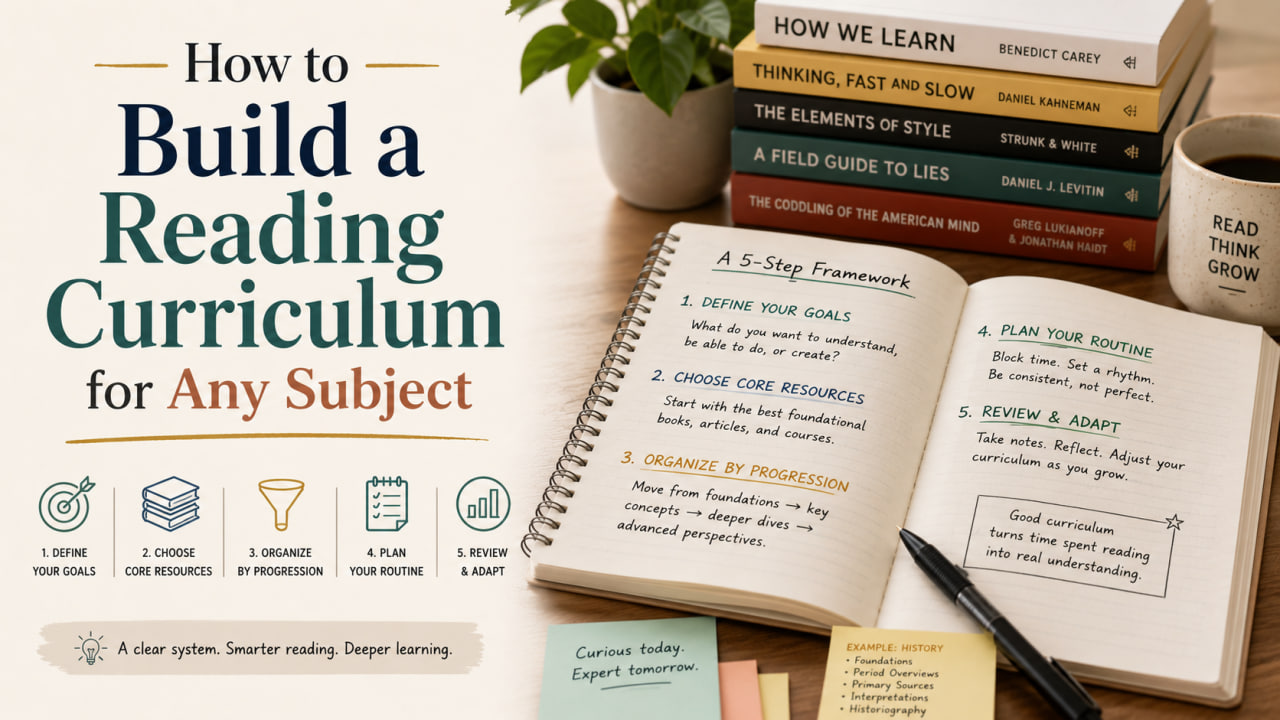
Self-Education Through Books
A pile of recommended books isn’t an education. A sequence is. Here’s how to design your own.
There’s a particular kind of ambition that strikes most curious people sooner or later: the desire to really learn a subject — not dabble, not skim a few articles, but understand it the way someone who studied it formally might. Philosophy, economics, military history, music theory, the workings of the brain. And the instinct is almost always the same: ask around, or search online, for the best books on the topic, and end up with a list. The list feels like progress. It rarely is.
A list of great books is not a curriculum, and the difference matters more than it sounds. A list tells you what to read; a curriculum tells you in what order, why, and how — and that structure is most of what makes formal education work. The good news is that you can build a real curriculum for yourself, on almost any subject, with a bit of deliberate planning. You don’t need a professor. You need a sequence, a purpose, and a way to tell whether it’s working.
Why a sequence beats a stack
Imagine handing a newcomer the ten best books in a field all at once. Several will assume knowledge they don’t yet have. One brilliant but advanced text will crush their confidence on page twenty. Another will contradict a third, and they’ll have no framework to judge the disagreement. The books are individually excellent and collectively useless, because nothing prepares the reader for anything else. Knowledge is cumulative; each idea rests on earlier ones, and a good curriculum respects that dependency.
This is what a syllabus quietly does in a real course. It puts the survey before the specialist text, the foundational concept before the one that builds on it, the easy win before the hard slog. It also sets a destination, so that every reading earns its place by moving you toward a defined understanding rather than just adding another impressive title to the pile. Recreating that structure for yourself is the whole game, and it’s far more achievable than it sounds.
Start with the destination, not the books
Before choosing a single title, get honest about what you actually want. “Learn economics” is not a goal; it’s a vague gesture. Do you want to understand the news, argue policy intelligently, manage your own money better, or prepare for graduate study? Each of those points to a different curriculum, a different depth, and a different set of books. The clearer your destination, the easier every later decision becomes, and the less time you waste reading things that don’t serve it.
Defining the end also rescues you from the trap of endless preparation — the sense that you must read everything before you’ve truly learned anything. You don’t. You need to read what carries you to your destination, and a modest, well-chosen path to a clear goal beats an exhaustive one to nowhere in particular. Write the goal down in a sentence. You’ll return to it every time the curriculum tempts you to wander.
Find the shape of the field first
Your first book should not be the best book in the field. It should be the one that gives you the map — a broad, readable survey or introduction that lays out the whole territory: the major questions, the key figures, the main schools of thought, the vocabulary. A good overview is worth more at the start than a masterpiece, because it gives you the framework into which everything else will later fit. Without that frame, deeper books are just facts with nowhere to land.
Many fields have a well-loved introductory text or a “very short introduction” style overview that experts themselves recommend to beginners. Find it. Free archives like Project Gutenberg and Open Library make it easy to sample older surveys at no cost, and open course materials such as those at MIT OpenCourseWare often publish the exact reading sequence a university uses — which is, in effect, a ready-made curriculum you can borrow and adapt. Reverse-engineering a real syllabus is one of the fastest ways to design your own.
A four-step build
Name the destination. One sentence: what you want to be able to understand or do.
Get the map. One broad survey that lays out the whole field and its vocabulary.
Sequence inward. Move from general to specific, easy to hard, foundational to advanced.
Build in checks. Decide how you’ll know you understood — writing, problems, or teaching it.
Sequence from general to specific
With the map in hand, the rest of the curriculum almost designs itself: you move steadily from the general to the particular. After the survey come the foundational texts that go deeper on the core ideas, then the more specialized works that explore the corners you’ve become curious about. Each step assumes what the previous one taught, so each is readable when you reach it. The art is in the ordering — placing each book where its prerequisites are already met.
A useful habit is to let your reading generate your next reading. A good book in a serious field cites the works that shaped it, and those citations are a curriculum hiding in plain sight. When a survey keeps pointing to one foundational text, that text is your next stop. When three different books all argue against a fourth, you’ve found something worth reading directly rather than secondhand. Following these threads turns a static list into a living path that adapts as your understanding grows.
Mix the canonical with the current
Most fields have a tension between the classic works that defined them and the recent ones that reflect where they are now, and a strong curriculum includes both. The canonical texts give you the deep structure, the arguments everything else responds to, the ideas that won’t go out of date. The current works give you the present state of the conversation, the corrections to old errors, and the questions live today. Read only the classics and you’ll sound knowledgeable but dated; read only the new and you’ll miss the foundations everyone assumes.
Be especially careful in fast-moving fields. In something like technology, medicine, or empirical science, a celebrated book from decades ago may be partly obsolete, however influential it remains. Pair it with something recent, and treat the older work as history of the field rather than current truth. In slower fields — philosophy, classic literature, foundational mathematics — age matters far less, and a centuries-old text can be as alive as anything written this year.
Read actively, or you’re just turning pages
The hardest truth of self-education is that reading alone, no matter how much of it, does not reliably produce understanding. It’s entirely possible to read a stack of excellent books, feel informed, and discover when pressed that you can’t actually explain or use much of it. Passive reading produces a comfortable illusion of competence that collapses the moment it meets a real demand. A curriculum that’s only a reading sequence is only half a curriculum.
The other half is some form of active engagement that forces the knowledge out of your head and into the open. Take notes in your own words rather than the author’s. Write short summaries of what each book argued. Try to explain a concept to someone — or to an empty room — and notice exactly where you stumble, because that stumble marks the boundary of your real understanding. In quantitative fields, do the problems; reading a math or statistics book without working exercises is barely studying it at all. Whatever the field, build in something you produce, not just something you consume.
It’s worth going one step further and building review into the curriculum from the start, because the cruel arithmetic of forgetting applies to self-education as much as to any classroom. Most of what you read in week one will be gone by week six unless you deliberately return to it. A light habit fixes this: keep your summaries and notes in one place, and revisit them periodically — briefly skimming earlier material before starting something new, or spending the occasional session doing nothing but recalling what you’ve already covered. This costs little time and pays enormous dividends, because a field only becomes usable once its parts are simultaneously available in your mind, not learned and forgotten in sequence. A curriculum that marches relentlessly forward without ever looking back produces a reader who has technically read everything and retained a third of it. Spaced return is how the rest survives.
Pace it, and plan to revise
A curriculum you never finish teaches you nothing, so be realistic about pace. It’s far better to read steadily through a modest sequence than to design an overwhelming one that you abandon in month two. Set a sustainable rhythm — a book every few weeks, a chapter on weekday mornings, whatever fits your real life — and protect it. Consistency over months will carry you through material that no heroic burst ever could.
Expect the plan to change, too. As you learn, you’ll discover that some branches of the field fascinate you and others bore you, that a book you’d planned to read is unnecessary, that a topic you’d ignored turns out to be central. Let the curriculum bend toward what you’re learning; rigidity is the enemy of curiosity. The first draft of your reading path is a hypothesis, and the reading itself is the experiment that corrects it. Keep the destination fixed and let the route adapt, and you’ll arrive with a genuine education that you built yourself.
Don’t let planning become the project
There’s a failure mode that specifically afflicts people methodical enough to build a curriculum in the first place, and it’s worth naming because it’s so seductive: the planning itself becomes a sophisticated form of procrastination. You research the ideal reading order, compare editions, read reviews of every candidate book, redraft the sequence, hunt for the perfect introductory text — and weeks pass in which you have learned nothing about the actual subject, only about which books exist. The plan grows ever more elaborate while the education hasn’t begun. Designing the curriculum feels like doing the work, but it is preparation for the work, and the two are easy to confuse.
The cure is a simple rule: start reading the first book within a day or two of starting to plan. You do not need the whole curriculum finalized to begin; you need only to know what comes first, which is nearly always a broad survey of the field. Read that while the later stages remain a rough sketch, and let the actual reading inform how you fill them in. A curriculum is not a monument to be perfected before use — it’s a working route you build and walk at the same time. The autodidacts who succeed are not the ones with the most beautiful plans. They’re the ones who started, kept a loose structure, and adjusted as they went. Treat the search for the perfect first book the same way: the second-best introduction read this week beats the ideal one you’re still hunting for next month. Momentum, in self-education, compounds faster than optimization, and a curriculum in motion teaches you more than a curriculum being perfected.
Common questions
Where do I find a syllabus to copy?
Open course materials — such as MIT OpenCourseWare — publish full reading sequences for university courses. Find a course in your subject, take its reading list and order, and adapt it to your goal. It’s a professionally designed curriculum, free for the borrowing.
How many books make a real curriculum?
Fewer than you’d think. A focused path of five to ten well-sequenced books, read actively, will teach you more than thirty read passively. Depth and order beat sheer volume.
Should I finish every book in the plan?
No. A curriculum is a route, not a contract. If a book has given you what you needed, or proves unnecessary as your understanding grows, move on. Finishing the curriculum’s purpose matters; finishing every page does not.
For free books and ready-made reading sequences, see Project Gutenberg, Open Library, and the published course materials at MIT OpenCourseWare. This article offers general guidance on self-directed learning.