The Business of Publishing
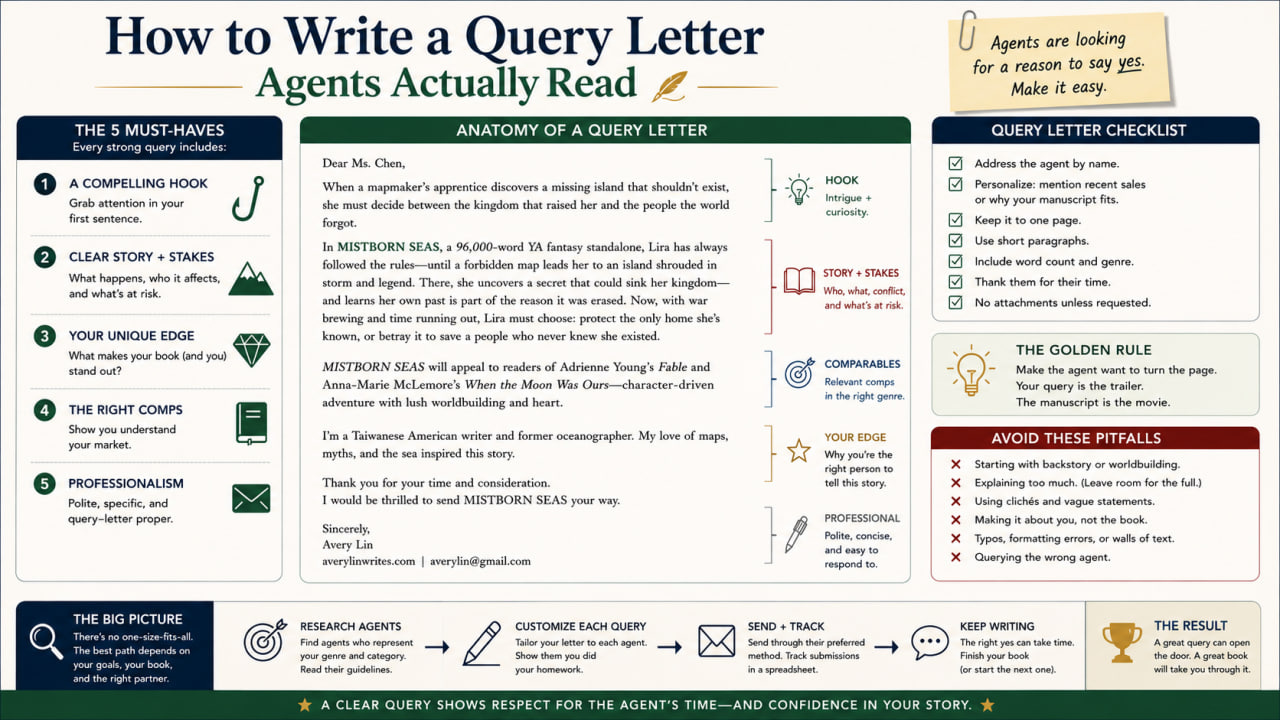
A query is not a summary of your book. It’s a one-page sales pitch with a brutally short window to earn a “send me more.”
The query letter is the gate almost every traditionally published novelist has to pass through, and it’s where a huge number of good books die — not because the books are bad, but because the query failed to do its job. A literary agent may receive thousands of these a year and request material from only a handful, which means your query has seconds to make an impression and a single page in which to do it. Understandably, writers find this terrifying, and the terror leads them to write queries that try to do too much, explain too much, and pitch too little. Learning what a query is actually for is most of the battle.
Here is the reframe that fixes most query problems: a query is not a summary of your book, and it is not a place to prove how complex and literary your work is. It is a sales pitch — a piece of persuasive marketing whose only goal is to make the agent want to read your manuscript. That’s it. It doesn’t have to convey the whole plot, capture every theme, or do justice to the book’s depth. It has to create enough intrigue and confidence that a busy professional types “please send the first fifty pages.” Once you accept that the query’s purpose is to sell, not to summarize, the right shape becomes clear.
What a query is really for
Think of the query the way you’d think of the back cover of a novel in a bookshop, or the blurb that makes you click “buy.” That copy doesn’t tell you everything that happens; it tells you just enough — the protagonist, their predicament, what’s at stake, the flavor of the thing — to make you want to find out the rest. A query works exactly the same way. Its job is to hook, to intrigue, and to leave the reader needing more, not to satisfy their curiosity by explaining the whole story. The query that tells the agent everything has removed the only reason for them to ask for the manuscript.
This is why the instinct to cram in the entire plot — every subplot, twist, and character — is so counterproductive. It overwhelms, confuses, and bores, and it signals that the writer doesn’t understand what the document is for. Agents can tell within a paragraph whether a writer grasps that a query is a pitch. The ones who do focus, intrigue, and leave room for desire; the ones who don’t deliver a dense, exhausting synopsis that answers questions nobody asked yet. Restraint — saying less, and making what you say compelling — is the whole skill.
The three things a query does
The hook (the book). A short, vivid pitch — protagonist, conflict, stakes — that makes the agent want to read it.
The housekeeping. Title, genre/category, word count, and a comparable title or two — the practical facts an agent needs.
The bio. A few lines about you, including only what’s relevant. Having no publishing credits is fine.
The pitch: the paragraph that matters most
The heart of the query is the pitch — usually a paragraph or two that makes the book sound irresistible. The most reliable approach is to center it on the essentials a reader of back-cover copy responds to: who the protagonist is, what they want, what stands in their way, and what’s at stake if they fail. These few elements, rendered with specificity and voice, do more than any plot summary. The agent doesn’t need the whole story; they need to feel the central tension and care about the person caught in it. Concrete, particular details beat vague generalities every time — not “a woman faces a difficult choice” but the specific woman, the specific choice, the specific cost.
Voice matters enormously here, and it’s where the pitch quietly does double work. The query’s prose is itself a sample of your writing, and a flat, generic pitch implies a flat, generic book, while a pitch with personality and control suggests a manuscript worth reading. So the pitch should not only convey the story but demonstrate that you can write — that you can be vivid, economical, and compelling on the page. Many requests are won as much by the way a query is written as by the story it describes. Treat every sentence as evidence, because that’s exactly how the agent reads it.
The housekeeping: facts an agent needs
Alongside the pitch, a query needs to supply a few practical facts cleanly and without fuss. State the title, the genre or category, and the approximate word count, because agents need to know what kind of book this is and whether it fits the norms of its market — a manuscript wildly outside the usual length for its category raises an immediate flag. It also helps to offer a comparable title or two: published books your work resembles, which instantly communicate the flavor, audience, and market position of yours in a way pages of description can’t. Good comps say “here’s the shelf I belong on and the readers who’ll want me.”
Choose comps with care. They should be reasonably recent and reasonably successful but not impossibly huge — comparing your debut to the best-selling novel of the decade reads as naive rather than confident. The aim is to signal that you understand your market and where your book sits in it, which reassures an agent that you’re a professional who has thought about readers, not just a manuscript. These housekeeping details are unglamorous, but getting them right marks you as someone who has done their homework, and getting them wrong — misjudging your category, your length, or your comps — quietly undermines even a strong pitch.
The bio: keep it relevant and brief
The bio paragraph trips up many writers, particularly those who have never published anything and assume that’s disqualifying. It isn’t. Agents sign debut authors with no credits constantly; the book is what matters most, and a thin bio is completely normal. Include any genuinely relevant credentials — prior publications, relevant expertise that lends authority to the book’s subject, meaningful writing awards — but if you have none of these, simply keep the bio short and don’t apologize for it. Padding it with irrelevant life details or hobbies does more harm than a brief, honest bio that gets out of the way.
The guiding principle is relevance: include what bears on this book or your credibility as its author, and leave out the rest. A nonfiction proposal is different — there your platform and authority on the subject are central and belong front and center — but for most fiction, the bio is a minor, supporting element, not the place the decision is made. Don’t agonize over it, don’t inflate it, and above all don’t let anxiety about a sparse bio distort the rest of the query. The pitch sells the book; the bio just rounds out the picture, and a modest one has never sunk a strong manuscript.
Mistakes that earn instant rejections
Certain query moves are so common and so off-putting that they trigger near-automatic rejection, and avoiding them clears a surprisingly high bar. Opening with a rhetorical question (“Have you ever wondered what you’d do if…?”) reads as amateurish because it’s a tired convention agents see endlessly. Declaring that your book is a guaranteed bestseller, will appeal to “everyone,” or is better than some famous title signals inexperience and arrogance rather than confidence. Running long — a query that sprawls past a page, or buries the pitch under throat-clearing — suggests you can’t self-edit, which is precisely the skill the document is supposed to demonstrate.
Vagueness is the quieter killer. A pitch built on abstractions — “a journey of self-discovery,” “a tale of love and loss,” “an unforgettable story of hope” — tells the agent nothing, because those phrases fit ten thousand books and conjure no specific image. Specificity is what makes a pitch land, and its absence is what makes most weak queries weak. Other reliable mistakes include not following an agent’s stated submission guidelines, querying an agent who doesn’t represent your genre, and addressing the letter generically when a name is available. None of these is about the quality of your book, which is the tragedy of them — they sink good manuscripts on avoidable technicalities.
Personalize, research, and don’t grovel
A little genuine personalization helps. Addressing the agent by name and, where you can do so sincerely, noting a real reason you’re querying them specifically — a book they represented that resembles yours, a stated interest that matches your work — shows you’ve done your research and aren’t simply blasting an identical letter to a list. But keep it brief and authentic; forced or fawning personalization is worse than none, and agents see through flattery instantly. The goal is to demonstrate professionalism and fit, not to ingratiate. One honest sentence of relevant personalization beats a paragraph of praise.
Underlying all of this is research and respect for the process. Different agents want different things; many publish their submission preferences, and following them exactly is non-negotiable, because failing to do so marks you as someone who didn’t bother to look. Query agents who actually represent your category, send what they ask for in the format they ask for, and treat the whole exchange as the professional interaction it is. None of this guarantees a request — the odds are long for everyone, and rejection is the norm even for excellent books — but a sharp, specific, professional query that follows the rules gives a strong manuscript its best possible chance to be read, which is all a query can ever do.
Send only when the book is ready
A final point underlies everything else: the best query in the world cannot rescue a manuscript that is not ready. A sharp query may win you a request, but the agent then reads the actual pages, and if the book disappoints, the brilliant query has only earned you a more painful rejection. Queries do not sell unfinished or unrevised books; they sell finished, polished ones. Before you send a single query, the manuscript should be complete and revised to the best of your ability — for fiction, that means an actual finished book, not a promising draft you intend to fix once someone shows interest. Agents represent books they can sell now, not potential they would have to wait on.
It also pays to treat querying as a process you can learn from rather than a single all-or-nothing throw. Send queries in batches rather than blasting your entire list at once, so that if the responses are uniformly silent you can revise the query and try again with what you have learned, instead of burning every agent on a version that was not working. Track who you have queried and what came back. If a query generates requests for pages but those requests turn into rejections, the problem is most likely in the manuscript; if it generates no requests at all, the query or the book’s market positioning is the more probable culprit. Reading the pattern of responses tells you where to focus your fixing, and keeps a long, rejection-heavy process feeling like something you can steer rather than merely endure.
Common questions
How long should a query be?
One page, kept tight: a short personalization or opening, a pitch of a paragraph or two, the housekeeping details, and a brief bio. If it sprawls past a page, it almost certainly needs cutting — brevity is part of what you’re demonstrating.
What if I have no writing credits or platform?
For fiction, that’s fine — agents sign debut authors constantly, and the manuscript is what counts. Keep the bio short and don’t apologize. For nonfiction, platform and subject authority matter more and should be featured.
Should I personalize every query?
A little, where it’s genuine — a real reason you chose that agent shows research and fit. But don’t force it or pile on flattery; a brief, honest note beats a paragraph of praise, and following the agent’s submission guidelines matters far more than personalization.
Submission norms and individual agent preferences vary and change — always check an agent’s current guidelines. For agent listings and querying resources, see Poets & Writers and the Authors Guild. General educational guidance on publishing.