Writing Craft
Good dialogue sounds like real speech but does work real speech never does. Here’s the difference, and how to write it.
Dialogue is where a lot of otherwise promising fiction quietly falls apart. The description is vivid, the premise is strong, and then the characters open their mouths and the whole thing deflates — the lines are stiff, or aimless, or so faithful to how people actually talk that they’re as boring as overheard small talk on a bus. Readers feel it instantly, even if they can’t name it: these don’t sound like people, or they sound exactly like people and that’s the problem. Dialogue is one of the hardest things to do well, precisely because it looks like it should be the easiest.
The core confusion is that beginning writers think the goal of dialogue is to reproduce real speech. It isn’t. Real speech is a disaster on the page — full of filler, repetition, half-finished thoughts, throat-clearing, and long stretches where nothing happens. Good dialogue creates the illusion of real speech while being far more efficient, purposeful, and shaped than anything anyone actually says. It’s a performance of naturalness, not a transcript of it. Once you understand that, most dialogue problems become solvable.
Real talk versus good dialogue
Record an actual conversation and read the transcript and you’ll be horrified. People say “um” constantly, circle back, leave sentences hanging, answer questions that weren’t asked, and spend astonishing amounts of time on nothing — weather, traffic, whether they’ve eaten. If you put that on the page faithfully, your reader will abandon you, because they came for a story, not for an accurate sample of human verbal noise. Reality, transcribed, reads as deeply unrealistic, because we don’t experience our own conversations as the mess they actually are.
Good dialogue keeps a few well-chosen markers of real speech — a contraction, an interruption, an incomplete thought at exactly the right moment — and discards the rest. It compresses. A real argument might take twenty minutes of repetition and circling; the dialogue version delivers the same emotional truth in eight sharp lines. The writer’s job is to distill speech to its essence, keeping just enough texture that it feels spontaneous while cutting everything that doesn’t earn its place. Naturalness on the page is an artifact of careful editing, not a recording.
Every line should be doing a job
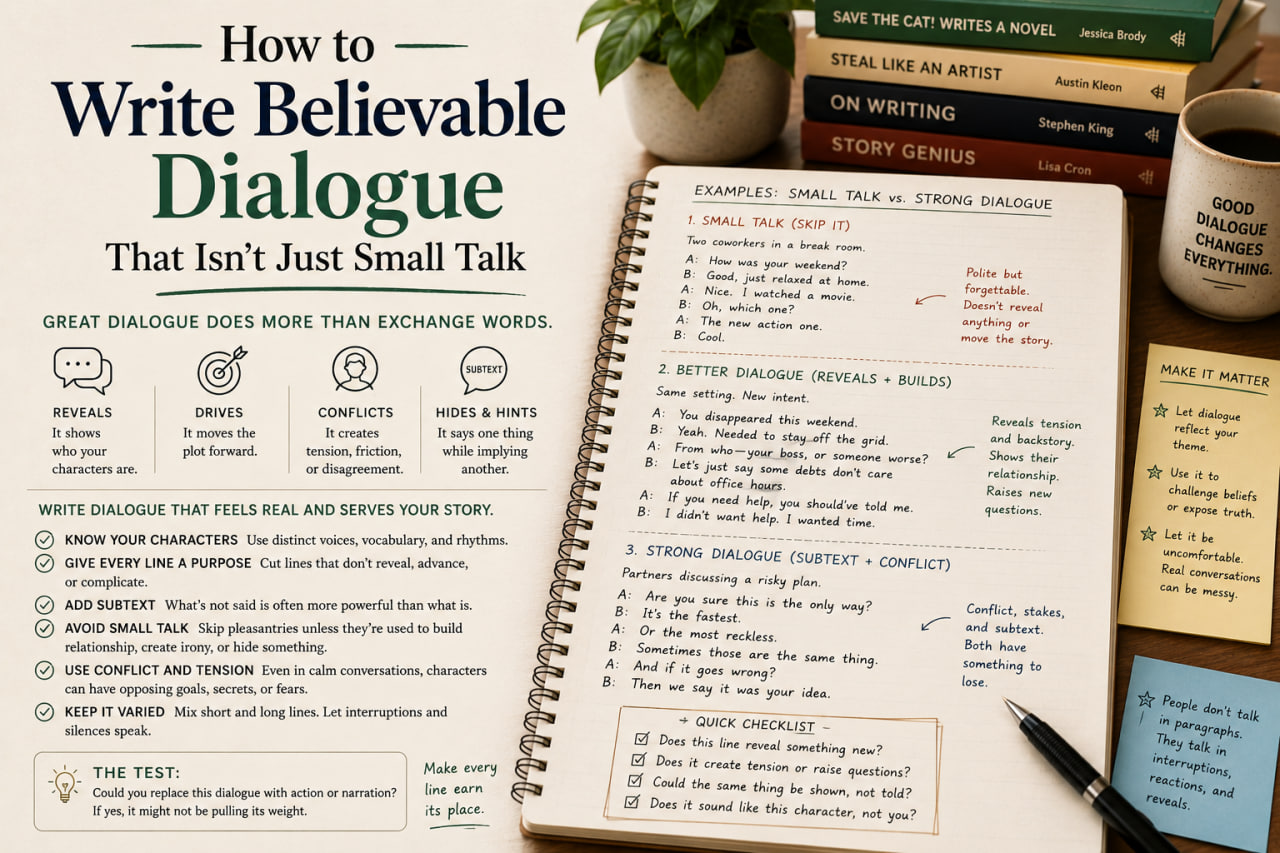
The single most useful principle for dialogue is that every exchange should be accomplishing something for the story, ideally more than one thing at once. Dialogue can reveal character, advance the plot, build or release tension, deliver information, deepen a relationship, or change the situation — and the best dialogue does several of these simultaneously. The reason much amateur dialogue feels like small talk is that it’s only small talk: it conveys nothing, changes nothing, and exists merely to fill the space where talking should happen.
Test any line by asking what would be lost if you cut it. If the answer is “nothing,” cut it. Greetings, pleasantries, and logistical chatter — “Hi, how are you,” “Good, you?” — almost never survive this test, which is why skilled writers cut straight to the part of the conversation that matters and trust the reader to assume the rest. A scene rarely needs to show characters saying hello; it needs to show the moment the conversation turns. Start late, leave early, and keep only the lines that move something.
People rarely say what they mean
Here is the secret that elevates dialogue from functional to electric: subtext. In real life, people constantly say one thing while meaning another — they hint, deflect, perform, avoid, imply, and talk around what they actually feel. We almost never state our true emotions and intentions directly, especially when the stakes are high. Dialogue that captures this indirection feels profoundly real and crackles with tension, because the reader senses the gap between what’s said and what’s meant and leans in to read it.
On-the-nose dialogue — where characters baldly state exactly what they feel and want — is the opposite, and it’s a reliable mark of inexperience. “I’m angry that you forgot my birthday and it makes me feel unloved” is something almost no real person would say; they’d say something clipped about not being hungry and slam a cupboard. The emotion lives under the words, and your job is to write the surface so the reader feels the depth beneath it. A conversation about whose turn it is to do the dishes can be, underneath, about whether a marriage is going to survive — and that buried second conversation is what makes the scene unforgettable.
What a strong line of dialogue does
Reveals something about who is speaking — their voice, mood, agenda.
Moves the scene: shifts power, raises a question, changes the situation.
Carries subtext — the real meaning sits under the literal words.
Sounds natural without being a transcript of real, aimless speech.
Earns its place — cutting it would cost the scene something.
Give every character a different voice
A common failure is that all the characters sound identical — like the author, talking to themselves in different fonts. Real people have distinct verbal fingerprints: vocabulary, rhythm, formality, the length of their sentences, the things they fixate on, the way they dodge or confront. A blunt character speaks in short declaratives; a nervous one qualifies everything; an educated one and a plain-spoken one reach for completely different words for the same idea. When voices are distinct enough, a reader can often tell who’s speaking without any attribution at all — the surest sign you’ve given each character a real mouth.
You build this by knowing your characters well enough to hear them, then being consistent. It helps to ask, for each speaker: how much do they say? How directly? What do they never talk about? What words would they never use? A teenager and a judge, a salesman and a grieving widow, should be unmistakable on the page from rhythm and word choice alone. Resist the temptation to differentiate them with heavy phonetic dialect, though — that’s a trap we’ll come back to. Distinctiveness comes far more from what and how they choose to say things than from misspelling their accents.
Beats, action, and the power of silence
Dialogue doesn’t happen in a void; it happens between people doing things, in places, with bodies. Breaking up speech with small actions — what writers call beats — grounds a conversation in physical reality and controls its pace. A character who stops mid-sentence to refill a glass, who won’t make eye contact, who keeps glancing at the door, tells the reader something words alone can’t. These beats also pace the scene, slowing a tense exchange or punctuating a revelation, and they replace the need to constantly label emotions: you show the clenched jaw rather than announcing the anger.
Silence is just as powerful as speech, and beginners underuse it. What a character doesn’t say — the question they refuse to answer, the pause before they lie, the subject they change — can carry more weight than any line. A well-placed silence forces the reader to fill the gap, and the gap they imagine is often more charged than anything you could write. Trust your reader to read the spaces. Some of the best moments in dialogue are the ones where someone says nothing at all.
Don’t use dialogue to dump backstory
One of the most common and most groan-inducing dialogue failures is using characters’ mouths to deliver information to the reader that the characters themselves would never actually say. The classic form is the line that begins, in effect, “As you know…” — one character telling another something they both obviously already know, purely so the reader can overhear it. “As you know, Sarah, our father died in the fire that destroyed the family business three years ago.” No human has ever spoken like this. People don’t narrate shared history to each other; they reference it glancingly, the way real intimates do, assuming the knowledge both of them hold.
This kind of writing — sometimes called maid-and-butler dialogue, after the stagey convention of servants explaining the household to each other for the audience’s benefit — instantly signals an inexperienced hand, because it sacrifices believability to convenience. The characters stop being people and become delivery mechanisms for exposition. Readers feel the wires, and the spell breaks. The information the writer wants to convey is real and often necessary; the mistake is the lazy delivery, not the desire to inform.
The fix is to let backstory and information emerge the way it does in life: in fragments, under pressure, when it’s relevant and contested, revealed through conflict rather than recited in calm. Information delivered during an argument, hinted at and half-withheld, or dropped as a barbed reference that the other character reacts to, feels natural and does double duty — it informs the reader while also revealing character and generating tension. If a piece of backstory can only be conveyed by a character saying something no real person would say, that’s a sign to find another route entirely: narration, action, or a scene that dramatizes the past rather than summarizing it through implausible talk. Dialogue should sound like people talking, never like the author talking through people. When in doubt, ask whether your characters are speaking to each other or secretly speaking to the reader — and route everything aimed at the reader through some other channel.
Read it aloud, and keep your tags humble
The most reliable dialogue test costs nothing: read it aloud. Stiff lines, unnatural rhythms, and words no human would actually say all reveal themselves the instant you hear them in the air. If you stumble reading a line, or it sounds like a written sentence rather than a spoken one, it needs work. Your ear catches what your eye glides over. Many professional writers do a full read-aloud pass on every scene of dialogue for exactly this reason, and it’s the single fastest way to improve.
Finally, resist the urge to dress up your dialogue tags. Beginners, afraid that “said” is too plain, reach for “exclaimed,” “retorted,” “opined,” “ejaculated,” and a thesaurus of attention-grabbing alternatives — and the result is exhausting and amateurish. “Said” is nearly invisible, which is exactly its virtue; it disappears and lets the dialogue carry the weight. Use it as your default, let the words themselves convey how they’re spoken, and add an adverb or a fancier verb only on the rare occasion the line genuinely needs it. Strong dialogue almost never needs to be told how it sounds; it sounds that way on its own.
Common questions
Should I write out accents phonetically?
Almost never. Heavy phonetic spelling is hard to read and can come across as mocking. Suggest an accent or dialect lightly — through word choice, rhythm, and the occasional regional phrase — and let the reader hear the rest. A little goes a very long way.
How do I cut small talk without losing realism?
Start the scene after the greetings and end it before the goodbyes. Readers automatically assume the dull connective talk happened; you don’t have to show it. Keep only the part of the conversation where something is actually at stake.
Is “said” really better than more colorful verbs?
Yes, as a default. “Said” is invisible and keeps the focus on the words. Colorful tags call attention to themselves and quickly grow tiresome. Reserve them for the rare line that truly needs the help, and let strong dialogue speak for itself. If you find yourself constantly propping lines up with elaborate tags and adverbs, that’s usually a sign the dialogue itself isn’t yet carrying its weight — fix the line, not the label.
To study dialogue from the masters, the classic novels at Project Gutenberg are free to read and analyze. For craft interviews with working writers, see The Paris Review. This article offers general guidance on the craft of fiction.