Writing Craft
The most repeated writing advice is also the most misunderstood — including the part where you’re sometimes supposed to ignore it.
“Show, don’t tell” is the most famous piece of writing advice in the English language, and also one of the most misapplied. Every workshop repeats it, every craft book enshrines it, and a great many writers nod along without quite knowing what it means in practice — or worse, apply it so literally that they ruin their prose in the opposite direction. The phrase is genuinely useful, but only if you understand what it’s actually pointing at, where it comes from, and the equally important truth that telling is not a sin and showing is not always right.
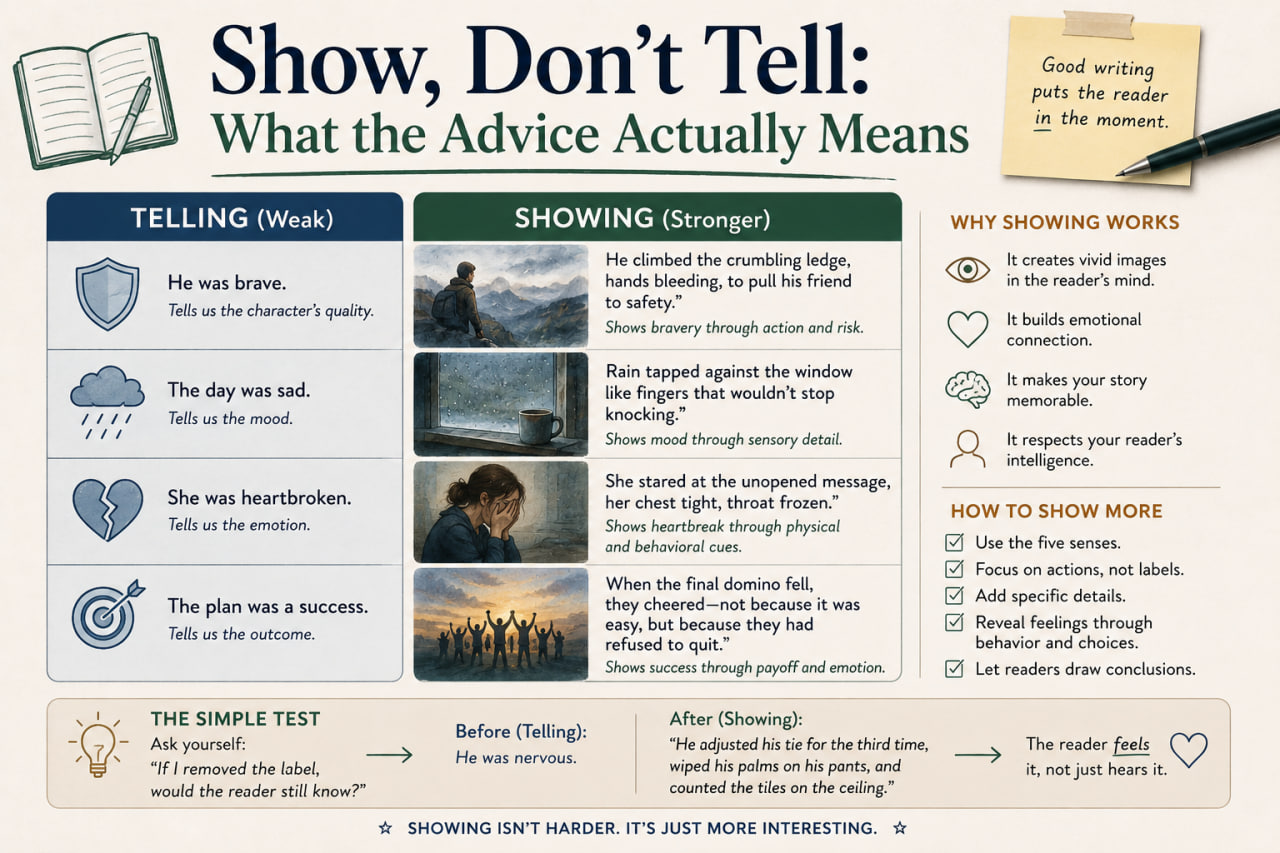
At its heart, the advice is about the difference between handing the reader a conclusion and giving them the experience that produces the conclusion themselves. Telling states; showing dramatizes. Telling reports that something is true; showing presents the evidence and lets the reader feel and conclude it. When you show, the reader does a small amount of work — and that participation is what makes fiction vivid and emotionally real rather than flat and secondhand. The reader who concludes a character is frightened, because you showed them the trembling hands and the held breath, believes it far more than the reader simply told “she was afraid.”
The classic example, and why it works
The textbook illustration is emotion. “John was angry” is telling: efficient, clear, and inert. The reader receives the label but feels nothing. The showing version gives the reader what anger looks like from outside — the jaw tightening, the voice dropping, the deliberate care with which he sets down the glass before he speaks — and lets them arrive at “he’s furious” on their own. The second version takes more words, but it puts the reader in the room, and that presence is the entire point of scene-based fiction.
It works because of how human attention and belief operate. We discount what we’re simply told and trust what we seem to observe for ourselves. A character described as “brave” is a claim; a character who walks back into a burning building is brave, demonstrated, and we believe it because we watched it. Showing turns assertions into evidence, and evidence is persuasive in a way that assertion never is. This is why the advice endures: it’s really about earning the reader’s belief rather than demanding it.
Where the advice comes from
The principle is older than the slogan, and knowing its lineage helps clarify what it’s really after. A version of the idea is often traced to the great short-story writers and dramatists of the nineteenth century, who pushed fiction away from the older habit of the narrator explaining everything and toward scenes that let readers see events unfold and draw their own conclusions. The famous illustration usually attributed to Chekhov captures it: rather than stating that the night was moonlit, give the reader the glint of light on a piece of broken glass, and let them assemble the moon themselves. The reader supplies the conclusion from the concrete particular — and what they supply, they own.
That history points at the deeper purpose hiding inside the catchy phrase. “Show, don’t tell” isn’t fundamentally about banning a grammatical mode; it’s about respecting the reader’s intelligence and inviting their participation. Telling treats the reader as a passive recipient of conclusions. Showing treats them as an active partner who gets to perceive, infer, and feel. The whole technique is really an act of trust — the writer trusting the reader to do the small work of interpretation, and being rewarded with a reader who’s genuinely in the story rather than being lectured about it from a distance.
But telling is a tool, not a crime
Here is where the advice goes wrong in earnest hands. Taken absolutely — never tell, always show — it produces bloated, exhausting prose in which every trivial transition is dramatized at full length and the reader drowns in detail. The truth that craft books often underemphasize is that skilled writing constantly tells, and does so deliberately. Telling is faster, and speed is sometimes exactly what a passage needs. You don’t dramatize the character’s entire boring Tuesday to get them to the meeting that matters; you tell us “the week crawled by” and move on.
Telling is the right choice for compression, transition, and anything that doesn’t deserve the reader’s full attention. Summarizing the unimportant lets you spend showing’s expensive, vivid currency where it counts — the scenes that carry the story’s weight. A novel that showed everything equally would have no shape, because emphasis comes precisely from the contrast between scene and summary, showing and telling. The skill isn’t to eliminate telling; it’s to know which mode each moment calls for. Show the things that matter and that you want the reader to experience; tell the things that merely need to be conveyed so the story can proceed.
A working rule of thumb
Show the emotional turning points, the key scenes, anything you want the reader to feel and believe.
Tell transitions, time passing, background, and anything routine that just needs conveying.
Show when the moment deserves the reader’s full presence and attention.
Tell when you need speed, compression, or to get efficiently from one scene to the next.
Emotion is where the rule matters most
If you internalize the advice anywhere, make it emotion, because that’s where telling does the most damage. Naming a feeling is the surest way to keep the reader from feeling it. “She felt devastated” informs the reader of devastation while holding them at arm’s length from it; the reader nods and feels nothing. Show the devastation — the way she keeps doing small ordinary tasks because stopping is unbearable, the cup of tea going cold, the sentence she starts and can’t finish — and the reader feels the weight directly. Emotional telling is a missed opportunity in nearly every case.
This connects to a specific category of weak writing: the abstract emotion word. “Happy,” “sad,” “angry,” “nervous,” “excited” — these are summaries of feeling, not feeling itself, and leaning on them is the most common form of telling when you should be showing. The reader has felt all these things, but your bare label doesn’t reconnect them to the sensation. The concrete, physical, specific detail does. Whenever you catch yourself naming an emotion at an important moment, treat it as a flag: the real scene is the one underneath the label, and that’s the one to write.
Specific detail does the showing
The engine of showing is concrete, sensory, specific detail — the things a reader can see, hear, smell, touch. Abstraction tells; specificity shows. “The kitchen was a mess” is a small tell; “dishes furred with three days of grease, a fly working the rim of a glass” is showing, and it does more than convey mess — it conveys a whole state of mind without ever naming it. Specific detail is showing’s vocabulary, and learning to reach for the precise, telling particular instead of the vague general is most of what learning to show really involves.
Not every detail, though — the right ones. Showing isn’t a license to describe everything exhaustively; that’s the over-correction, and it buries the reader as surely as too much telling bores them. The art is in selection: one perfect, revealing detail does more than ten generic ones. The single image that implies the whole — the wedding ring left on the kitchen counter — lets the reader’s imagination supply the rest, and what they supply is more powerful than anything you’d spell out. Show through the well-chosen detail, not the exhaustive inventory.
Showing isn’t only visual
A common misreading of the advice is that showing means describing what things look like — piling on visual description until the reader can picture the scene. Visual detail is one tool, but showing works through every channel of experience, and some of the most powerful showing isn’t visual at all. Sound, smell, texture, and physical sensation often reach a reader more directly than sight; the particular smell of a hospital corridor can convey dread faster than any described expression. Action shows: a character’s choices and behavior reveal who they are more convincingly than any narrated summary of their personality. Even dialogue is a form of showing, dramatizing a relationship in real time rather than describing it.
Interiority can be shown, too, which surprises writers who assume thoughts and feelings can only be told. You can dramatize a character’s inner state through the specific, revealing things they notice, the associations their mind makes, the way their attention snags or drifts. A grieving character who can’t stop noticing the small domestic details their lost person used to handle is being shown, from the inside, without the word “grief” ever appearing. The principle isn’t “describe the visible world more.” It’s “render experience concretely, through whatever sense or behavior or perception carries it best,” and let the reader feel and conclude rather than be informed. Visual description is merely the most obvious instance of a much broader craft. Once you stop equating showing with looking, whole new registers open up — you can show through what a character eats, how they fill a silence, or which memory surfaces unbidden, and your prose stops feeling like a camera and starts feeling like an experience.
Finding your tells in revision
You won’t get this right while drafting, and you shouldn’t try — first drafts are allowed to tell freely just to get the story down. The work happens in revision, where you can hunt for the places you told something that deserved showing. There are reliable warning signs to search for. Abstract emotion words — the “felt,” “was angry,” “seemed sad” family — flag spots where you summarized a feeling instead of dramatizing it. So-called filter words like “saw,” “heard,” “noticed,” and “realized” often put a needless layer between the reader and the experience: “she saw the door was open” is weaker than “the door stood open.”
Go through a draft looking specifically for these flags, and at each one ask the real question: does this moment deserve to be shown, or is telling the right call here? Sometimes you’ll dramatize the flagged line into a vivid scene; sometimes you’ll decide the telling was correct and leave it, because it was a transition that didn’t merit the reader’s full attention. That judgment — made moment by moment, not by blanket rule — is the actual skill the famous advice was always pointing toward. “Show, don’t tell” isn’t a commandment to obey everywhere. It’s a reminder to show the things that matter, and the wisdom to know which ones those are.
Common questions
Is it ever fine to just tell the reader something?
Constantly. Telling is the right tool for transitions, summary, background, and anything routine. The advice is really “don’t tell the things that should be shown” — chiefly the emotional and dramatic high points — not “never tell anything.”
What are “filter words” and should I cut them all?
Words like saw, heard, felt, noticed, and realized that place the narrator between the reader and the experience. Cutting many of them tightens prose, but not all — sometimes the filter is exactly the point. Flag them in revision and judge each one.
Won’t showing everything make my book too long?
Yes — which is why you don’t. Show the moments that matter and tell the rest. Showing everything equally is the classic over-correction; emphasis comes from the contrast between what you dramatize and what you summarize. A book that is all scene has no light and shade, and the reader, given no signal about what matters most, grows as numb as if they’d been told everything.
Study how published authors balance scene and summary by reading widely; thousands of classic works are free at Project Gutenberg. For craft resources and writing guidance, see the Purdue OWL and Poets & Writers. General educational guidance on fiction craft.